Credit: Kobe University
A team of Japanese researchers revealed the mechanism for side effects such as fever and bone pain caused by G-CSF, which is widely used for peripheral blood hematopoietic stem cell harvesting (PBSCH). This is an important method for hematopoietic stem cell transplantation (HSCT) used to treat hematological malignancies such as leukemia.
G-CSF is essential for treatment of hematological malignancies and other types of cancers, but the mechanism for its unfavorable side effects has not been elucidated until now. The findings from this research revealed not only the mechanism of the unfavorable effects of G-CSF, but also a new function of neutrophils, a type of blood cell which was previously recognized just as a consumer of invading substances. This research can lead to better understanding of the homeostasis of blood-forming (hematopoietic) cells as well as improving the methods of PBSCH. The findings, by a research group led by Junior Associate Professor KATAYAMA Yoshio and graduate student KAWANO Yuko from the Kobe University Graduate School of Medicine, Hematology, were published in the online version of Blood on November 9 (Japan time).
In recent years, there has been a growing need for HSCT to treat hematological malignancies. HSCT is done to rescue a normal generation of blood cells (hematopoiesis) after the treatment of malignancies. Hematopoietic stem cells are usually found in the bone marrow, but under certain conditions they are released into the peripheral blood (regular blood vessels) where they can be harvested in blood samples.
G-CSF stimulates the bone marrow to mobilize stem cells into the peripheral blood. G-CSF has been widely used for PBSCH because it is a safe method. However, the mechanism for the mobilization of hematopoietic cells by G-CSF largely remained unclear, and there is no convincing reason to explain the existence of "poor mobilizers" (people who displayed poor mobilization of hematopoietic cells to peripheral blood by G-CSF which results in the insufficiency of hematopoietic cells for HSCT) and the mechanism of unfavorable effects such as fever and bone pain caused by G-CSF. Understanding of those mechanisms could largely contribute to the improvement of transplantation therapy.
Professor Katayama's research group focused on the effectiveness of standard anti-inflammatory drugs in treating fever and bone pain caused by G-CSF. These anti-inflammatory drugs suppress the production of PGE2, which is involved in inflammation and pain, so the group expected that PGE2 might be the cause of unfavorable effects by G-CSF.
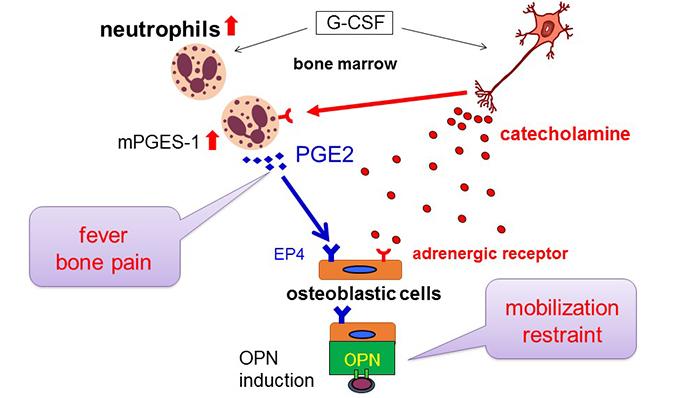
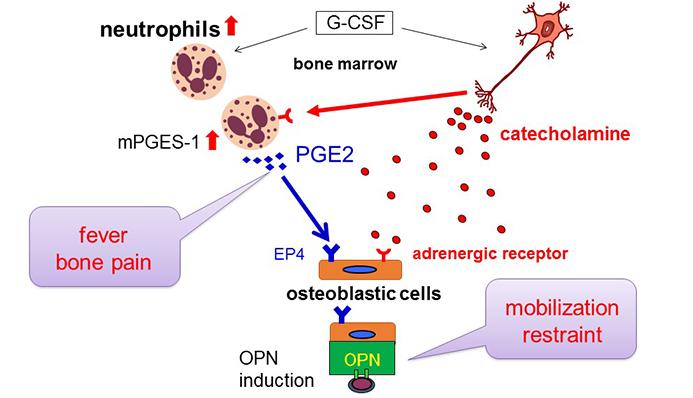
Using mouse models to test this hypothesis, they discovered that PGE2 inhibited the mobilization of hematopoietic stem cells to peripheral blood, and that blood cells produced PGE2 by the treatment of G-CSF. Furthermore, they revealed that, among blood cells, neutrophils produced PGE2 by G-CSF-induced stress stimulation (sympathetic nerve stimulation). The researchers investigated the fever response in denervated mice by neurotoxin and neutrophil-depleted mice by antibodies, and displayed that in these mice fever caused by G-CSF was diminished. PGE2 also affected osteoblastic cells in the bone marrow to increase osteopontin (OPN), a known inhibiting factor of stem cell mobilization to peripheral blood which resulted in decreases in the numbers of mobilized stem cells.
These findings displayed that the production of PGE2 by neutrophils governed by the sympathetic nervous system is behind the unpleasant symptoms caused by G-CSF, and this is one of the causes of suppression of stem cell mobilization. Based on this discovery, researchers now have information to treat unfavorable effects of G-CSF as well as to predict the currently unpredictable poor mobilizers and treat them using OPN antibodies.
Because sympathetic nerve stimulation occurs under stress conditions, the fact that sympathetic signals stimulate neutrophils to produce the inflammatory PGE2 means that highly-motile neutrophils may be involved in stress-related inflammation in the whole body. These facts indicate the possibility that neutrophils are also involved in carcinogenesis, the progression of cancer, autoimmune disorders and hardened arteries.
###
Media Contact
Eleanor Wyllie
[email protected]
@KobeU_Global
http://www.kobe-u.ac.jp/en/