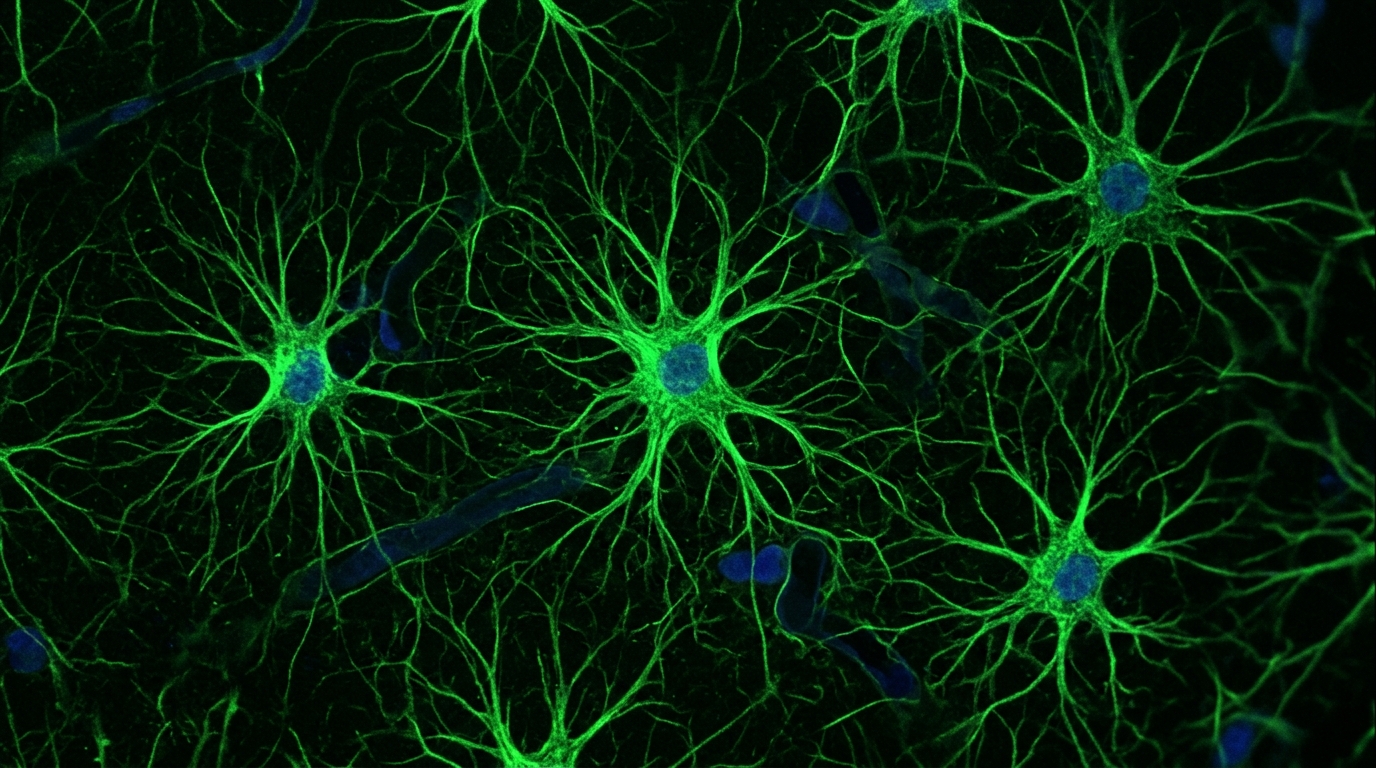
Elevated levels of plasma glial fibrillary acidic protein significantly modulate the relationship between phosphorylated tau at threonine 217 and clinical progression across the Alzheimer’s disease continuum, according to a multi-cohort study. Investigators found that individuals exhibiting concurrent elevations in both plasma markers experienced worse baseline cognitive performance, faster longitudinal cognitive decline, and a heightened risk of clinical worsening compared to those positive only for p-tau217.
While plasma p-tau217 serves as a robust biomarker of Alzheimer’s disease pathology and disease progression, individuals who test positive for this marker frequently display substantial clinical heterogeneity. This variability indicates that additional modifying biological processes shape individual clinical trajectories. To address this question, researchers evaluated whether plasma glial fibrillary acidic protein, an indicator of astrocyte reactivity, modifies the association between elevated p-tau217 and cognitive decline.
The investigation analyzed 3,505 individuals spanning the aging and Alzheimer’s disease spectrum drawn from six independent cohorts. For each participant, baseline evaluations included amyloid-beta positron emission tomography, plasma glial fibrillary acidic protein, plasma p-tau217, and the Clinical Dementia Rating Sum of Boxes. Study participants were subsequently classified into four distinct biomarker groups determined by their positivity status for glial fibrillary acidic protein and p-tau217.
To evaluate clinical patterns, the research team examined cross-sectional associations with cognitive severity using linear regression and analysis of covariance. Five-year longitudinal cognitive trajectories were evaluated using linear mixed-effects models. Investigators further conducted variance partitioning analyses to decompose the proportion of biomarker-attributable variance in individual annual rates of change on the Clinical Dementia Rating Sum of Boxes, while time to clinical worsening—defined as an increase of at least 0.5 points on the scale—was assessed through Kaplan–Meier survival analysis and Cox proportional hazards regression.
Longitudinal modeling demonstrated that individuals with co-elevated plasma glial fibrillary acidic protein and p-tau217 exhibited an annual progression rate on the Clinical Dementia Rating Sum of Boxes that was 62 percent higher than that observed in individuals positive for p-tau217 alone (p = 0.008). In survival analyses, co-elevation was associated with an increased hazard of clinical worsening (hazard ratio 1.28; 95% confidence interval 1.01 to 1.61). Variance partitioning revealed that the interaction between glial fibrillary acidic protein and p-tau217 accounted for 68.6 percent of the biomarker-related variance in longitudinal cognitive decline, markedly exceeding the independent contributions of p-tau217 at 25.3 percent and glial fibrillary acidic protein at 1.1 percent.
The study concluded that astrocyte reactivity is associated with greater cognitive impairment and accelerated clinical decline among individuals with elevated p-tau217, providing prognostic stratification within the p-tau217-positive population. Combining plasma measurements of glial fibrillary acidic protein and p-tau217 offers measurable value for identifying individuals at higher risk of progression, with implications for clinical risk stratification and trial enrichment.
Subject of Research: Astrocyte reactivity and cognitive decline risk in Alzheimer's disease
Article Title: Astrocyte reactivity identifies p-tau217-positive individuals at elevated risk of cognitive decline across the Alzheimer’s disease continuum
Article References: Bellaver, B., Povala, G., Ferreira, P. C. L., Leffa, D. T., Bauer-Negrini, G., Ferrari-Souza, J. P., Lussier, F. Z., Amaral, L., Tuma, R. L., Oliveira Franco, A. D., Karim, H. T., Hong, C. H., Roh, H. W., Rahmouni, N., Macedo, A., Therriault, J., Servaes, S., Stevenson, J., Trudel, L., … Foroud, T. (2026). Astrocyte reactivity identifies p-tau217-positive individuals at elevated risk of cognitive decline across the Alzheimer’s disease continuum. Molecular Neurodegeneration. https://doi.org/10.1186/s13024-026-00995-5
Image Credits: AI Generated
DOI: 10.1186/s13024-026-00995-5
Keywords: Alzheimer's disease, plasma p-tau217, plasma GFAP, astrocyte reactivity, cognitive decline, Clinical Dementia Rating, CDR-SB, biomarkers, amyloid-beta PET, longitudinal progression, prognostic stratification, clinical trial enrichment, Cox proportional hazards, linear mixed-effects models, variance partitioning, HEAD study
News Source: Cassandra Pierce. (November 19, 2026). Astrocyte Marker GFAP Identifies Elevated Cognitive Decline Risk Across Alzheimer Continuum. Scienmag.