• HOME
  • NEWS
  • EXPLORE
    • CAREER
      • Companies
      • Jobs
    • EVENTS
    • iGEM
      • News
      • Team
    • PHOTOS
    • VIDEO
    • WIKI
  • BLOG
  • COMMUNITY
    • FACEBOOK
    • INSTAGRAM
    • TWITTER
Sunday, October 4, 2026
BIOENGINEER.ORG
No Result
View All Result
  • Login
  • HOME
  • NEWS
  • EXPLORE
    • CAREER
      • Companies
      • Jobs
        • Lecturer
        • PhD Studentship
        • Postdoc
        • Research Assistant
    • EVENTS
    • iGEM
      • News
      • Team
    • PHOTOS
    • VIDEO
    • WIKI
  • BLOG
  • COMMUNITY
    • FACEBOOK
    • INSTAGRAM
    • TWITTER
  • HOME
  • NEWS
  • EXPLORE
    • CAREER
      • Companies
      • Jobs
        • Lecturer
        • PhD Studentship
        • Postdoc
        • Research Assistant
    • EVENTS
    • iGEM
      • News
      • Team
    • PHOTOS
    • VIDEO
    • WIKI
  • BLOG
  • COMMUNITY
    • FACEBOOK
    • INSTAGRAM
    • TWITTER
No Result
View All Result
Bioengineer.org
No Result
View All Result
Home NEWS Science News Cancer

Potential New Drug Target for Lung Cancer

Bioengineer by Bioengineer
January 26, 2015
in Cancer
Reading Time: 2 mins read
0
Share on FacebookShare on TwitterShare on LinkedinShare on RedditShare on Telegram

A new study by University of Kentucky Markey Cancer Center researchers suggests that targeting a key enzyme and its associated metabolic programming may lead to novel drug development to treat lung cancer.

Cancer cells undergo metabolic alterations to meet the increased energy demands that support their excess growth and survival. The Krebs cycle in the mitochondria of cells is used to supply both energy and building materials for cell growth. Two mitochondrial enzymes – pyruvate carboxylase (PC) and glutaminase replenish carbon to the Krebs cycle.

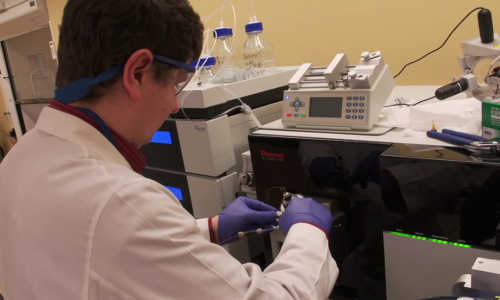
Published in the Journal of Clinical Investigation, the study collected metabolic data directly from more than 120 human lung cancer patients. Researchers Teresa Fan, Andrew Lane, and Richard Higashi, now part of UK’s Center for Environmental and Systems Biochemistry (CESB), worked with other collaborators to measure the in situ activity of these two enzymes in patients with early stage lung cancer. When they infused the patients with a glucose tagged with stable heavy atoms immediately prior to surgical removal of tumor tissue, they found that PC was selectively activated – in other words, PC expression may play an important role in the development of lung cancer.

By using molecular genetic tools to reduce the amount of PC in human lung cancer cells, the team observed decreased cell growth, a compromised ability to form colonies in soft agar (a gelatinous material specifically used to grow bacteria and other cells), and a reduced rate of tumor growth in mice. The loss of PC also induced widespread changes in the central metabolism of the cell, suggesting a role for PC in early stage metabolic reprogramming.

“We now know much more about metabolic reprogramming of cancerous tissues in human patients, particularly that the activation of pyruvate carboxylase is important to lung cancer cell growth and survival,” said Fan, UK professor of toxicology and faculty member of the Markey Cancer Center and CESB at the University of Kentucky. “Ultimately, figuring out how to target PC may help researchers develop new, more effective therapeutic strategies to improve upon current lung cancer treatments, which are limited and harmful.”

The team’s work was funded by the National Cancer Institute, the National Institute of Diabetes and Digestive and Kidney Diseases, and the National Institutes of Health (NIH)Common Fund. UK’s RC-SIRM is one of six NIH Common Fund-supported Regional Comprehensive Metabolomics Resource Centers. The overall mission of the Center is to enable cutting-edge approaches and to provide state-of-the art instrumentation for stable isotope-resolved metabolomics.

Unlike radioactive isotopes, stable isotopes do not decay, and they occur naturally in the body in low amounts. Enriching these isotopes with glucose or glutamine allows researchers to track the atoms through the metabolic transformation process, so researchers can backtrack to see what reactions have occurred and detect whether cancer cells have altered the metabolic pathway.

Story Source:

The above story is based on materials provided by University of Kentucky College of Medicine.

Share12Tweet8Share2ShareShareShare2

Related Posts

Iodine Density CT Offers First Real Glimpse of Lung Ablation Success

Iodine Density CT Offers First Real Glimpse of Lung Ablation Success

October 4, 2026
PET Scan Glucose Uptake Offers Clues to Immunotherapy Biomarker in Esophageal Cancer

PET Scan Glucose Uptake Offers Clues to Immunotherapy Biomarker in Esophageal Cancer

October 4, 2026

The Hidden RNA Master Switch That Behaves Differently in Every Cancer

October 4, 2026

Laser Therapy Offers New Hope for Rare Spinal Tumors When Surgery Runs Out of Options

October 4, 2026
Please login to join discussion

POPULAR NEWS

  • Alloys That Shrink Their Own Grains: New PIX Mechanism Refines Metals With Heat Alone

    Alloys That Shrink Their Own Grains: New PIX Mechanism Refines Metals With Heat Alone

    29 shares
    Share 12 Tweet 7
  • Endurance Exercise Reshapes the Liver in Males and Females Through Distinct Molecular Routes

    29 shares
    Share 12 Tweet 7
  • Single Transcription Factor PU.1 Rapidly Converts Fibroblasts into Macrophage-Lineage Cells

    29 shares
    Share 12 Tweet 7
  • New Scale Measures How Ready Nurse Educators Really Are for the AI Era

    29 shares
    Share 12 Tweet 7

About

We bring you the latest biotechnology news from best research centers and universities around the world. Check our website.

Follow us

Recent News

Alloys That Shrink Their Own Grains: New PIX Mechanism Refines Metals With Heat Alone

Endurance Exercise Reshapes the Liver in Males and Females Through Distinct Molecular Routes

Single Transcription Factor PU.1 Rapidly Converts Fibroblasts into Macrophage-Lineage Cells

Subscribe to Blog via Email

Enter your email address to subscribe to this blog and receive notifications of new posts by email.

Join 85 other subscribers
  • Contact Us

Bioengineer.org © Copyright 2023 All Rights Reserved.

Welcome Back!

Login to your account below

Forgotten Password?

Retrieve your password

Please enter your username or email address to reset your password.

Log In
No Result
View All Result
  • Homepages
    • Home Page 1
    • Home Page 2
  • News
  • National
  • Business
  • Health
  • Lifestyle
  • Science

Bioengineer.org © Copyright 2023 All Rights Reserved.