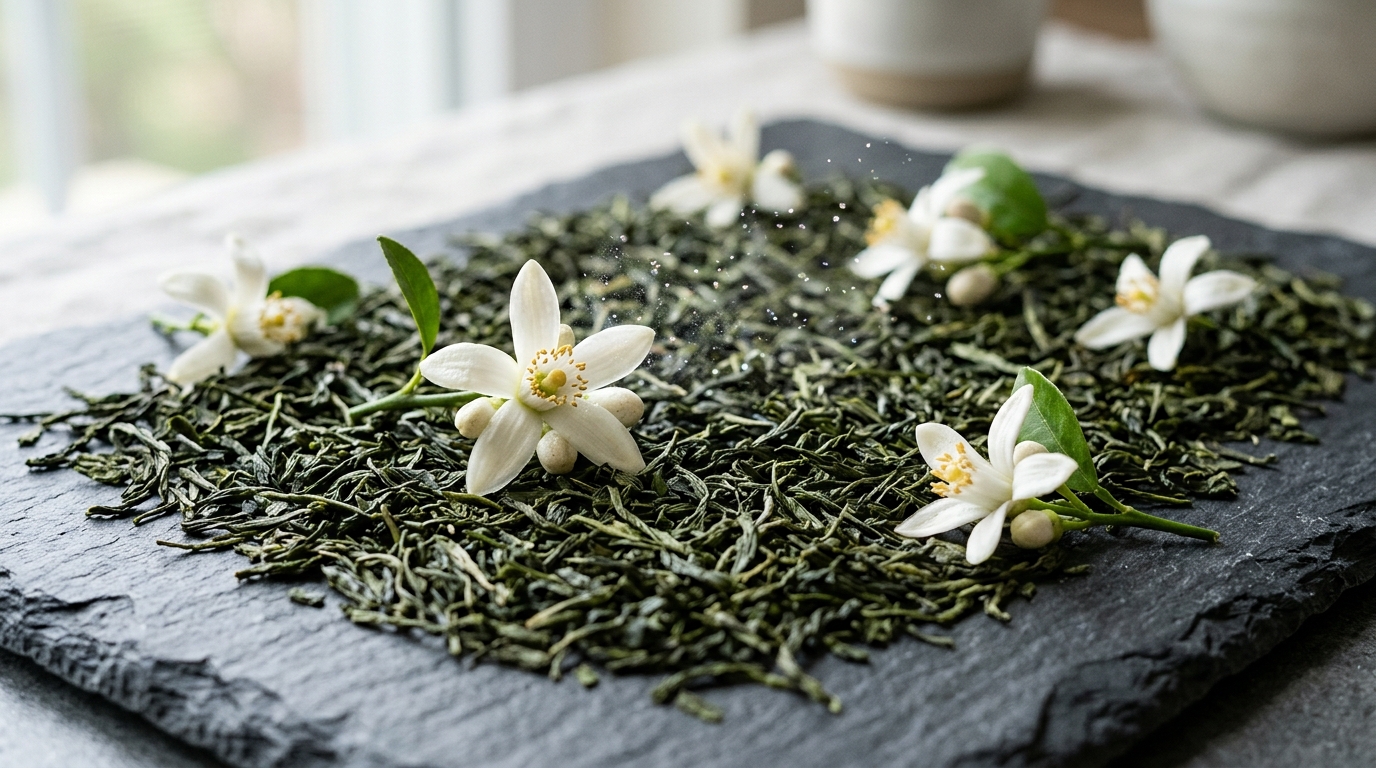
A comparative investigation into the flavor chemistry of scented tea has revealed that the physical matrix and fermentation background of base tea leaves fundamentally govern how floral aroma compounds accumulate during repeated scenting cycles. Researchers evaluating the valorization of pomelo blossoms discovered that strip-shaped, non-fermented baked green tea captures and preserves key floral volatiles far more effectively than semi-fermented, tightly rolled Baiyaqilan oolong tea. Across three successive scenting rounds, the overall volatile concentration in the baked green tea series surged by approximately one hundred thousand micrograms per gram, whereas the oolong tea matrix exhibited an increase of less than four thousand micrograms per gram. These contrasting trajectories demonstrate that the base tea matrix does not merely provide a passive background flavor, but actively determines the degree of volatile adsorption, the chemical stability of trapped fragrance molecules, and the extent of endogenous compound degradation during thermal tea processing.
The research addresses a substantial agricultural challenge in commercial citrus cultivation, where extensive flower thinning is routinely conducted every spring to optimize fruit set and fruit development. In typical pomelo orchards, massive quantities of fragrant blossoms are pruned and discarded annually as agricultural waste, despite containing rich profiles of naturally sweet and fresh volatile constituents. While small portions of thinned blossoms are occasionally harvested for essential oil distillation, the overwhelming majority remain entirely unexploited. Incorporating these discarded pomelo flowers into scented tea manufacturing represents a promising pathway for circular agricultural valorization and value-added product development. Prior scientific investigations into scented teas have predominantly focused on jasmine and osmanthus blossoms combined with standard green tea bases. Consequently, the dynamic evolution of volatile compounds, the comparative role of distinct leaf matrices, and the precise identification of candidate aroma-active compounds during pomelo flower scenting had remained largely uncharacterized until this evaluation.
To establish controlled experimental conditions, the research team harvested fresh pomelo flowers between three and six in the morning in March 2025 from commercial orchards in Pinghe County, Fujian Province, China. The gathered blossoms underwent impurity removal and were blended at a one-to-two weight ratio of fresh flowers to base tea leaves, using base leaves with an initial moisture content of six percent. The scenting procedure subjected both tea varieties to identical three-stage protocols across six independent processing batches. The first round was conducted at thirty-five to forty degrees Celsius for twelve hours, generating first-stage teas designated as GTPF1 and QLPF1. The second round ran at forty to fifty degrees Celsius for ten hours to produce GTPF2 and QLPF2. Finally, a third scenting round was maintained at forty to fifty degrees Celsius for ten hours, after which spent blossoms were removed and scented leaves were dried at eighty degrees Celsius for fifteen minutes, stabilizing final moisture content at approximately eight percent.
Sensory evaluations conducted by a trained panel of ten evaluators, comprising five men and five women aged twenty to twenty-six from Zhejiang University, provided human perceptual validation of the scenting transformations. Operating within specialized sensory booths maintained under positive pressure, controlled illumination, fifty percent relative humidity, and twenty-two degrees Celsius, panelists evaluated tea infusions across five criteria: aroma intensity, freshness, persistence, floral note, and woody note. Between sample evaluations and replicates, panelists reset their olfactory receptors by smelling roasted coffee beans to eliminate sensory fatigue and carryover effects. Infusions prepared from the third-stage green tea product demonstrated superior scores in aroma persistence, concentration, freshness, and multi-layered floral complexity, outperforming all other tested samples. Conversely, while Baiyaqilan oolong tea exhibited pronounced woody nuances that carried through into the finished scented beverage, its overall floral enhancement was substantially muted, reinforcing the conclusion that loose green tea leaves integrate floral volatiles into a far more cohesive sensory profile.
Chemical profiling of volatile compounds relied on complementary analytical methodologies, coupling automated flash gas chromatography electronic nose measurements with headspace solid-phase microextraction gas chromatography-mass spectrometry. For electronic nose determinations, tea liquor brewed from three grams of sample infused in boiling water for four minutes was incubated at forty degrees Celsius under five hundred revolutions per minute agitation, before headspace volatiles were injected into a dual-column Heracles Neo analyzer equipped with DB-5 and DB-1701 columns and twin flame ionization detectors. For mass spectrometry, volatile analytes adsorbed onto a divinylbenzene, carboxen, and polydimethylsiloxane fiber were separated on an HP-5ms column using helium carrier gas, with cyclohexanone serving as an internal standard for semi-quantification. Across the two tea systems and successive processing stages, the analytical pipeline resolved seventy-three distinct volatile compounds. These constituents encompassed thirty-one hydrocarbons, nine aldehydes, eight alcohols, eight terpenoids, six esters, five ketones, one heterocycle, one oxime, one phenol, and one nitrile, establishing a comprehensive library of chemical transformations.
Direct characterization of intact fresh pomelo flowers prior to mixing provided an empirical baseline for floral volatile donation. Gas chromatographic analysis demonstrated that linalool possessed the highest estimated concentration among all detected floral compounds, followed by methyl anthranilate, nerolidol, indole, beta-myrcene, (E)-beta-farnesene, geraniol, and alpha-farnesene. To assess sensory relevance beyond raw abundance, the investigators calculated odor activity values by dividing measured concentrations by published water odor thresholds. Fifteen distinct floral volatiles exhibited odor activity values exceeding one, indicating concentrations sufficient to trigger human olfactory detection. Notably, methyl anthranilate registered the highest estimated odor activity value at 17,509.07, followed by geraniol at 7,995.54, linalool at 3,215.02, indole at 412.00, and nerolidol at 148.11. This pronounced divergence between absolute chemical abundance and calculated odor contribution highlighted the necessity of pairing quantitative chromatography with threshold modeling, as lower-concentration compounds like methyl anthranilate exert profound influences over the perceived fragrance signature.
During continuous scenting treatments, compositional proportions shifted dramatically within both tea matrices, most visibly characterized by an extraordinary surge in volatile alcohols. In both unscented green and oolong base leaves, alkanes represented the predominant native fraction, while alcohols accounted for only 3.70 to 5.78 percent of total volatiles. Following pomelo flower scenting, alcohols expanded to constitute 73.03 to 75.32 percent of the volatile profile, a massive expansion attributed to the microporous solid-adsorbent architecture of tea leaves combined with hydrogen bonding between alcohol hydroxyl groups and tea polyphenols. However, the fate of volatile terpenoids diverged starkly between the two matrices. While the unscented green tea base contained no detectable terpenoids prior to processing, scenting endowed the finished green tea product with a conspicuous terpenoid signature. In sharp contrast, oolong tea possessed a high endogenous terpenoid load prior to scenting, but these compounds suffered steady degradation, rearrangement, and thermal evaporation across successive heating rounds, demonstrating that matrix characteristics dictate whether volatile classes accumulate or decline.
Mathematical clustering utilizing the Mfuzz algorithm resolved volatile trajectories across the scenting stages into three primary operational patterns: sustained enrichment, net reduction, and transient accumulation followed by subsequent loss. In the baked green tea series, thirty-eight compounds exhibited progressive enrichment, led by linalool, indole, beta-farnesene, nerolidol, citral, geraniol, terpineol, and methyl salicylate, whereas only sixteen native compounds declined. Conversely, the oolong tea series saw enrichment in only twenty-three compounds, while thirty-seven endogenous volatiles decreased significantly, including limonene, benzaldehyde, decane, and beta-ionone. Furthermore, several compounds in the oolong matrix, such as terpineol, citral, citronellol, nonadecane, and 2,5-dimethylnonane, exhibited transient spikes during initial scenting stages before dropping sharply after final drying. Tracking the most drastically shifting constituents across four structural families—beta-myrcene among terpenoids, linalool among alcohols, methyl anthranilate among esters, and indole among heterocycles—revealed that while all four increased in both tea varieties, their total accumulated concentrations in the finished oolong product were nearly an order of magnitude lower than in green tea.
Multivariate statistical modeling using principal component analysis and orthogonal partial least squares-discriminant analysis established clear separation between the unscented base teas and finished scented products. Principal component analysis of electronic nose sensor arrays explained 98.3 percent of total variance across PC1 and PC2, identifying a distinctive chromatographic peak at approximately sixty-two seconds on the DB-5 column that dual-column retention indices confirmed as linalool. In orthogonal partial least squares models, the green tea comparison yielded robust parameters with an R2X of 0.752, R2Y of 0.999, and predictive Q2 of 0.986, isolating twenty-one differential compounds with variable importance in projection values exceeding one. The oolong model similarly demonstrated high validity with an R2X of 0.843 and Q2 of 0.979, uncovering twenty-nine differential volatiles, of which eighteen represented significant losses of endogenous aroma constituents. When directly comparing the two finished teas, thirty-three differential compounds were identified, with thirty-two accumulating at significantly higher levels in the green tea matrix, while only alpha-farnesene showed higher retention in oolong, explaining its lingering woody note.
Quantitative odor activity value modeling across the scenting stages established five candidate key aroma-active compounds that define the distinctive sensory quality of pomelo flower tea: linalool, methyl anthranilate, geraniol, indole, and nerolidol. In baked green tea, linalool surged from 109.89 micrograms per kilogram to 67,102.68 micrograms per kilogram, achieving a finished odor activity value of 1,342.05, while methyl anthranilate, geraniol, indole, and nerolidol rose from undetectable baseline levels to 13,346.25, 6,471.66, 5,111.66, and 2,829.45 micrograms per kilogram, respectively. In oolong tea, linalool reached only 6,430.76 micrograms per kilogram, and endogenous grassy volatiles declined by approximately sixty-eight percent, dropping from 1.43 × 10^3 to 4.62 × 10^2 micrograms per gram. These contrasting outcomes underscore that loose, strip-shaped green tea leaves provide superior surface area and shorter diffusion pathways compared to the tightly rolled, spherical morphology of oolong tea leaves. Ultimately, the investigation demonstrates that optimizing floral scented tea requires balancing floral volatile uptake against endogenous aroma preservation, offering valuable scientific parameters for transforming discarded pomelo blossoms into high-value functional tea products.
Subject of Research: Dynamic aroma formation and base tea matrix effects during pomelo flower scenting
Article Title: Aroma formation during repeated pomelo flower scenting: Dynamic evolution of volatile compounds and the role of base tea matrix
Article References: Liang, Y., Wu, Z., Dai, Z., Chen, J., Chen, S., Ye, X., & Cheng, H. (2026). Aroma formation during repeated pomelo flower scenting: Dynamic evolution of volatile compounds and the role of base tea matrix. Food Chemistry: X, 40, Article 104784. https://doi.org/10.1016/j.fochx.2026.104784
Image Credits: AI Generated
DOI: 10.1016/j.fochx.2026.104784
Keywords: pomelo flower tea, baked green tea, Baiyaqilan oolong tea, volatile organic compounds, tea scenting, linalool, methyl anthranilate, geraniol, nerolidol, indole, gas chromatography mass spectrometry, electronic nose, odor activity value, orthogonal partial least squares discriminant analysis, floral volatile enrichment, flavor chemistry
News Source: Bethany Barker. (November 18, 2026). Green Tea Matrix Captures Pomelo Flower Volatiles More Effectively Than Oolong. Scienmag.