Credit: University of Exeter
Organelles are the functional units of a cell. Like different parts of a production line in a factory, they perform specialised functions but depend on and interact with each other.
To adapt their functions to cellular needs, organelles need to be dynamic: they have to move in order to interact and cooperate with other organelles, to stay in position or to multiply by increasing in size and then dividing.
How these dynamic processes are mediated and regulated in the cell is an important and challenging question in cell biology.
Scientists have now discovered how the movement and membrane dynamics of a specific organelle – called peroxisomes – are mediated.
Peroxisomes fulfil important protective functions in the cell and are vital for health; loss of peroxisome function and dynamics leads to severe developmental and neurological defects.
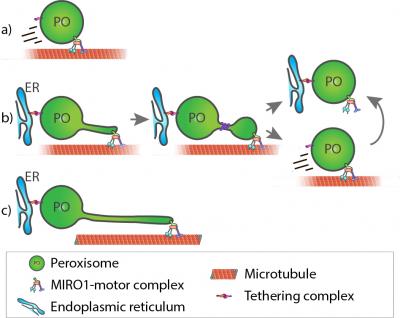
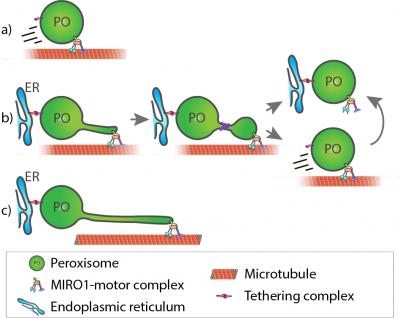
Much about the way peroxisomes work is still unknown, but University of Exeter researchers have identified a protein called MIRO1 that plays a key role in attaching peroxisomes to motor proteins – allowing them to move within the cell.
"In this study, we identified MIRO1 as the missing adaptor protein which links peroxisomes to molecular motors and revealed a new role for MIRO1 in peroxisome motility in mammalian cells," said Professor Michael Schrader, of the University of Exeter.
"In addition, we used MIRO1 as a tool to generate pulling forces at peroxisomes in living cells.
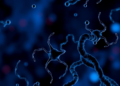
"We were able to redistribute peroxisomes within cells, but interestingly could even multiply them (by pulling them apart) or pull out enormously long protrusions of the peroxisomal membrane in patient cells.
"These experiments have provided us with new insights into the molecular mechanisms determining peroxisome number and shape in the cell under normal and disease conditions.
"In peroxisomal disorders, we often see altered numbers, different shapes or even different distributions of peroxisomes in patient cells.
"Understanding why this happens and how to modulate peroxisome numbers or distribution can provide new possibilities to improve cell performance in those patients.
"This might also be relevant to age-related conditions like dementia, deafness and blindness, as peroxisomes are known to have important protective functions within sensory cells."
The research team combined molecular cell biology, microscopy, live-cell imaging analysis – by Dr Jeremy Metz from the Biomedical Informatics Hub – and mathematical modelling – by Dr David Richards of Exeter's Centre for Biomedical Modelling and Analysis – to present the first mathematical model to understand, explain and predict peroxisome membrane dynamics in health and disease.
People with severe peroxisomal disorders, also known as Zellweger Spectrum Disorders, often die as children or young adults, and a charity called Zellweger UK exists to raise awareness and to support families and sufferers.
The research was funded by the Biotechnology and Biological Sciences Research Council, the Wellcome Trust and the Medical Research Council.
The paper, published in the journal Traffic, is entitled: "A role for MIRO1 in motility and membrane dynamics of peroxisomes."
###
The authors were Inês G Castro, David M Richards, Jeremy Metz, Joseph L Costello, Josiah B Passmore, Tina A Schrader, Ana Gouveia, Daniela Ribeiro and Michael Schrader.
While this work was submitted, two other studies have been published supporting a role for MIRO1 at peroxisomes (Okumoto et al., J Cell Biol. 2017 Dec 8; Covill-Cooke et al., bioRxiv 2017, Dec 30).
Media Contact
Alex Morrison
[email protected]
44-013-927-24828
@uniofexeter
http://www.exeter.ac.uk
Related Journal Article
http://dx.doi.org/10.1111/TRA.12549