• HOME
  • NEWS
  • EXPLORE
    • CAREER
      • Companies
      • Jobs
    • EVENTS
    • iGEM
      • News
      • Team
    • PHOTOS
    • VIDEO
    • WIKI
  • BLOG
  • COMMUNITY
    • FACEBOOK
    • INSTAGRAM
    • TWITTER
Wednesday, November 18, 2026
BIOENGINEER.ORG
No Result
View All Result
  • Login
  • HOME
  • NEWS
  • EXPLORE
    • CAREER
      • Companies
      • Jobs
        • Lecturer
        • PhD Studentship
        • Postdoc
        • Research Assistant
    • EVENTS
    • iGEM
      • News
      • Team
    • PHOTOS
    • VIDEO
    • WIKI
  • BLOG
  • COMMUNITY
    • FACEBOOK
    • INSTAGRAM
    • TWITTER
No Result
View All Result
Bioengineer.org
No Result
View All Result
Home NEWS Science News Technology

Reinforcement Learning Framework Improves Space Utilization in Online 3D Bin Packing

by
November 18, 2026
in Technology
Reading Time: 2 mins read
0
Reinforcement Learning Framework Improves Space Utilization in Online 3D Bin Packing

Reinforcement Learning Framework Improves Space Utilization in Online 3D Bin Packing

Share on FacebookShare on TwitterShare on LinkedinShare on RedditShare on Telegram

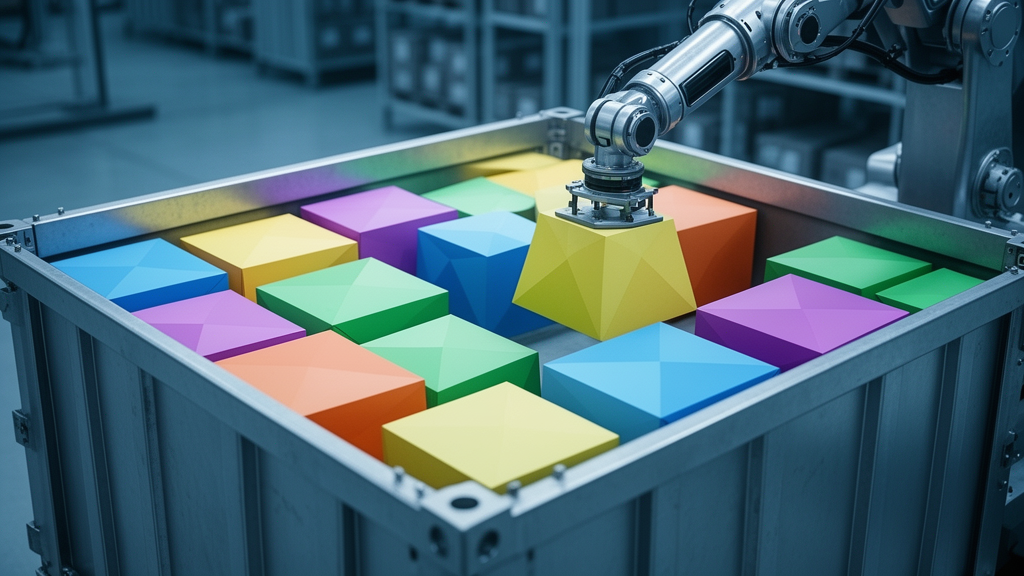
Researchers at Shibaura Kogyo Daigaku have introduced a deep reinforcement learning framework that improves container space utilization in the online three-dimensional bin packing problem. The research, conducted by Thien Tran Van, Ngoc Tam Bui, and corresponding author Hiroshi Hasegawa at the Toyosu Campus in Koto City, Japan, was published as an original research article in Frontiers in Robotics and AI within the Robot Learning and Evolution section. The study addresses automated logistics and parcel sorting systems, where marginal gains in container space utilization yield significant operational benefits.

The three-dimensional bin packing problem, commonly designated as 3D-BPP, represents a critical computational challenge for optimizing automated logistics and parcel logistics. However, existing computational methods often feature overly complex network architectures and underutilize both buffer space and lookahead information regarding incoming cargo.

To address these operational limitations, the authors developed a novel deep reinforcement learning framework built upon a streamlined architecture. The core foundation of the model utilizes a dual-stream Transformer backbone, which decouples processing into two coordinated streams: an Item Stream operating with Lookahead Cross-Attention and a Space Stream operating with Geometry Cross-Attention.

The streamlined Transformer backbone is coupled with a dynamic HyperBiaffine decoder driven by an integrated Hypernetwork. This mechanism enables the system to autonomously recalibrate packing strategies based on real-time spatial clutter and anticipated future cargo.

The authors conducted extensive evaluations across three standard benchmark datasets: RS, CUT-1, and CUT-2. Testing began with a baseline configuration featuring a buffer capacity of one item and a lookahead capacity of zero items. Under these baseline parameters, the proposed deep reinforcement learning model achieved a space utilization of 87.3 percent, directly outperforming the state-of-the-art Packing Configuration Tree method, which achieved 86.0 percent space utilization.

The performance advantage was further demonstrated when the researchers scaled the system’s operational capacity. By maximizing both buffer and lookahead capacities to five, the proposed model achieved a peak space utilization of 94.4 percent across the evaluations. In comparison, the state-of-the-art Packing Configuration Tree method attained 93.3 percent space utilization under the identical expanded capacity of five buffer items and five lookahead items.

According to the authors, these comparative results across the RS, CUT-1, and CUT-2 datasets firmly validate the high efficiency and superior performance of their proposed reinforcement learning method.

Subject of Research: Deep reinforcement learning for online 3D bin packing in automated logistics

Article Title: Leveraging buffer and lookahead information for online 3D bin packing via deep reinforcement learning

Article References: Van Thien, T., BUI, N.-T., & Hasegawa, H. (2026). Leveraging buffer and lookahead information for online 3D bin packing via deep reinforcement learning. Frontiers in Robotics and AI, 13, 1964467. https://doi.org/10.3389/frobt.2026.1964467

Image Credits: AI Generated

DOI: 10.3389/frobt.2026.1964467

Keywords: 3D bin packing problem, deep reinforcement learning, space utilization, logistics automation, online bin packing, parcel logistics, sorting systems, dual-stream transformer, lookahead cross-attention, geometry cross-attention, hyperbiaffine decoder, hypernetwork, packing configuration tree, buffer capacity, lookahead capacity, RS dataset, CUT-1 dataset, CUT-2 dataset

News Source: Denise Maddox. (November 18, 2026). Reinforcement Learning Framework Improves Space Utilization in Online 3D Bin Packing. Scienmag.


Tags: 3D bin packing problembuffer capacityCUT-1 datasetCUT-2 datasetDeep Reinforcement Learningdual-stream transformergeometry cross-attentionhyperbiaffine decoderhypernetworklogistics automationlookahead capacitylookahead cross-attentiononline bin packingpacking configuration treeparcel logisticsRS datasetsorting systemsspace utilization
Share12Tweet7Share2ShareShareShare1

Related Posts

Core-Shell Zinc Oxide and Bismuth Sulfide Photoanodes Boost Solar Hydrogen Production

Core-Shell Zinc Oxide and Bismuth Sulfide Photoanodes Boost Solar Hydrogen Production

November 18, 2026
Moving Reflective Targets Enable Online Multi-LiDAR Calibration in Sparse Maritime Environments

Moving Reflective Targets Enable Online Multi-LiDAR Calibration in Sparse Maritime Environments

November 18, 2026

Federated Deep Learning Framework Secures Connected Devices Against Multi-Vector Cyber Attacks

November 18, 2026

Optimized Gradient Boosting Models Predict Concrete Compressive Strength with High Accuracy

November 18, 2026

POPULAR NEWS

  • Nurse-Led Interventions Ease Cancer Distress but Personalization Trials Are Needed

    Nurse-Led Interventions Ease Cancer Distress but Personalization Trials Are Needed

    29 shares
    Share 12 Tweet 7
  • Analysis of 1.2 Million Patients Finds 7.6 Percent Surgical Complication Rate

    29 shares
    Share 12 Tweet 7
  • Alcohol Weakens Anti-PD-1 Cancer Immunotherapy in Mice, Study Finds

    29 shares
    Share 12 Tweet 7
  • Presurgical Axitinib and Immunotherapy Linked to Shorter Kidney Cancer Thrombus Surgery

    29 shares
    Share 12 Tweet 7

About

We bring you the latest biotechnology news from best research centers and universities around the world. Check our website.

Follow us

Recent News

T Cell Depletion Protects Dopaminergic Neurons After Head Injury in Mice

Ear-Based Nerve Stimulation Shows Preliminary Cognitive Benefits in Spinal Cord Pilot

Visuospatial Memory Game Reveals Interpretable Behavioral Profiles in Children With ADHD

Subscribe to Blog via Email

Enter your email address to subscribe to this blog and receive notifications of new posts by email.

Join 88 other subscribers
  • Contact Us

Bioengineer.org © Copyright 2023 All Rights Reserved.

Welcome Back!

Login to your account below

Forgotten Password?

Retrieve your password

Please enter your username or email address to reset your password.

Log In
No Result
View All Result
  • Homepages
    • Home Page 1
    • Home Page 2
  • News
  • National
  • Business
  • Health
  • Lifestyle
  • Science

Bioengineer.org © Copyright 2023 All Rights Reserved.