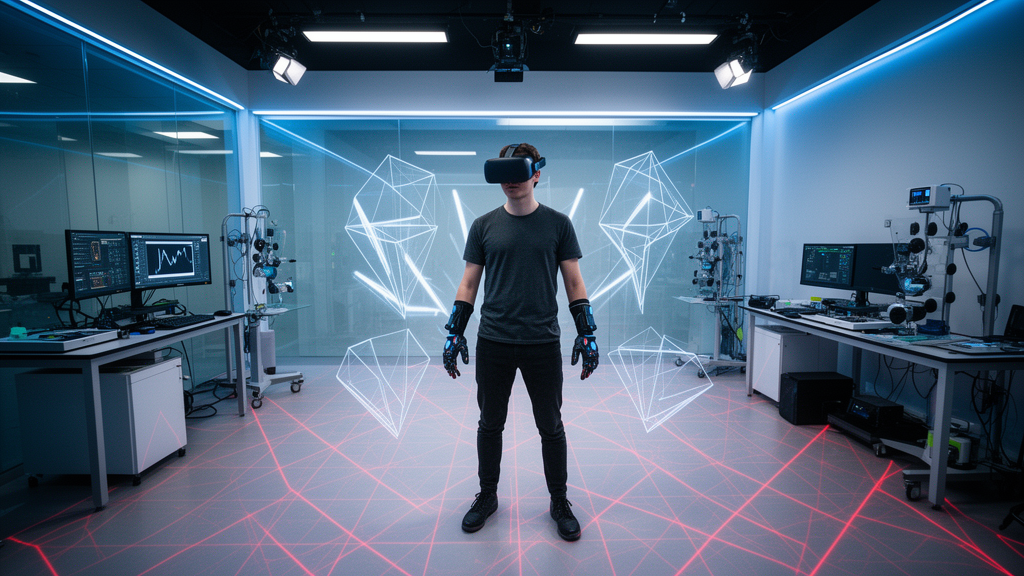
Immersive virtual reality systems are increasingly incorporating multisensory feedback, such as haptic, olfactory, and proprioceptive cues, to enhance user embodiment and experience. While these technologies show potential for improving task performance and clinical outcomes, a recent perspective article highlights that this expanded immersive capability introduces a complex, often overlooked, constellation of risks. These threats, which categorize into discomfort, safety, privacy and security, and societal issues, necessitate a proactive approach to developing technical and governance solutions as these systems transition from controlled research environments to widespread adoption. Understanding these vulnerabilities is critical to ensuring that future embodied experiences are designed with safety and ethics as fundamental pillars.
Discomfort remains a significant hurdle in multisensory virtual reality, primarily driven by sensory conflict and precise integration challenges. Because the human brain expects multisensory inputs to be temporally synchronized, even minor latency in haptic or olfactory feedback relative to visual stimuli can disrupt immersion and trigger cybersickness. Research indicates that cognitive demand increases when users must reconcile inconsistent sensory information, making these systems highly sensitive to performance variations. Studies have shown that when multisensory cues fail to align with a user’s internal expectations or environmental context, the result is frequently disorientation or nausea, rather than the intended sense of realism.
Beyond physical discomfort, these emerging technologies introduce new cyber-physical safety vulnerabilities. As systems become more sophisticated, integrating haptic feedback—such as localized temperature changes or functional electrical stimulation—creates potential for physical harm if systems malfunction or are compromised by malicious actors. Although currently theoretical, the risk of extreme sensations causing burns or involuntary muscular contractions highlights the danger of hacking in environments where physical and digital boundaries are blurred. Furthermore, the manipulation of sensory inputs could pose severe consequences in safety-critical settings, including remote medical procedures or digital therapeutic interventions where precise feedback is essential for patient health.
Privacy and security concerns are amplified by the deep integration of biometric sensors required for advanced multisensory experiences. Headsets now collect vast amounts of granular data, including body composition, movement patterns, and neural signatures, which can be exploited for unauthorized user identification or identity theft. Because multisensory experiences generate unique physiological responses, researchers have observed that subject identification accuracy increases significantly compared to traditional audio-visual setups. The limited computational resources of wearable devices often complicate the implementation of robust cryptographic protections, leaving these systems vulnerable to eavesdropping and data interception during transmission.
The integration of generative AI within these immersive media platforms adds another layer of complexity. While AI can enhance realism, it also enables sophisticated social engineering attacks, such as deepfake videos that are made more persuasive through synchronized smell or haptic feedback. This combination of sensory stimulation could be used to manipulate user behavior, for instance, by persuading individuals to interact with malicious links or altering their decision-making processes in commercial contexts. The threat of cognitive manipulation—where sensory inputs are used to influence appetite, mood, or judgment without the user’s explicit awareness—remains a growing concern that requires urgent attention.
Societal challenges, particularly regarding inclusivity and the digital divide, further complicate the landscape. Advanced multisensory hardware, such as smart noses and haptic suits, is currently expensive and not mass-produced, potentially limiting access to affluent users or developed countries. Moreover, these systems are often engineered based on normative assumptions about body size, mobility, and sensory sensitivity, which risks systematically marginalizing users with disabilities or diverse physical requirements. The environmental cost of powering the necessary high-speed telecommunications infrastructure and server farms for generative AI also presents a long-term sustainability challenge that cannot be ignored.
Addressing these multi-dimensional threats requires a shift toward ground-up design that integrates security and inclusivity from the earliest stages of development. For example, proactive monitoring of physiological signals could allow systems to detect signs of cybersickness or adverse reactions, triggering automatic adjustments or emergency shutdowns. Robust governance frameworks and transparent disclosure of how multisensory persuasion techniques are employed are essential to maintain user trust. By adopting open-science practices and inclusive design standards, the research community can ensure that the development of immersive reality does not exacerbate systemic inequality.
While mitigation strategies are currently in development, they remain uneven across the different categories of risk. Current approaches range from real-time synchronization mechanisms to reduce discomfort, to hardware-level safety thresholds that prevent physical harm. However, many identified threats lack widely accepted, validated countermeasures, underscoring a significant imbalance between the speed of technological evolution and the maturity of risk-mitigation efforts. Future scholarly and interdisciplinary collaboration will be vital to establish standardized frameworks that weigh the clear benefits of multisensory immersion against these complex, emerging security and ethical considerations.
Expanding on the technical requirements for user comfort, researchers have identified that neural monitoring can serve as a critical tool for managing the complex interplay between sensory input and human perception. By utilizing electroencephalography (EEG) integrated directly into virtual reality headsets, developers can monitor objective indicators of user experience in real time. One well-documented measure is frontal alpha power asymmetry, which provides insight into a user’s emotional state. In neuroergonomics, left-side dominance in alpha power is frequently associated with approach-related or positive behaviors, while right-side dominance suggests avoidance or withdrawal. Future immersive systems could leverage these neural signatures to automatically adapt the multisensory intensity of an experience, such as disabling specific haptic or olfactory stimuli when a subject exhibits signs of avoidance, thereby preventing the transition from mild discomfort to full-blown cybersickness.
Beyond the cognitive experience, the physical safety of users in these systems is a priority, particularly as wearables become more sophisticated. The inclusion of Peltier thermoelectric elements for thermal feedback or functional electrical stimulation to mimic touch introduces hardware-level risks that are largely absent in traditional media. Should these systems suffer from technical failure or malicious manipulation, they have the potential to cause localized skin burns or involuntary muscular contractions. These risks are exacerbated by the possibility of remote attacks that alter virtual boundaries, effectively forcing users to collide with furniture or walls, an attack vector that has been demonstrated in experimental conditions.
The privacy landscape is similarly complex, as these systems rely on a vast array of granular biometric data. Modern headsets do not simply track movement; they capture body composition, emotional responses, and distinct neural signatures. Research indicates that incorporating multisensory stimuli into these data streams increases user identification accuracy by more than 20% compared to conventional audio-visual recordings. Because wearable devices often lack the memory and processing power to support full, robust cryptographic schemes, data transmission remains a vulnerable point of entry for eavesdropping. Addressing this requires a paradigm shift toward edge-based processing, where biometric data is anonymized locally on the device before it ever reaches cloud-based servers, thereby reducing the exposure of sensitive user identifiers.
The infrastructure required to power modern multisensory experiences—including 5G telecommunications and massive server farms running generative AI—places significant strain on global resources, contributing to high electricity consumption, water usage, and carbon emissions. Furthermore, because these devices are frequently designed around normative assumptions of body size and physical mobility, they carry a high risk of excluding users with disabilities or diverse physical requirements. Furthermore, research into sensory perception has shown that individuals experience smells differently depending on their age, gender, and pre-existing medical conditions. Designing inclusive systems requires a move away from rigid, one-size-fits-all hardware toward platforms that offer customizable sensory profiles and support diverse demographic needs.
The integration of foundation AI models into these platforms offers a possible mitigation for resource strain through technologies such as scene captioning. Instead of streaming high-resolution visual data, semantic information can be transmitted, which requires significantly less bandwidth, and then reconstructed locally on the receiver’s hardware. While promising for accessibility, this strategy also introduces new security vulnerabilities, including the risk of model hallucinations and potential data leaks from the training sets. Advanced techniques like model pruning and quantization will be necessary to ensure that these large language models can operate reliably on local hardware. These advancements not only preserve user privacy but also allow for the potential democratization of the field through open-science and low-cost, DIY initiatives that could narrow the existing digital divide.
Governance remains the final, critical hurdle in the responsible development of multisensory immersive media. Drawing from established frameworks in the Digital Twins literature, it is evident that any system processing behavioral and sensory data requires clear guidelines for data sharing and the fair allocation of responsibility. Because olfactory and haptic inputs can influence appetite, mood, and consumer judgment without the user’s explicit awareness, the transparent disclosure of these persuasive techniques is essential for maintaining institutional and user trust. The research community is therefore tasked with balancing the clear therapeutic benefits of these technologies—such as their proven utility in stroke neurorehabilitation or stress reduction—with the development of standardized ethical frameworks. Such collaboration must ensure that as the field evolves, the drive for greater immersion does not inadvertently compromise the safety, security, or social equity of the global user base.
Subject of Research: Emerging safety, security, and societal threats in multisensory virtual reality systems.
Article Title: Embodied multisensory immersive experiences: a perspective into emerging threats and possible solutions
Article References: Falk, T. H., Ghinea, G., & Grønli, T.-M. (2026). Embodied multisensory immersive experiences: a perspective into emerging threats and possible solutions. Frontiers in Virtual Reality, 7, 1992504. https://doi.org/10.3389/frvir.2026.1992504
Image Credits: AI Generated
DOI: 10.3389/frvir.2026.1992504
Keywords: virtual reality, multisensory, cybersecurity, cybersickness, privacy, haptic feedback, biometric sensors, cognitive manipulation, immersive media, digital divide, generative AI, inclusive design, wearable technology, neuroergonomics, safety engineering, ethical AI
News Source: Denise Maddox. (November 18, 2026). Emerging Security and Safety Risks in Immersive Multisensory Virtual Reality. Scienmag.