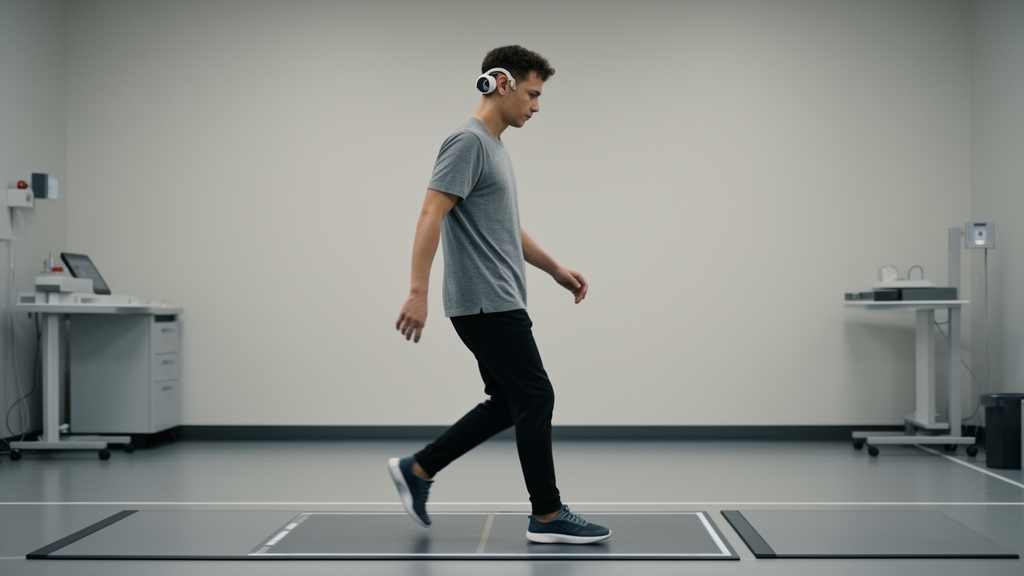
Adults with sensorineural hearing loss who are scheduled for cochlear implantation exhibit a distinct, task-dependent gait signature across multiple body segments, according to a study investigating movement patterns and functional mobility. The research demonstrates that individuals with hearing impairment and frequent concomitant vestibular deficits display significant alterations in how their bodies move during overground walking tasks compared to age-matched healthy controls.
To analyze these movement differences, researchers evaluated adults presenting with either unilateral or bilateral sensorineural hearing loss alongside age-matched control participants. Each participant completed comprehensive clinical assessments as well as fourteen distinct overground walking tasks designed to evaluate mobility under varying degrees of physical and sensory difficulty.
Biomechanical data were captured using six wearable inertial measurement units placed systematically across the body, including the head, trunk, upper limb, and lower limbs. Through these wearable sensors, investigators quantified kinematic range, movement variability, gait timing, asymmetry, and composite global kinematic scores to identify multi-segment movement patterns across the body.
The kinematic evaluations revealed that participants with hearing loss and frequent vestibular impairment exhibited compressed ranges of motion and reduced across-stride variability across multiple body segments. Simultaneously, these individuals showed increased cycle-to-cycle variability for selected kinematic measures and specific tasks, establishing an overall gait pattern that combined restricted body movement with less consistent stepping behavior across successive strides.
These biomechanical disparities became especially pronounced during complex tasks that increased functional demands on the motor control system, notably walking with eyes closed, executing pivot turns, and navigating obstacles. Such conditions challenge dynamic stability by restricting visual sensory inputs or requiring active directional changes and obstacle avoidance during forward locomotion.
Clinical testing further identified group-level differences in physiological and functional outcomes between the cohorts. Participants preparing for cochlear implantation demonstrated reduced vestibulo-ocular reflex gain alongside elevated rates of dizziness, oscillopsia, and balance-related difficulties relative to healthy comparison peers.
Notably, global kinematic scores derived from just three walking tasks and a single inertial measurement unit positioned on the head, back, or ipsilateral ankle successfully differentiated the groups despite the reduced instrumentation. Kinematic metrics correlated more strongly with functional performance than with physiological vestibular measurements, indicating that wearable sensors capture functional mobility characteristics that effectively complement standard clinical testing.
The clinical investigation, published in the Journal of NeuroEngineering and Rehabilitation, addressed key gaps surrounding how hearing impairment influences physical stability and mobility. Although sensorineural hearing loss has been linked to impaired balance, disrupted walking patterns, and heightened fall risk, prior scientific understanding remained limited regarding the precise distribution of movement differences across anatomical segments, including the head, trunk, and lower limbs. Furthermore, researchers sought to determine how these multi-segment kinematic variations manifest across diverse walking tasks presenting distinct functional demands to the motor control system.
Subject of Research: Gait kinematics and functional mobility in cochlear implant candidates
Article Title: Altered gait kinematics and functional mobility in cochlear implant candidates with sensorineural hearing loss and frequent vestibular impairment
Article References: De Marzi, M., Aryan, R., Millar, J. L., Bowditch, S. P., Schubert, M. C., & Cullen, K. E. (2026). Altered gait kinematics and functional mobility in cochlear implant candidates with sensorineural hearing loss and frequent vestibular impairment. Journal of NeuroEngineering and Rehabilitation. https://doi.org/10.1186/s12984-026-02201-5
Image Credits: AI Generated
DOI: 10.1186/s12984-026-02201-5
Keywords: sensorineural hearing loss, cochlear implant candidates, gait kinematics, functional mobility, vestibular impairment, inertial measurement units, wearable sensors, vestibulo-ocular reflex, balance impairment, fall risk, pivot turns, obstacle negotiation, dizziness, oscillopsia, overground walking, stride variability
News Source: Ophelia Keating. (November 18, 2026). Cochlear Implant Candidates Show Task-Dependent Gait and Mobility Alterations. Scienmag.