A new research study has demonstrated a sustainable, one-step method for synthesizing active food packaging films by upcycling indigoidine fermentation waste into bacterial cellulose (BC) matrices. By utilizing indigoidine fermentation waste (IFW) as a dual-function medium, researchers successfully combined BC biosynthesis and pigment incorporation into a single production cycle. This approach provides a viable route for industrial upcycling, potentially reducing the costs associated with post-processing functionalization steps while simultaneously addressing the environmental impact of residual fermentation waste streams. The resulting BC-indigoidine composite films displayed improved moisture barrier performance and significant light-shielding capabilities, which were confirmed through comprehensive structural, thermal, and functional characterizations.
Fresh fruit products are inherently susceptible to rapid quality degradation during postharvest storage due to a complex interplay of respiratory metabolism, moisture loss, tissue softening, and microbial colonization. Conventional preservation methods often rely on chemical preservatives, wax coatings, or petroleum-based plastic packaging, which are frequently associated with environmental persistence, high energy demands, and potential safety concerns. While biopolymer-based packaging materials have emerged as renewable and biodegradable alternatives, they often face critical limitations regarding moisture resistance, structural stability, and light protection. Achieving high-performance biopolymer films that meet all commercial requirements without resorting to costly, multi-step post-formation modifications remains a significant challenge for sustainable food packaging technology.
Bacterial cellulose (BC) produced by microorganisms such as Komagataeibacter sucrofermentans offers a high-purity, biocompatible matrix for food packaging applications. However, traditional functionalization of BC generally requires physical coating or chemical modification after the fibrous network has formed. These methods are frequently inefficient, potentially leading to poor retention of active compounds, uneven distribution within the cellulose network, and increased production costs. In contrast, the integration of active compounds during the biosynthesis of the cellulose scaffold—an in situ functionalization strategy—avoids the need for separate loading steps. The research team hypothesised that indigoidine, a blue pigment with documented antioxidant and antimicrobial activities, could be incorporated into BC films by using fermentation waste as a nutritive medium, creating a synergy between waste valorisation and packaging material development.
The indigoidine-producing yeast, an engineered strain of Rhodosporidium toruloides, was cultivated in monosodium glutamate production wastewater to generate indigoidine. The fermentation process resulted in a waste stream, IFW, containing not only indigoidine but also significant quantities of residual nutrients. The experimental design focused on optimising the BC-indigoidine film production using static and dynamic cultivation modes. Following an initial screening of parameters, including pH levels, inoculum size, and incubation temperatures, the researchers identified batch dynamic cultivation at 30 °C as the most efficient process. This selected method demonstrated high film yield and indigoidine removal, while effectively reducing the chemical oxygen demand and nutrient load of the original waste stream.
Structural and morphological analyses confirmed the integrity of the BC-indigoidine matrix. Scanning electron microscopy showed that the composite maintained the characteristic nanofibrous structure of pristine BC, with the pigment broadly and uniformly distributed across the scaffold. This uniform distribution was supported by energy-dispersive X-ray spectroscopy, which identified a consistent nitrogen signal throughout the film, distinct from the nitrogen-free background observed in pure BC. Furthermore, Fourier transform infrared spectroscopy and X-ray diffraction analyses demonstrated that the incorporation of indigoidine did not disrupt the fundamental crystalline structure of Cellulose I. Although the degree of ordered packing within the cellulose network was slightly lower in the composite compared to pure BC, the structural stability remained sufficient for handling and packaging utility.
To investigate the molecular mechanisms underlying the stability of the BC-indigoidine association, the research team conducted molecular dynamics simulations. These simulations indicated that indigoidine molecules rearrange within the cellulose microfibril environment to achieve stable associations. The findings revealed that hydrogen-bonding interactions, predominantly involving BC hydroxyl groups as donors and indigoidine nitrogen or oxygen atoms as acceptors, contributed to the association. Moreover, the simulation results suggested that the presence of indigoidine displaced water molecules from the cellulose interface, reducing local hydration. This molecular-level interaction is consistent with the experimental observations of decreased moisture content and improved water vapour barrier properties in the produced films.
The functional performance of the composite films was evaluated through light-shielding and water-barrier tests. Pure BC typically shows minimal absorption in the visible region, but the BC-indigoidine composite exhibited broad-spectrum UV–visible light shielding due to the conjugated molecular structure of the pigment. This enhanced optical functionality is highly desirable for food packaging, as it can mitigate light-induced lipid and protein oxidation. Concurrently, the water vapour permeability of the BC-indigoidine film was reduced by approximately 22% compared to pristine BC. This result is attributed to the presence of indigoidine occupying the interstitial spaces of the nanofibrous scaffold, thereby creating more tortuous diffusion paths for water vapour.
Antimicrobial activity tests were also conducted against Candida albicans, Staphylococcus aureus, and Escherichia coli. Although agar diffusion assays revealed no clear inhibition zones, potentially due to the poor aqueous solubility of indigoidine, subsequent viable-cell enumeration confirmed significant microbial growth inhibition. After 6 h of incubation, the composite film produced log reductions ranging from 0.54 to 0.75 across the three test microorganisms, with antimicrobial rates between 71% and 82%. These findings support the utility of the BC-indigoidine film as a protective barrier against common food-borne pathogens, offering a functional advantage over pristine BC packaging.
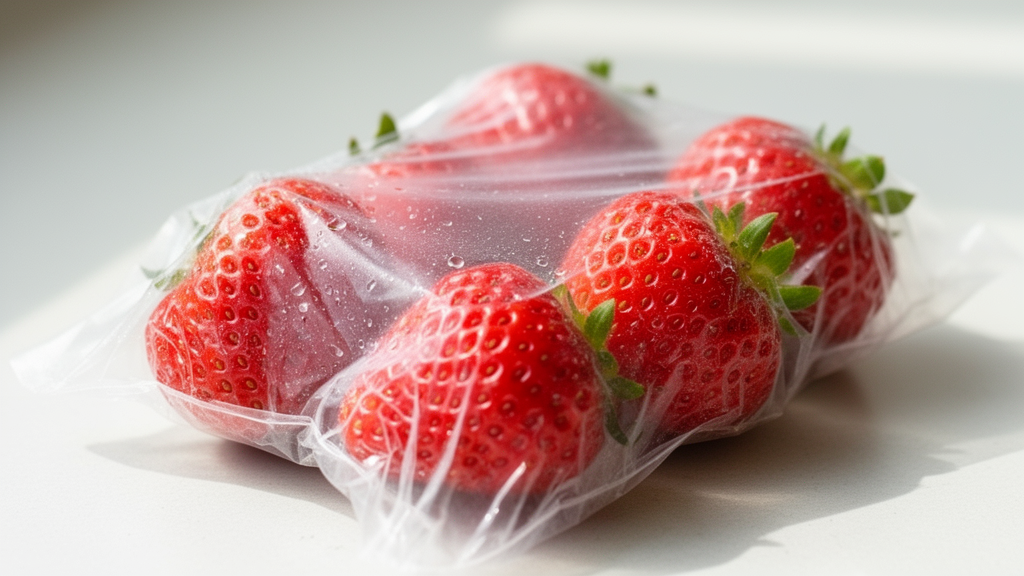
Finally, a strawberry preservation trial demonstrated the practical viability of the BC-indigoidine films. Strawberries wrapped in the composite film and stored at 30 °C showed significantly less surface shrinkage and dehydration compared to those in the unwrapped control or the pristine BC-wrapped group. Weight loss analysis corroborated these observations: after 5 d, the BC-indigoidine group reached a weight loss of 30.59 ± 1.92%, whereas the unwrapped control suffered a mass reduction of 70.38 ± 11.06%, and the pristine BC group exhibited 50.22 ± 14.20% loss. This performance was also consistent during 10 d of storage at 4 °C, indicating that the BC-indigoidine film effectively delayed fruit senescence and spoilage.
The study concluded that the in situ construction of active packaging from fermentation residuals provides a sustainable and efficient strategy for food preservation. All samples complied with safety standards regarding residual methanol and heavy metal content, further confirming their suitability for food contact. While these findings show considerable promise, the authors noted that further research is required to fully elucidate the interfacial and antimicrobial mechanisms at play. Future efforts will also need to broaden the scope of fruit preservation testing to include a wider range of products and environmental conditions, ensuring that these active bioplastic materials can reliably meet the diverse requirements of the global food industry.
A critical technical aspect of this research involved evaluating the impact of the waste-derived medium preparation on film properties. By comparing the chemical oxygen demand (COD), total nitrogen (TN), and total phosphorus (TP) levels in the fermentation waste before and after a specific centrifugation step, the researchers isolated the effects of removing indigoidine from the medium. The analysis revealed that COD and TN concentrations decreased by approximately 757.65 mg/L and 150.56 mg/L, respectively, while TP remained effectively unchanged. To confirm these shifts were tied to pigment removal, the team reintroduced an equivalent amount of purified indigoidine into the depleted medium. This re-addition restored COD and TN levels to near-original values, establishing that the observed changes in medium composition were primarily due to the pigment itself, rather than other components.
The study also employed sophisticated analytical techniques to ensure compliance with stringent food safety protocols, which is vital for materials intended for direct food contact. Quantifying residual methanol in the dried composite films was a key safety measure, yielding levels of 18.6 mg/kg for the BC-indigoidine film, which falls within the regulatory limits specified by the National Food Safety Standard (GB 9685–2016). Additionally, the researchers performed detailed inductively coupled plasma mass spectrometry to measure levels of heavy metals, including iron, arsenic, cadmium, mercury, and lead. The concentrations of these elements in the composite film complied with the national standards for paper and paperboard materials (GB 4806.8–2022), providing an essential safety baseline for the proposed packaging application.
Furthermore, the team explored the thermal behavior of the composite using thermogravimetric analysis and derivative thermogravimetry. Pure bacterial cellulose typically degrades at a maximum rate near 341 °C. The composite film showed a slight advancement in this peak degradation temperature to 336 °C, likely due to the earlier thermal decomposition of the integrated indigoidine. The research noted that this decomposition process may produce nitrogen-containing species that promote the dehydration of the cellulose matrix into a char layer. This char subsequently functions as a thermal barrier, inhibiting the rapid degradation of the remaining internal cellulose scaffold. Given that this initial decomposition temperature remains substantially higher than standard thermal processing temperatures used in pasteurization, the findings suggest the composite possesses sufficient thermal stability for functional food packaging applications.
These observations regarding thermal, chemical, and safety characteristics, alongside the performance data in fruit preservation, collectively outline the utility of the one-step synthesis process. While the study effectively demonstrated that indigoidine-rich fermentation waste can serve as a dual-function medium, the authors identified that future research must further clarify the precise antimicrobial mechanisms and interfacial behavior of the pigment within the cellulose network to fully realize the material’s potential in industrial, large-scale applications.
Subject of Research: Sustainable bio-based food packaging materials
Article Title: Bacterial cellulose-indigoidine films from fermentation waste for active strawberry packaging: Formation, characterization, and functional assessment
Article References: Yu, Z., Yin, H., Yang, M., Zhang, X., Guo, J., & Qiao, N. (2026). Bacterial cellulose-indigoidine films from fermentation waste for active strawberry packaging: Formation, characterization, and functional assessment. Food Chemistry: X, 40, Article 104780. https://doi.org/10.1016/j.fochx.2026.104780
Image Credits: AI Generated
DOI: 10.1016/j.fochx.2026.104780
Keywords: Bacterial Cellulose, Indigoidine, Fermentation Waste, Food Packaging, Active Packaging, Postharvest Preservation, Strawberry Storage, Sustainable Materials, Biopolymer Films, Microbial Fermentation, Cellulose Nanofibrils, Shelf Life Extension, Sustainable Agriculture, Material Science, Food Waste Valorization
News Source: Bethany Barker. (November 18, 2026). Fermentation Waste-Derived Cellulose Films Extend Strawberry Shelf Life. Scienmag.