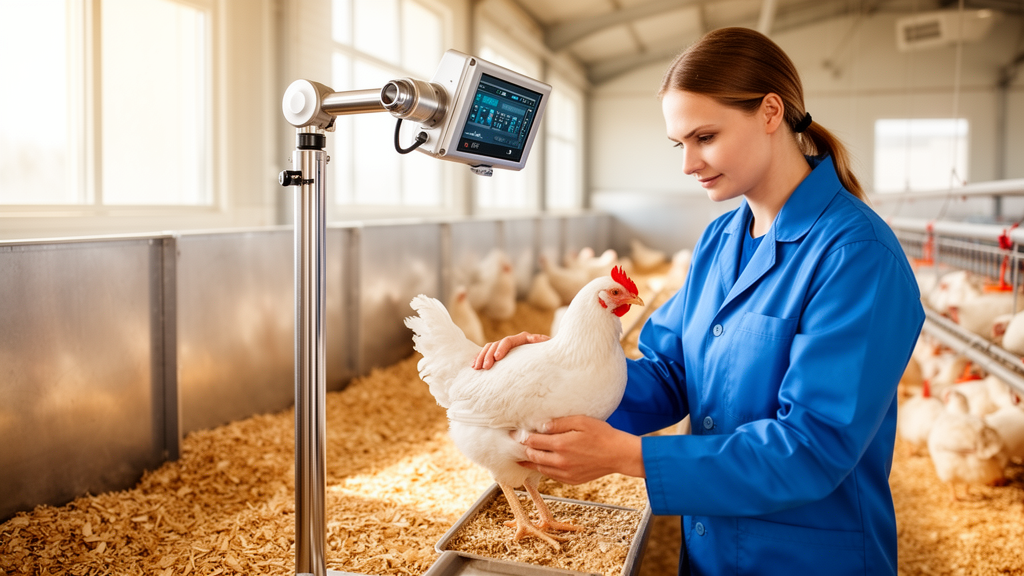
A deep learning framework applying convolutional neural network architectures to poultry diagnostic imagery has attained an overall prediction accuracy of 96.5 percent and an F1 score of 96.8 percent across four distinct health conditions in chickens. Conducted by an international team of engineering and computer science researchers, the investigation evaluated an optimized neural network design incorporating transfer learning through the EfficientNet family to identify pathologies directly from photographic records. Published in the journal Discover Data, the study established an automated pipeline capable of categorizing avian health status without relying on manual veterinary feature extraction. By testing model efficacy against photographic datasets representing healthy chickens alongside three prevalent pathological states, the authors demonstrated that automated computer vision models can successfully discriminate subtle visual manifestations of poultry disease. The resulting analytical framework addresses long-standing challenges in early veterinary detection, providing empirical evidence that scaled convolutional architectures can achieve high diagnostic precision on standardized avian imagery.
Poultry farming occupies a foundational position within worldwide agricultural production and food security systems, supplying essential animal protein through the large-scale management of avian species including chickens, turkeys, ducks, and geese. Within commercial operations, avian populations remain highly susceptible to infectious diseases that threaten operational profitability, flock welfare, and broader food supply chains. Conventional diagnostic approaches across commercial poultry enterprises depend extensively on manual visual inspection, post-mortem assessments, and specialized laboratory testing protocols. While these established veterinary methods provide authoritative diagnoses, they frequently prove labor-intensive, protracted in turnaround time, and vulnerable to human observation errors. Such operational bottlenecks introduce critical delays between initial pathogen exposure and therapeutic intervention, allowing infections to circulate through commercial flocks and imposing severe economic losses on agricultural producers. These persistent diagnostic constraints have intensified demand for automated, cost-effective computational methodologies capable of expediting disease identification through real-time observation.
Prior investigations reviewed by the researchers demonstrated the utility of machine learning algorithms in anticipating agricultural outbreaks, though earlier systems operated under notable structural boundaries. Previous computational initiatives focused primarily on statistical forecasting from structured tabular parameters, such as ambient temperature, flock age, breed, humidity levels, and recorded environmental markers. In one foundational study cited in the literature, researchers leveraged environmental telemetry to predict avian influenza outbreaks with an accuracy rate of 92.2 percent. In a parallel investigation on broiler chickens, algorithmic modeling of flock age, breed characteristics, and environmental metrics yielded a 90.4 percent accuracy rate for coccidiosis forecasting. Systematic literature surveys highlighted predictive accuracies spanning 80 to 98 percent across diverse poultry ailments including Newcastle disease and infectious bronchitis. However, the authors noted that these earlier frameworks exhibited acute limitations in processing raw visual symptoms, restricting their capability to diagnose physical pathologies such as body lesions or fecal abnormalities directly from optical data.
To contextualize algorithmic performance, the authors examined earlier comparative evaluations of classical machine learning models trained on veterinary health records from commercial farms in Nigeria. A benchmarking study analyzing health records from over 2,000 chickens tested decision tree, random forest, k-nearest neighbors, and support vector machine classifiers under ten-fold cross-validation. In that historical assessment, the random forest classifier achieved a leading accuracy rate of 90 percent, while decision trees reached 85 percent and k-nearest neighbors achieved 82 percent. The support vector machine model demonstrated the lowest predictive accuracy at 78 percent across standard metrics including precision, recall, and F1 score. In another historical evaluation encompassing records from over 1,500 commercial chickens, a logistic regression model achieved an 84 percent accuracy rate in predicting disease outbreaks, identifying low body weight and elevated enzyme concentrations as critical indicators. Despite their predictive utility at the population level, these traditional models relied heavily on manual feature engineering and could not categorize individual bird health directly from visual appearance.
To overcome the visual diagnostics gap, the current study utilized a dedicated image repository derived from an extension of the publicly accessible Chicken Disease Image Classification collection on Kaggle. The assembled research dataset comprised approximately 2,000 high-quality images organized evenly across four designated categories representing prevalent avian health conditions. Specifically, the data repository contained 500 images of chickens exhibiting Coccidiosis, 500 images showing manifestations of Salmonella, 500 images documenting Newcastle Disease, and 500 control images depicting healthy birds. This four-class balance prevented mathematical bias toward any individual disease category during algorithmic training. For experimental validation, the researchers divided the complete 2,000-image collection into distinct operational partitions using a standard 70:30 split ratio, allocating 70 percent of the visual data to model training while reserving the remaining 30 percent exclusively for independent testing and performance validation.
Raw photographic inputs within the dataset were originally captured using mobile camera phones under practical operational conditions, resulting in wide variations in photographic resolution and illumination. To establish geometric consistency and satisfy neural network input constraints, the team executed a rigorous digital preprocessing routine across all gathered image files. Every raw photograph was systematically resized to a uniform spatial resolution of 224 by 224 pixels, directly matching the native input dimension requirements of the EfficientNet architectures. In addition to spatial resizing, the researchers standardized the optical data by converting pixel values from their original 8-bit integer range of 0 to 255 into normalized floating-point values between 0 and 1. This mathematical transformation was accomplished by dividing all raw pixel intensities by 255. Standardizing input magnitudes through this numerical normalization routine accelerates gradient descent convergence during computational training and prevents disproportionately large pixel values from destabilizing algorithmic weight updates.
The computational architecture designed for the diagnostic framework integrated deep convolutional neural networks with transfer learning mechanisms rooted in EfficientNetB3 and EfficientNetB5 pre-trained network backbones. Convolutional networks operate through hierarchical layered structures where stacked convolutional filters extract spatial features from input imagery, followed by pooling layers that reduce feature map dimensions to constrain computational complexity. In the proposed workflow, the researchers adapted pre-trained EfficientNet models by preserving their learned low-level convolutional feature extractors while modifying their decision heads. The original final fully connected classification layer was severed and replaced with a newly designed task-specific fully connected layer engineered to generate probability distributions across the four avian diagnostic classes. During model adaptation, the pre-trained convolutional feature weights were preserved while the newly appended dense layer was trained exclusively on the avian image dataset, allowing the system to leverage robust generalized visual representations while specializing in poultry pathology.
To ensure stable optimization and prevent empirical overfitting during training, the investigators incorporated several architectural modifications alongside standard backpropagation. Dropout layers were integrated into the neural network architecture, randomly deactivating select neural units during training passes to curtail co-adaptation of features and enhance generalization on unseen test imagery. In parallel, the team implemented batch normalization layers across the network hierarchy to stabilize internal covariate shift, facilitating higher learning rates and accelerating optimization convergence. Model optimization was driven by the Adam optimizer, which iteratively adjusts network weights by minimizing a formal loss function across successive training epochs. Systematic hyperparameter tuning guided the selection of operational settings, iteratively adjusting parameters including learning rate, batch size, and regularization factors to maximize final predictive accuracy while monitoring loss curves across both training and validation phases.
Rigorous empirical evaluation on the reserved testing partition confirmed that the optimized convolutional model achieved an overall accuracy of 96.5 percent alongside an F1 score of 96.8 percent. The authors analyzed performance using multiple statistical criteria, including overall accuracy metrics, precision, recall, F1 scores, and visual confusion matrix representations. The confusion matrix generated from test evaluations documented a high concentration of correct classifications along the principal diagonal relative to erroneous predictions across all four evaluated conditions. The model reliably distinguished healthy chicken images from those exhibiting pathologies associated with Coccidiosis, Salmonella, and Newcastle Disease. By achieving balanced sensitivity across both healthy controls and infected subjects, the neural architecture proved capable of handling subtle optical manifestations of avian disease without succumbing to elevated false-positive or false-negative classification rates.
Direct comparative evaluations against conventional machine learning models demonstrated the marked superiority of the convolutional transfer learning framework over traditional classification approaches. Classical machine learning techniques evaluated in tabular and engineered feature settings have historically required human experts to identify, extract, and select relevant diagnostic indicators before running classification algorithms. This human-dependent feature engineering introduces structural subjectivity, risks omitting subtle diagnostic markers, and struggles to capture complex hierarchical visual patterns embedded within photographic pixels. In contrast, the deep EfficientNetB3 architecture automatically synthesized multi-scale visual features directly from the raw pixel matrices, significantly outperforming classical benchmark models across all evaluated performance dimensions. The findings provide quantitative justification for deploying deep neural networks in agricultural computer vision, establishing that end-to-end automated feature extraction delivers superior diagnostic consistency compared to manual veterinary engineering.
To translate algorithmic performance into practical veterinary utility, the researchers deployed their trained model into an interactive web-based software application designed for agricultural stakeholders. The computational backend was developed using the Python programming language and structured through the lightweight Flask web framework, while the frontend user interface was constructed using HTML, Cascading Style Sheets, and JavaScript to deliver responsive interactivity. The operational software platform enables poultry farmers, field veterinarians, and livestock managers to upload digital photographs of chickens directly through a standard web browser. Upon receiving an uploaded image, the integrated system executes real-time inference, returning classification predictions alongside diagnostic confidence scores across the four evaluated health categories. By combining high-accuracy deep learning with accessible web technologies, the study provides a scalable framework to support timely veterinary interventions, reduce commercial flock mortality, and mitigate economic losses in poultry farming.
Subject of Research: Deep learning architectures for automated poultry disease prediction from image data
Article Title: Analysis of deep learning algorithm for predicting poultry diseases
Article References: Babatunde, A. O., Oladipo, I. D., Ajagbe, S. A., Akanmu, M. A., Akinpelu, S. A., Bankale, M. I., Muritala, I., & Mudali, P. (2025). Analysis of deep learning algorithm for predicting poultry diseases. Discover Data, 3(1), Article 44. https://doi.org/10.1007/s44248-025-00078-8
Image Credits: AI Generated
DOI: 10.1007/s44248-025-00078-8
Keywords: poultry disease prediction, convolutional neural networks, deep learning, EfficientNetB3, EfficientNetB5, transfer learning, coccidiosis, salmonella, newcastle disease, chicken pathology, image classification, veterinary diagnostics, computer vision in agriculture, data augmentation, hyperparameter tuning, confusion matrix, Flask web application
News Source: William Thompson. (November 18, 2026). Deep Learning Model Detects Common Poultry Diseases With 96.5 Percent Accuracy. Scienmag.