Biomimetic mineral coatings inspired by the crystalline architecture of tooth enamel can overcome the long-standing stiffness deficit of recycled aggregate concrete, increasing its static elastic modulus by 17.4 percent to 28.4 gigapascals while decreasing 96-hour water absorption by 38.7 percent under optimized synthesis parameters. In a comprehensive experimental investigation, researchers evaluated how an in situ calcium phosphate mineralization process conducted on recycled coarse aggregates restores macroscopic load-bearing rigidity. The structural deployment of concrete produced from demolished building rubble has historically faced severe limitations because recycled aggregates carry a legacy of porous adhered mortar and cracked interfacial transition zones, resulting in an elastic modulus drop of 40 to 80 percent compared to conventional concrete formulated with natural aggregates at matching target strengths. Although traditional concrete design frequently focuses on compressive strength, bulk elastic modulus is the decisive physical metric governing elastic deformability, deflection limits, internal force redistribution, and crack width evolution under service loads.
The fundamental mechanical vulnerability of recycled aggregate concrete stems directly from the multi-interfacial morphology created by residual cementitious mortar clinging to original aggregate cores. This attached old mortar acts as an intrinsically compliant, porous phase embedded within the structural matrix, interrupting efficient stress transfer among the pristine aggregate, the aged mortar, and newly hydrated cement paste. Beyond its own deficient stiffness, the residual mortar promotes the creation of an additional defective interfacial transition zone populated by loosely oriented calcium hydroxide crystals, producing a serial cascade of compliant interfaces that degrades overall structural performance. While compressive strength can frequently be compensated through mix adjustments or binder additions, macroscopic stiffness remains fundamentally impaired because load-induced stresses cannot bridge these compliant interfacial zones effectively. Previous remediation methodologies—such as pre-soaking aggregates in strong acids, impregnating surfaces with polymer emulsions, applying pozzolanic slurries, or accelerating surface carbonation—have produced modest surface densification, yet they fail to establish a continuous, stiffness-compatible mineral scaffold across the critical aggregate-paste boundary.
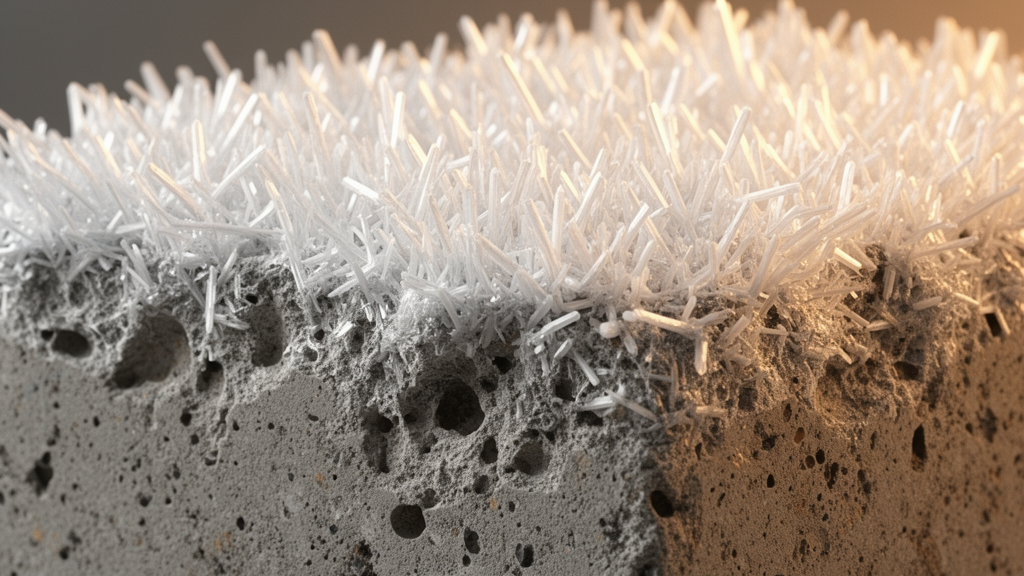
To overcome these microstructural limitations, researchers looked toward natural tooth enamel, which ranks as the hardest and stiffest biological tissue known, exhibiting an elastic modulus spanning 62 to 108 gigapascals. Biological enamel derives its remarkable rigidity not merely from its chemical composition—roughly 96 percent hydroxyapatite nanocrystals by mass, alongside 3 percent organic matter and 1 percent water—but from the dense, highly organized alignment of hydroxyapatite nanorods bundled into structural prisms. The research team hypothesized that by engineering an artificial, oriented hydroxyapatite coating directly over recycled coarse aggregates using an organic template, the compliant legacy mortar could be effectively replaced by a high-modulus mineral phase. Earlier explorations into calcium phosphate mineralization in cement systems frequently yielded disordered, loosely connected precipitates that failed to restore bulk modulus because uncontrolled local supersaturation and inadequate nucleation guidance generated discrete, fragile clusters rather than a continuous, compact mineral shell. Implementing a reaction-regulated aqueous system provided the controlled environment required to assemble a coherent, enamel-mimetic reinforcement layer.
The chemical assembly protocol utilized analytical-grade calcium nitrate tetrahydrate and sodium dihydrogen phosphate dissolved in water to generate a reactive mineralization suspension maintained at a stoichiometric calcium-to-phosphorus molar ratio of 1.67. Sodium dodecyl sulfate was incorporated at a concentration of 500 milligrams per liter to serve as an organic surfactant template, guiding the nucleation and directional growth of hydroxyapatite crystals, while sodium hydroxide adjusted the system pH to an alkaline regime between 10 and 11. Recycled coarse aggregates with particle sizes ranging from 4.75 to 20 millimeters were initially immersed in a 0.5 mole per liter calcium nitrate solution for two hours to preload aggregate surfaces with calcium ions, followed by air-drying. The conditioned aggregates were subsequently submerged into the freshly prepared mineralization suspension under controlled thermal regimes, comparing ambient baseline curing at 20 degrees Celsius against mild thermal activation at 60 degrees Celsius for 24 hours, alongside accelerated kinetic trials at 100 degrees Celsius for 3 and 24 hours.
Following surface mineralization, the treated aggregates were washed, dried to constant mass, and incorporated into C40 design grade concrete mixtures prepared in accordance with standard civil engineering specifications. The concrete formulations integrated ordinary Portland cement of grade 42.5, class I fly ash, natural sand aggregate measuring 0 to 4.75 millimeters, and a polycarboxylate ether superplasticizer dosed at 0.3 percent of the total binder mass. Mixing water was strictly calibrated based on aggregate absorption measurements to maintain an effective water-to-binder ratio of 0.42 across all mixtures. Cubic concrete specimens measuring 100 millimeters were cast, demolded after 24 hours, and cured in a standard moist environment at 20 degrees Celsius and relative humidity exceeding 95 percent until testing at 7 and 28 days. Static elastic modulus was determined through compressive loading at a steady rate of 0.6 megapascals per second using twin 50-millimeter strain gauges affixed to opposing specimen faces, calculating the secant slope between 0.5 megapascals and one-third of peak compressive strength.
Mechanical testing demonstrated that the biomimetic surface treatment restored elastic stiffness far more dramatically than it enhanced compressive resistance, underscoring the acute sensitivity of elastic modulus to interfacial engineering. Untreated control concrete exhibited static elastic moduli of approximately 21.0 gigapascals at 7 days and 24.2 gigapascals at 28 days, whereas mineralized aggregate concretes achieved elevated values of 22.3 to 25.3 gigapascals at 7 days and 26.0 to 28.4 gigapascals at 28 days. Concrete containing aggregates treated at 60 degrees Celsius for 24 hours achieved the maximum recovery, recording a 20.5 percent modulus increase at 7 days and a 17.4 percent increase at 28 days. By comparison, compressive strength of the untreated concrete rose from 30.0 megapascals at 7 days to 38.0 megapascals at 28 days, while the optimal mineralized mixture reached 33.1 megapascals at 7 days and 43.7 megapascals at 28 days, reflecting more modest relative gains of 9.7 and 14.9 percent.
Evaluation of axial stress-strain curves revealed that biomimetic mineralization transformed the overall constitutive behavior of recycled concrete from a deformable, defect-controlled deformation mode into a rigid, load-bearing response. Under compressive loading, all specimens followed a three-stage progression comprising a quasi-linear elastic stage, a nonlinear ascending branch, and post-peak softening, yet mineralized concrete displayed markedly steeper ascending branches, narrower peak regions, and steeper post-peak descending slopes. Concrete incorporating aggregate mineralized at 60 degrees Celsius for 24 hours demonstrated the most compact mechanical response, yielding the lowest absolute 28-day peak strain of 0.00168. Extended curing between 7 and 28 days induced a concurrent upward and leftward shift in stress-strain profiles, with peak strain decreasing by 19.44 percent in concrete with aggregates treated at 100 degrees Celsius for 24 hours compared to a 9.32 percent reduction in untreated control concrete, demonstrating that continued cement hydration progressively enhanced the mechanical compatibility between the mineralized aggregate shell and surrounding paste.
Water absorption evaluations over 96 hours provided clear evidence that in situ mineralization dramatically suppressed fluid transport by reconstructing the internal pore architecture. Untreated recycled aggregate concrete consistently exhibited the highest moisture uptake throughout testing, reaching a cumulative 96-hour absorption of 1.91 percent as capillary suction rapidly drew water through microcracks in the adhered mortar and porous interfacial zones. In contrast, all mineralized aggregate concretes exhibited reduced fluid uptake, led by the 60-degree, 24-hour treatment which lowered 96-hour water absorption to 1.17 percent, achieving a 38.7 percent reduction relative to the control. This transport resistance operates through a dual-barrier mechanism wherein intra-aggregate pores and microcracks are sealed by precipitating calcium phosphate minerals, while the continuous hydroxyapatite shell densifies the aggregate-paste boundary and substantially increases the tortuosity of moisture transport pathways. Excessively aggressive mineralization at 100 degrees Celsius produced higher water absorption of 1.36 percent, showing that overly rapid precipitation hindered effective pore blocking.
Microstructural characterization utilizing scanning electron microscopy combined with energy-dispersive X-ray spectroscopy illuminated the physical and chemical reconstruction occurring across the interfacial transition zone. In untreated concrete, the interface presented an obvious microstructural gap with an estimated transition zone width of roughly 60 micrometers, accompanied by sharp elemental fluctuations including severe depletion of calcium and oxygen alongside weak, inconsistent silicon and aluminum signals. Following mineralization at 60 degrees Celsius for 24 hours, the interfacial morphology densified into a tightly consolidated band, narrowing the interfacial transition zone width to approximately 30 to 40 micrometers. Elemental line scans across the modified interface revealed consistent intensities of calcium, oxygen, and phosphorus, marked by a distinct phosphorus peak concentrated within the transition boundary. The spatial overlap of these calcium-oxygen-phosphorus phases with silicon-containing cement hydration products confirmed that the biomimetic mineral layer achieved genuine chemical integration with the surrounding matrix rather than functioning as an unbonded superficial coating.
Three-dimensional X-ray computed tomography quantitatively tracked how mineral deposition reorganized internal phase distributions and multiscale pore networks within 40-millimeter cubic sections. Reconstructed scans revealed that biomimetic mineralization reduced bulk pore fractions from 4.4 percent in untreated concrete down to 2.5 to 3.1 percent, representing a total porosity reduction of 43.0 to 50.2 percent. Grayscale thresholding segmentation demonstrated that the apparent volume fraction of old adhered mortar fell from 33.1 percent in control specimens to 23.1 percent in the optimal 60-degree group, while the effective new mortar fraction expanded to 48.9 percent. This apparent shift reflected localized density gains, as heavy mineral infiltration increased the X-ray attenuation of the porous old mortar shell, causing it to register as dense matrix. Furthermore, equivalent pore diameter distributions showed that micropores between 0 and 50 micrometers expanded to 29.48 percent while harmful macroscopic pores exceeding 150 micrometers contracted to 9.76 percent, confirming that controlled mineralization eliminates stress concentrators and establishes durable stiffness recovery.
Subject of Research: Interfacial biomimetic mineralization for stiffness recovery in recycled aggregate concrete
Article Title: Elastic modulus recovery in concrete incorporating biomimetically mineralized recycled aggregates
Article References: Liu, H., Ma, T., Xiao, J., & Zhu, P. (2026). Elastic modulus recovery in concrete incorporating biomimetically mineralized recycled aggregates. Low-carbon Materials and Green Construction, 4(1), Article 18. https://doi.org/10.1007/s44242-026-00114-z
Image Credits: AI Generated
DOI: 10.1007/s44242-026-00114-z
Keywords: recycled aggregate concrete, elastic modulus recovery, biomimetic mineralization, hydroxyapatite coating, interfacial transition zone, recycled coarse aggregates, adhered mortar, compressive strength, X-ray computed tomography, scanning electron microscopy, pore structure refinement, static secant modulus, water absorption reduction, sodium dodecyl sulfate, axial stress-strain behavior, reaction kinetics, enamel-inspired materials, construction waste recycling
News Source: Neil Sanderson. (November 18, 2026). Biomimetic Hydroxyapatite Coating Restores Elastic Modulus in Recycled Aggregate Concrete. Scienmag.