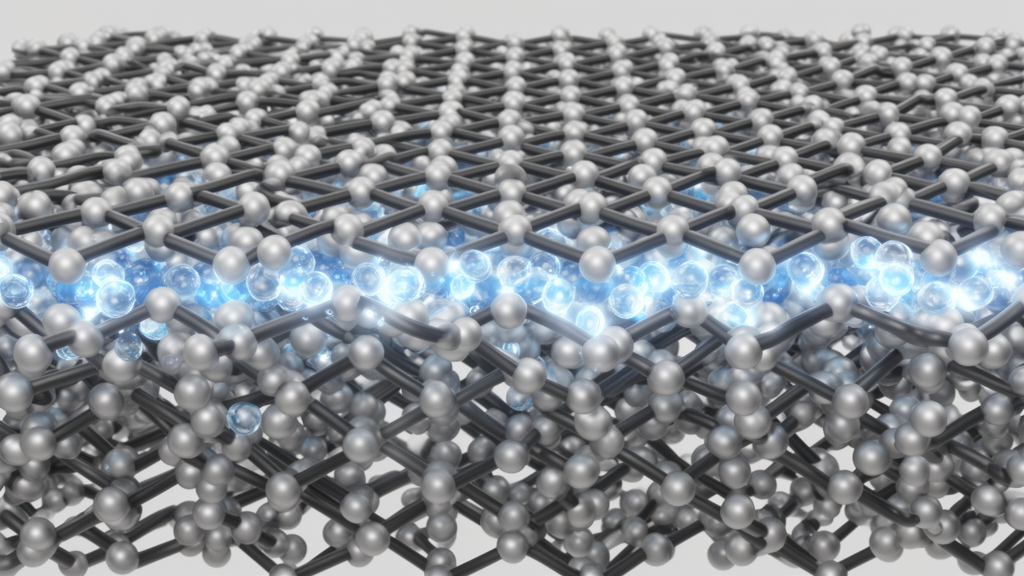
The global transition to sustainable energy systems has intensified the need for advanced materials that can efficiently convert and store power. Nanocomposite materials, which integrate multiple nanoscale constituents, are increasingly recognized for their ability to surpass the performance limits of single-component materials. These advanced materials combine complementary functions, such as electrical conductivity, catalytic activity, and structural stability, within a single architecture. A recent comprehensive review critically examines how composition, nanoscale organization, and interfacial engineering govern the performance of nanocomposites in technologies including solar cells, fuel cells, supercapacitors, and lithium-ion batteries. Rather than relying on simple combinations, effective design requires tailoring interfaces to specific rate-limiting processes, such as ion transport, electron conductivity, or surface-reaction kinetics.
In the field of photovoltaics, nanocomposites are being utilized to enhance power conversion efficiency by addressing challenges like charge-carrier recombination and inefficient light harvesting. For dye-sensitized solar cells, nanocomposite-based counter electrodes often incorporate conductive carbon networks to improve mass transport and electrocatalytic activity. Similarly, in perovskite solar cells, nanocomposites integrated into electron-transport layers help facilitate carrier extraction and passivate interfacial defects. These design strategies emphasize the importance of matching the material’s function with the specific device architecture, as performance improvements are often highly dependent on the particular electronic and optical limitations being addressed.
Fuel cell technologies face analogous constraints related to sluggish electrode kinetics, catalyst degradation, and mass-transport limitations. Nanocomposite design addresses these by engineering catalysts and membrane materials to extend electrochemically active surface areas and improve ionic transport. Ceramic fuel cells, for example, have benefited from the development of nanocomposites that regulate oxygen-ion transport through defect chemistry and specialized heterointerfaces. However, the performance of these materials depends on a careful balance between catalytic activity, noble-metal loading, and long-term durability. Maintaining these critical interfaces during prolonged high-temperature operation remains a significant challenge for translating laboratory-scale improvements into scalable, durable fuel-cell technologies.
Energy storage systems, particularly supercapacitors and lithium-ion batteries, utilize nanocomposites to resolve the persistent trade-off between energy density and power capability. Supercapacitors store charge through mechanisms like electric double-layer capacitance and surface Faradaic redox reactions, with nanocomposites providing the necessary balance of conductive networks and redox-active sites. The integration of conducting polymers with carbon-based frameworks allows for efficient charge storage and rapid ion diffusion, significantly improving performance at high current densities. By tailoring hierarchical porosity and interfacial interactions, researchers have demonstrated that nanocomposite electrodes can achieve higher capacitance and stability than their individual constituents. These systems are increasingly moving toward binder-free architectures that maximize the utilization of electroactive materials.
For lithium-ion batteries, silicon-based nanocomposites have emerged as high-capacity anode candidates, yet their practical application is limited by the massive volume changes during cycling that lead to particle fracture and solid-electrolyte interphase instability. To mitigate this, graphene-based frameworks are being employed to provide mechanical buffering and maintain electrical connectivity while accommodating volume expansion. These frameworks, such as graphene-wrapped silicon structures, not only prevent structural degradation but also promote the formation of more stable, lithium-fluoride-rich interphases, which reduce irreversible capacity loss. While these strategies successfully extend cycle life, the ultimate feasibility of such materials depends on achieving a balance between high specific capacity and the ability to maintain consistent areal capacity over extended operational periods.
Synthesis methods for these materials are as diverse as the applications, ranging from physical approaches like ball milling to chemical strategies including hydrothermal and in-situ polymerization techniques. While physical methods are generally scalable, they may introduce structural defects or contamination. Chemical approaches offer superior control over morphology and interfacial characteristics, enabling the creation of precise, multifunctional architectures. However, the complexity of these synthesis routes often introduces challenges related to reproducibility, scalability, and environmental impact. Green synthesis approaches that utilize bio-derived reagents and benign solvents represent an emerging field of study, although such methods must be rigorously validated to ensure they can produce high-performance materials for demanding electrochemical applications.
The environmental and economic viability of these technologies requires a transition from focusing solely on peak laboratory performance to considering full-device lifecycle sustainability. A comprehensive evaluation of nanocomposite materials necessitates the assessment of precursor sourcing, processing intensity, and end-of-life recovery of active components, including transition and noble metals. Current recycling strategies, such as hydrometallurgical processing, demonstrate potential for high recovery rates, yet they must be integrated with scalable manufacturing processes. Emerging lifecycle assessment studies emphasize that high gravimetric capacity or power density should not be the sole metrics for success; rather, factors like manufacturing complexity, material cost, and environmental footprint must be central to material design.
Moving forward, the research roadmap for nanocomposite energy technologies prioritizes the integration of predictive design tools and standardized testing protocols. Machine learning and artificial intelligence are expected to accelerate the discovery of optimal architectures by enabling rapid screening and property prediction. Furthermore, testing these materials under practically relevant conditions—including extended cycling, high current densities, and real-world temperature fluctuations—is essential for identifying which candidates can successfully transition from controlled laboratory demonstrations to industrial implementation. Bridging this gap will require consistent, standardized reporting of both electrochemical metrics and lifecycle indicators, ensuring that next-generation nanocomposites are not only efficient but also durable and sustainable.
In conclusion, the development of nanocomposite materials provides a powerful, versatile framework for advancing energy conversion and storage technologies. By engineering interfaces and hierarchical architectures, researchers can harness synergistic effects to overcome inherent limitations in individual material classes. However, the continued maturation of this field depends on addressing significant challenges in scalability, structural durability, and economic feasibility. Future efforts will need to focus on establishing robust, mechanism-driven design principles that account for both electrochemical performance and practical integration. Through a multifaceted approach that combines advanced synthesis, realistic testing, and sustainable engineering, nanocomposite-based systems will play a critical role in realizing the transition to high-performance, long-lasting, and carbon-neutral energy solutions.
Bibliographic tracking from the OpenAlex database illustrates the accelerating momentum behind these systems, with annual research publications on nanocomposites for energy storage climbing from 246 in 2016 to 1,428 in 2025, while energy conversion studies grew from 200 to 644 over the same decade. In perovskite solar cells, incorporating MXene and cobalt sulfide into a tin oxide electron transport layer elevated power conversion efficiency from 13.81 percent to 17.69 percent, generating a short-circuit current density of 20.74 milliamperes per square centimeter. For dye-sensitized devices, combining tungsten disulfide with niobium pentoxide produced an efficiency of 5.92 percent, surpassing isolated tungsten disulfide at 4.22 percent. In ceramic fuel cells, spray-pyrolyzed lanthanum strontium manganese oxide and praseodymium oxide cathodes achieved a polarization resistance of 0.21 ohm square centimeters at 650 degrees Celsius and a peak power density of 1.22 watts per square centimeter at 800 degrees Celsius by extending active triple-phase boundary regions.
Electrochemical testing of supercapacitor electrodes highlights how conductive supports amplify charge storage and kinetic reversibility. A polypyrrole and iron-cobalt sulfide composite grown directly on nickel foam delivered a specific capacitance of 3,178 farads per gram at two amperes per gram in potassium hydroxide, retaining 97.5 percent capacitance after 2,500 cycles. Solvothermal graphene and tungsten oxide nanowire composites achieved 465 farads per gram at one ampere per gram with 97.7 percent retention over 2,000 cycles in sulfuric acid. Pyrolysis of graphene oxide with coordination polymers yielded porous nitrogen-doped carbon composites containing copper, iron, and zinc that exhibited capacitances of 369, 298.5, and 309.5 farads per gram at 0.5 amperes per gram. These figures substantially outperformed counterpart structures lacking graphene, which yielded 147.2, 270.1, and 271.0 farads per gram, demonstrating that integrated carbon matrices reduce charge transfer resistance.
In lithium-ion battery research, coupling layered or alloying active phases with conductive carbon frameworks provides quantitative improvements in rate capability and structural endurance. Layered vanadium disulfide integrated with graphene nanosheets maintained a discharge capacity of 114.2 milliampere-hours per gram at a current rate of 20 C, outpacing pristine vanadium disulfide at 90 milliampere-hours per gram. For silicon anodes, self-assembled reduced graphene oxide and silicon composites yielded a reversible capacity of 2,317 milliampere-hours per gram with an initial Coulombic efficiency of 93.2 percent and 85 percent retention after 100 cycles at 0.1 amperes per gram. Furthermore, core-shell configurations of graphene-wrapped silicon restricted electrode volume expansion to 112 percent compared to 265 percent for unbuffered silicon, retaining 72.5 percent capacity after 150 cycles while suppressing electrolyte degradation through the formation of a stable, lithium-fluoride-rich interphase.
Technological maturity assessments reveal that nanocomposite deployment follows distinct commercial readiness tiers. Carbon-based formulations have reached readiness levels eight and nine, delivering electrical conductivities near 1,000 siemens per meter in commercial batteries and capacitances of 150 to 300 farads per gram in carbon nanotube capacitors. Intermediate materials at readiness levels six through eight, including graphene-silicon anodes offering capacities of 1,500 to 3,000 milliampere-hours per gram, represent near-term industrial prospects.
Subject of Research: Design and performance of nanocomposite materials for energy conversion and storage applications.
Article Title: Review: design, function, and translation of next-generation nanocomposite materials for energy conversion and storage applications
Article References: Kalimuthu, P., Anushya, G., Mariyappan, V., Veerakumar, P., Alam, M. M., Ramachandran, R., & Muthusamy, K. (2026). Review: design, function, and translation of next-generation nanocomposite materials for energy conversion and storage applications. Journal of Materials Science: Composites, 7(1), Article 24. https://doi.org/10.1186/s42252-026-00111-2
Image Credits: AI Generated
DOI: 10.1186/s42252-026-00111-2
Keywords: nanocomposites, energy-storage, energy-conversion, photovoltaics, supercapacitors, lithium-ion-batteries, fuel-cells, interface-engineering, heterostructures, electrochemical-kinetics, structural-stability, scalable-manufacturing, lifecycle-assessment, green-synthesis, energy-sustainability, charge-transport, material-design
News Source: Denise Maddox. (November 17, 2026). Nanocomposite Architecture Design Critical for High-Performance Energy Conversion and Storage. Scienmag.