A newly developed nitrogen-doped hard carbon material derived from waste macadamia nut shells achieved a high reversible capacity of 321.8 milliampere-hours per gram and a first-cycle initial Coulombic efficiency of 92.3 percent in sodium-ion battery testing. Designated as HCN-50:1, the biomass-derived anode material demonstrated notable electrochemical capability when evaluated at a current density of 0.02 amperes per gram. The reported performance directly tackles several operational difficulties that have constrained conventional host anodes in sodium energy storage configurations.
Beyond its initial electrochemical efficiency, the synthesized material sustained robust charge delivery under accelerated discharge rates and prolonged cycling conditions. When tested at an elevated current density of 1 ampere per gram, the hard carbon electrode maintained a reversible capacity of 146.7 milliampere-hours per gram, demonstrating superior rate performance. Furthermore, long-term durability assessments revealed that the electrode retained over 90 percent of its capacity after 500 operational cycles, indicating high cycling stability during continuous cell usage.
The research team synthesized the HCN-50:1 material from agricultural waste macadamia nut shells using an integrated two-part preparation strategy. Their method combined biomass pretreatment alongside metal-assisted crosslinking to accomplish effective nitrogen incorporation across the carbon precursor. Material analyses confirmed that this combined processing generated an engineered carbon network featuring an appropriate nitrogen content, a well-developed internal pore architecture, and expanded interlayer spacing tailored to facilitate transport.
To clarify the internal electrochemical dynamics governing sodium ion uptake, the authors examined the underlying storage mechanism using in situ Raman spectroscopy coupled with colorimetric analysis. These operando spectroscopic evaluations identified the active storage behavior as a hybrid process involving adsorption, intercalation, and pore-filling. By directly monitoring changes within the electrode structure, the researchers tracked how the tailored carbon matrix safely hosts sodium ions across different charge stages.
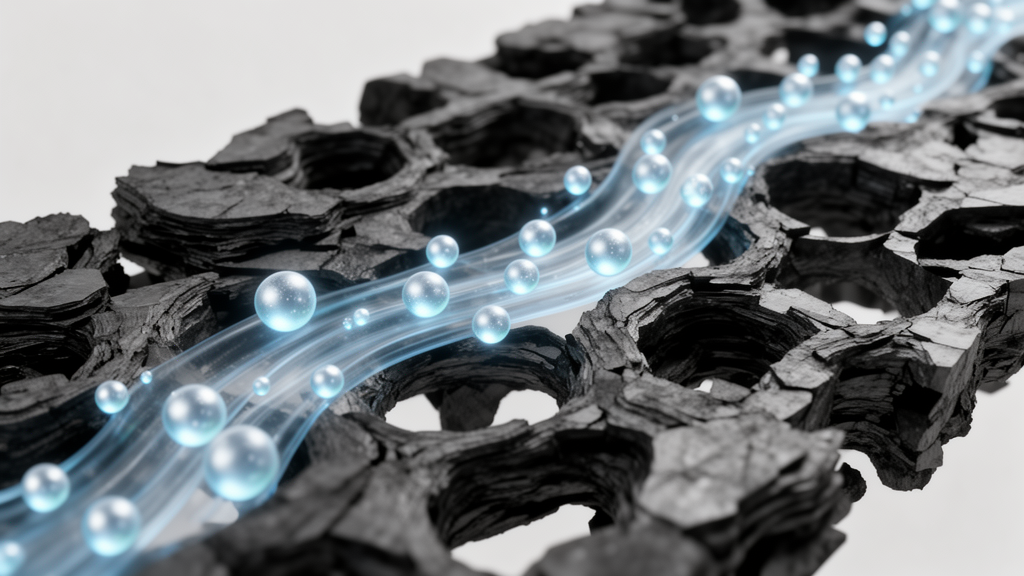
This study addresses an urgent broader challenge within renewable energy infrastructure, where affordable and efficient energy storage systems are essential for achieving carbon neutrality. Sodium-ion batteries have attracted substantial interest as candidates for large-scale energy storage networks because sodium is naturally abundant, inexpensive, and shares fundamental electrochemical properties with lithium-ion batteries. However, the larger ionic radius of sodium ions causes sluggish diffusion kinetics and pronounced volume variations inside host materials, severely constraining the practical use of conventional battery anodes.
Hard carbon remains a commercially viable anode choice for sodium-ion batteries due to its disordered internal structure, ample interlayer spacing, and tunable microstructural characteristics. Nevertheless, conventional hard carbon anodes frequently suffer from low initial Coulombic efficiency, inadequate rate capability, and poor cycling durability. The authors note that the performance demonstrated by macadamia shell-derived hard carbon provides new insights and highlights a feasible pathway for engineering high-performance biomass-derived anodes for future sodium-ion storage applications.
Subject of Research: Biomass-derived hard carbon anodes for sodium-ion batteries
Article Title: Macadamia nut shell-derived nitrogen-doped hard carbon: boosting cycling stability and rate capability of sodium-ion batteries
Article References: Ji, S., Guo, Y., Zhang, Y., Zhu, Z., Liu, G., Ding, K., & Zeng, X. (2026). Macadamia nut shell-derived nitrogen-doped hard carbon: boosting cycling stability and rate capability of sodium-ion batteries. Ionics. https://doi.org/10.1007/s11581-026-07566-0
Image Credits: AI Generated
DOI: 10.1007/s11581-026-07566-0
Keywords: sodium-ion batteries, hard carbon, biomass anode, macadamia nut shells, nitrogen doping, initial Coulombic efficiency, cycling stability, rate capability, biomass pretreatment, metal-assisted crosslinking, in situ Raman spectroscopy, colorimetric analysis, pore filling, interlayer spacing, energy storage systems, diffusion kinetics, reversible capacity
News Source: Faith Mcneil. (November 17, 2026). Macadamia Shell Hard Carbon Anode Boosts Sodium Battery Cycling and Efficiency. Scienmag.