• HOME
  • NEWS
  • EXPLORE
    • CAREER
      • Companies
      • Jobs
    • EVENTS
    • iGEM
      • News
      • Team
    • PHOTOS
    • VIDEO
    • WIKI
  • BLOG
  • COMMUNITY
    • FACEBOOK
    • INSTAGRAM
    • TWITTER
Wednesday, November 18, 2026
BIOENGINEER.ORG
No Result
View All Result
  • Login
  • HOME
  • NEWS
  • EXPLORE
    • CAREER
      • Companies
      • Jobs
        • Lecturer
        • PhD Studentship
        • Postdoc
        • Research Assistant
    • EVENTS
    • iGEM
      • News
      • Team
    • PHOTOS
    • VIDEO
    • WIKI
  • BLOG
  • COMMUNITY
    • FACEBOOK
    • INSTAGRAM
    • TWITTER
No Result
View All Result
Bioengineer.org
No Result
View All Result
Home NEWS Science News Technology

Hatch Distance Control Produces Strong Ultralow Modulus Titanium Alloy for Bioimplants

by
November 17, 2026
in Technology
Reading Time: 2 mins read
0
Hatch Distance Control Produces Strong Ultralow Modulus Titanium Alloy for Bioimplants

Hatch Distance Control Produces Strong Ultralow Modulus Titanium Alloy for Bioimplants

Share on FacebookShare on TwitterShare on LinkedinShare on RedditShare on Telegram

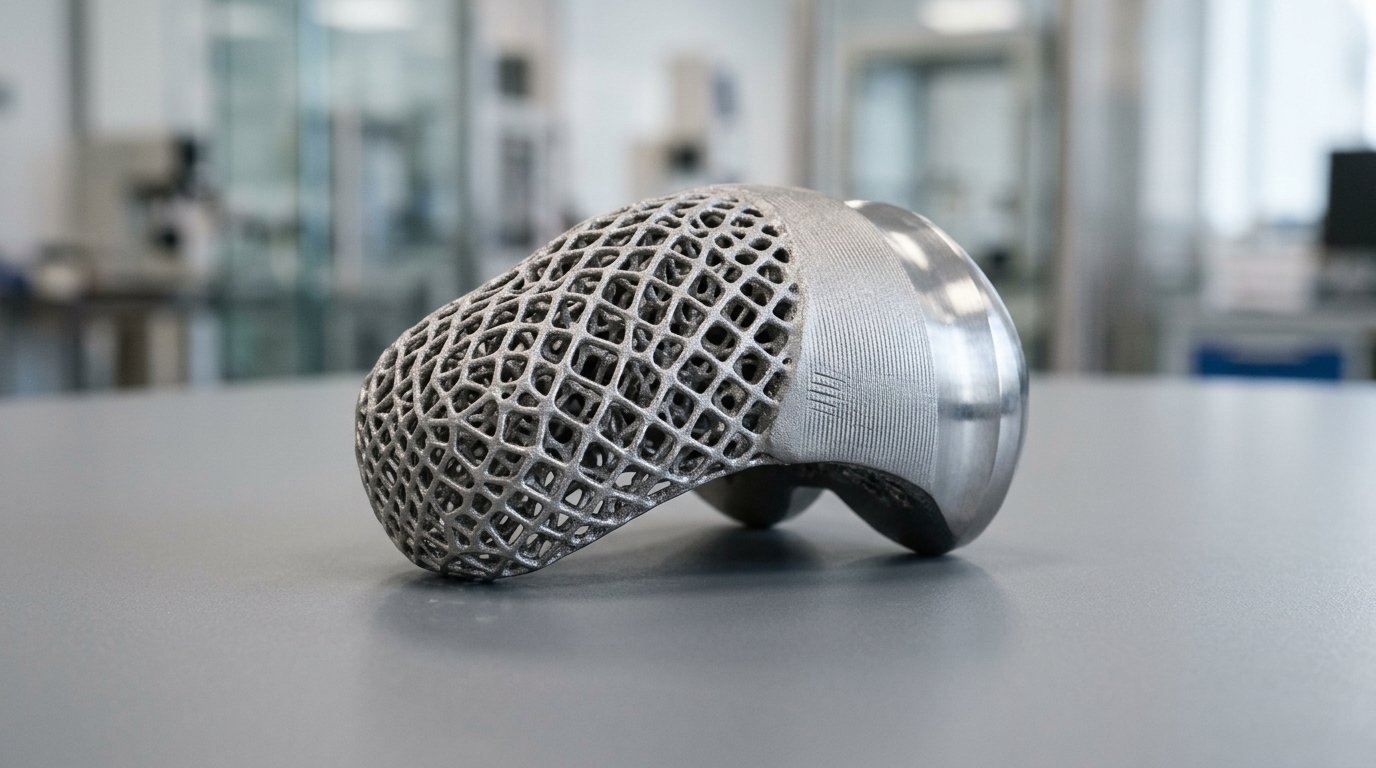
Manipulating the hatch distance during laser powder bed fusion additive manufacturing of a Ti-25Nb atomic percent alloy simultaneously achieves a low Young’s modulus of 32 GPa and a high ultimate tensile strength of 813 MPa. Published in npj Advanced Manufacturing by Abayomi A. Akinwande and colleagues, the study demonstrates that precise scan strategy control directly governs mechanical performance in beta-titanium systems, providing a targeted method to tailor elastic modulus and strength without changing the underlying chemical composition of the alloy.

The researchers found that implementing a small hatch distance of 10 μm fundamentally alters the thermal behavior and internal architecture of the laser powder bed fusion build. This specific scan spacing completely eliminates melt-pool centerline walls within the material. Furthermore, the 10 μm hatch distance redirects epitaxial solidification during the printing process, shifting crystal growth from a standard bottom-to-top trajectory into a side-to-side growth orientation across the melt tracks.

This redirected solidification produces a distinct hierarchical ladder-like microstructure throughout the additively manufactured Ti-25Nb alloy. Detailed examination reveals that this ladder-like structural configuration contains densely distributed melt-pool boundaries alongside cellular boundaries. At the same time, this controlled laser powder bed fusion processing imparts a strong {101}β crystallographic texture to the body-centered cubic beta matrix, creating a highly organized boundary network across the printed component.

Mechanistically, the hierarchical ladder-like microstructure suppresses long-range β to α″ martensitic transformation by enforcing a nanodomain-mediated transformation pathway under applied stress. By restricting martensitic transformation to localized nanodomains, the material retains high structural strength while exhibiting compliant elastic behavior. Consequently, the authors conclude that hatch-distance-controlled microstructure engineering establishes a viable, composition-independent processing route for the production of ultralow-modulus beta-titanium bioimplants.

Subject of Research: Additive manufacturing of ultralow-modulus titanium alloys for bioimplants

Article Title: Ultra-low modulus, high-strength β-Ti alloy with ladder-like microstructure through scan strategy control in laser powder bed additive manufacturing

Article References: Akinwande, A. A., Lin, W., Biswas, P., Heinrich, H., & Ma, J. (2026). Ultra-low modulus, high-strength β-Ti alloy with ladder-like microstructure through scan strategy control in laser powder bed additive manufacturing. npj Advanced Manufacturing. https://doi.org/10.1038/s44334-026-00120-w

Image Credits: AI Generated

DOI: 10.1038/s44334-026-00120-w

Keywords: laser powder bed fusion, additive manufacturing, Ti-25Nb alloy, titanium alloys, beta-titanium, hatch distance, scan strategy, Young's modulus, ultimate tensile strength, ladder-like microstructure, epitaxial solidification, melt-pool boundaries, cellular boundaries, {101}β texture, martensitic transformation, nanodomain-mediated transformation, bioimplants, microstructure engineering

News Source: Denise Maddox. (November 17, 2026). Hatch Distance Control Produces Strong Ultralow Modulus Titanium Alloy for Bioimplants. Scienmag.


Tags: Additive Manufacturingbeta titaniumbioimplantscellular boundariesepitaxial solidificationhatch distanceladder-like microstructurelaser powder bed fusionmartensitic transformationmelt-pool boundariesmicrostructure engineeringnanodomain-mediated transformationscan strategyTi-25Nb alloytitanium alloysultimate tensile strengthYoung's modulus{101}β texture
Share12Tweet7Share2ShareShareShare1

Related Posts

Optimized Gradient Boosting Models Predict Concrete Compressive Strength with High Accuracy

Optimized Gradient Boosting Models Predict Concrete Compressive Strength with High Accuracy

November 18, 2026
Review of Sixty Studies Traces Hadoop Shift Toward Sustainable Cloud-Native Analytics

Review of Sixty Studies Traces Hadoop Shift Toward Sustainable Cloud-Native Analytics

November 18, 2026

Multimodal Security Framework Pairs Brainwave Authentication With Keystroke Dynamics Under Risk

November 18, 2026

Vacuum Dewatering and Preloading Form Shallow Hard-Shell Layer on Dredged Silt

November 18, 2026

POPULAR NEWS

  • Nurse-Led Interventions Ease Cancer Distress but Personalization Trials Are Needed

    Nurse-Led Interventions Ease Cancer Distress but Personalization Trials Are Needed

    29 shares
    Share 12 Tweet 7
  • Analysis of 1.2 Million Patients Finds 7.6 Percent Surgical Complication Rate

    29 shares
    Share 12 Tweet 7
  • Alcohol Weakens Anti-PD-1 Cancer Immunotherapy in Mice, Study Finds

    29 shares
    Share 12 Tweet 7
  • Presurgical Axitinib and Immunotherapy Linked to Shorter Kidney Cancer Thrombus Surgery

    29 shares
    Share 12 Tweet 7

About

We bring you the latest biotechnology news from best research centers and universities around the world. Check our website.

Follow us

Recent News

Basophil Activation Tests Suggest Possible IgE Pathway in Protamine Anaphylaxis Case

Optimized Gradient Boosting Models Predict Concrete Compressive Strength with High Accuracy

Review of Sixty Studies Traces Hadoop Shift Toward Sustainable Cloud-Native Analytics

Subscribe to Blog via Email

Enter your email address to subscribe to this blog and receive notifications of new posts by email.

Join 88 other subscribers
  • Contact Us

Bioengineer.org © Copyright 2023 All Rights Reserved.

Welcome Back!

Login to your account below

Forgotten Password?

Retrieve your password

Please enter your username or email address to reset your password.

Log In
No Result
View All Result
  • Homepages
    • Home Page 1
    • Home Page 2
  • News
  • National
  • Business
  • Health
  • Lifestyle
  • Science

Bioengineer.org © Copyright 2023 All Rights Reserved.