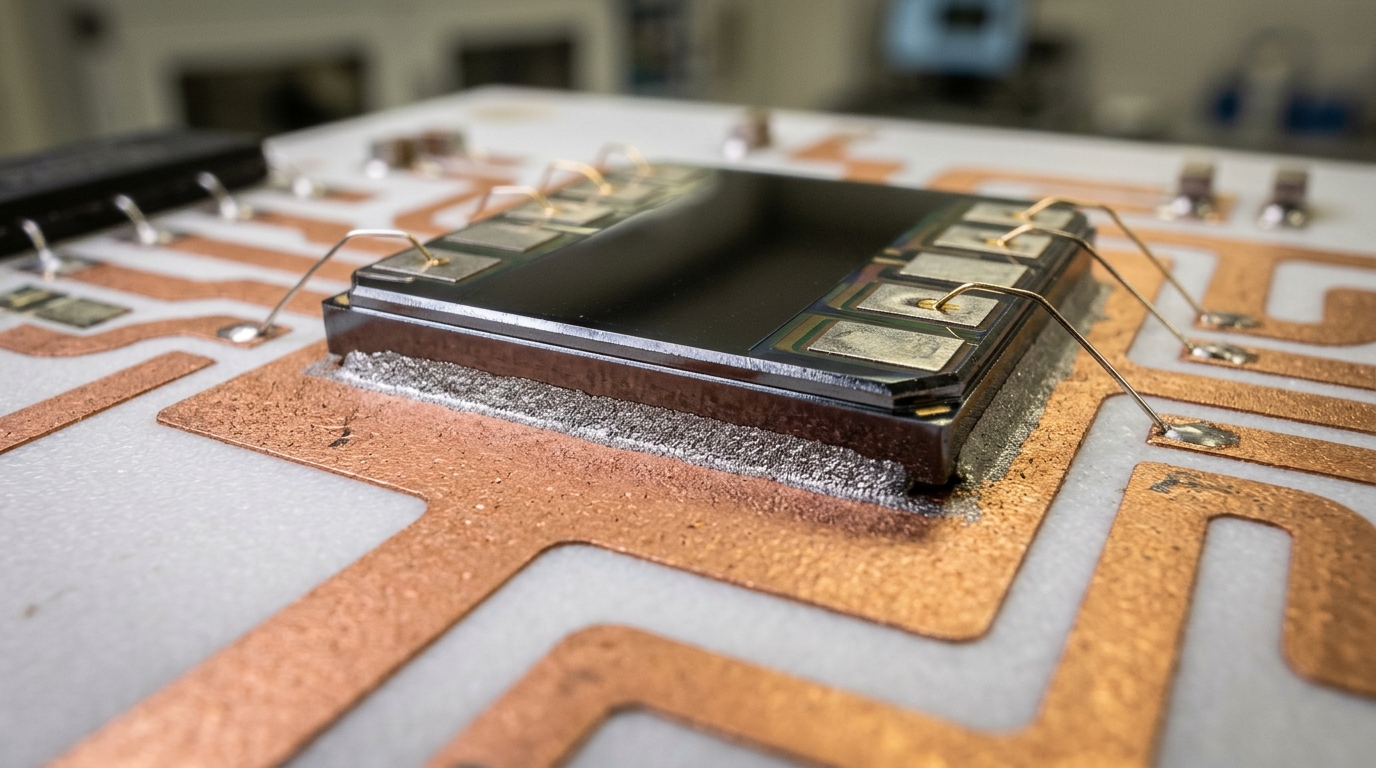
Researchers have developed an advanced bonding technique for semiconductor power devices that addresses the limitations of conventional solid-liquid interdiffusion (SLID) processes. By integrating microwave hybrid heating (MHH) with nano-silver (Ag) reinforcement, the study demonstrates a significant improvement in the formation of intermetallic compounds (IMCs) within copper/indium-silver/copper (Cu/In-Ag/Cu) joints. This approach offers a potential solution for creating high-temperature-stable die-attach interconnects, which are critical for the reliability of third-generation semiconductor power technologies.
Conventional SLID bonding typically requires prolonged isothermal holding times to achieve the complete conversion of solder into stable intermetallic compounds. To overcome this, the research team employed MHH combined with nano-silver particles to accelerate the reaction kinetics. In this configuration, a bulk silicon carbide (SiC) susceptor was used to facilitate energy transfer, proposing that molten indium absorbs microwave energy directly. This creates a volumetric heating effect that effectively promotes the rapid growth of the intermetallic layer at significantly reduced processing times compared to traditional methods.
The experimental setup involved investigating the influence of silver content, ranging from 10 to 40 weight percent, on the bonding performance. Kinetic analysis of the process revealed that the growth of Cu11In9 shifted from a bulk-diffusion mechanism to a grain-boundary-diffusion mechanism as the bonding temperature increased between 170 °C and 250 °C. The researchers identified 30 weight percent nano-Ag as the optimal concentration for achieving the desired joint characteristics. Compared to conventional micro-sized silver particles, the nano-Ag displayed superior uniformity during dissolution, facilitating the creation of dense full-IMC joints that were effectively free of residual indium and large voids after 120 minutes of processing at 250 °C.
Mechanical testing of the joints showed that the optimized configuration yielded a shear strength of 28.05 MPa. This result represents a more than four-fold improvement over the shear strength of 6.02 MPa observed in Ag-free joints. The study also highlighted the sensitivity of the bonding quality to silver concentration, noting that lower silver contents resulted in incomplete conversion of the intermetallic phases. Conversely, increasing the silver content to 40 weight percent led to coalescing porosity within the joint, which served to limit the overall shear strength to approximately 11.3 MPa.
Beyond initial mechanical strength, the researchers examined the microstructural stability of the joints, particularly under conditions related to electromigration. Observations indicated that the formation of the (Ag, Cu)In2 phase played a crucial role in suppressing copper transport within the joint structure. This phase contributed to enhanced microstructural stability compared to that found in Ag-free joints, which are generally more susceptible to degradation under operational stressors.
Long-term reliability was assessed through aging tests conducted at a constant temperature of 280 °C. During these tests, the shear strength of the optimized joint was monitored over 675 hours. The results showed a gradual decrease in strength, ultimately reaching 4.17 MPa after the full duration of the aging period. The study attributes this sustained performance to the presence of Ag-containing intermetallic compounds, which helped delay void growth and structural degradation that typically accompany prolonged thermal exposure.
The combined strategy of utilizing MHH and nano-Ag reinforcement proves to be an effective approach for promoting the formation of full intermetallic joints. By improving joint uniformity and mechanical performance, this method offers a viable pathway for the high-temperature packaging of third-generation semiconductor power devices. The study highlights the potential for refined bonding techniques to extend the lifespan and reliability of power electronics under demanding thermal conditions.
Subject of Research: Advanced solid-liquid interdiffusion bonding for semiconductor power device packaging.
Article Title: Microwave hybrid heating assisted solid-liquid interdiffusion bonding of Cu/In-Ag/Cu joints: intermetallic growth, mechanical properties, and reliability
Article References: Zhang, S., Mehmood, S., Chu, Y., Zhang, S., & Ma, J. (2026). Microwave hybrid heating assisted solid-liquid interdiffusion bonding of Cu/In-Ag/Cu joints: intermetallic growth, mechanical properties, and reliability. Journal of Materials Science: Materials in Engineering. https://doi.org/10.1186/s40712-026-00643-2
Image Credits: AI Generated
DOI: 10.1186/s40712-026-00643-2
Keywords: Microwave hybrid heating, Solid-liquid interdiffusion, Power semiconductors, Intermetallic compounds, Nano-silver reinforcement, Cu/In-Ag/Cu joints, High-temperature packaging, Semiconductor manufacturing, Mechanical shear strength, Microstructural stability, Electromigration, SiC susceptor, Joint reliability, Thermal aging, Interfacial engineering
News Source: Denise Maddox. (November 17, 2026). Microwave Heating and Nano-Silver Boost High-Temperature Semiconductor Power Device Bonding. Scienmag.