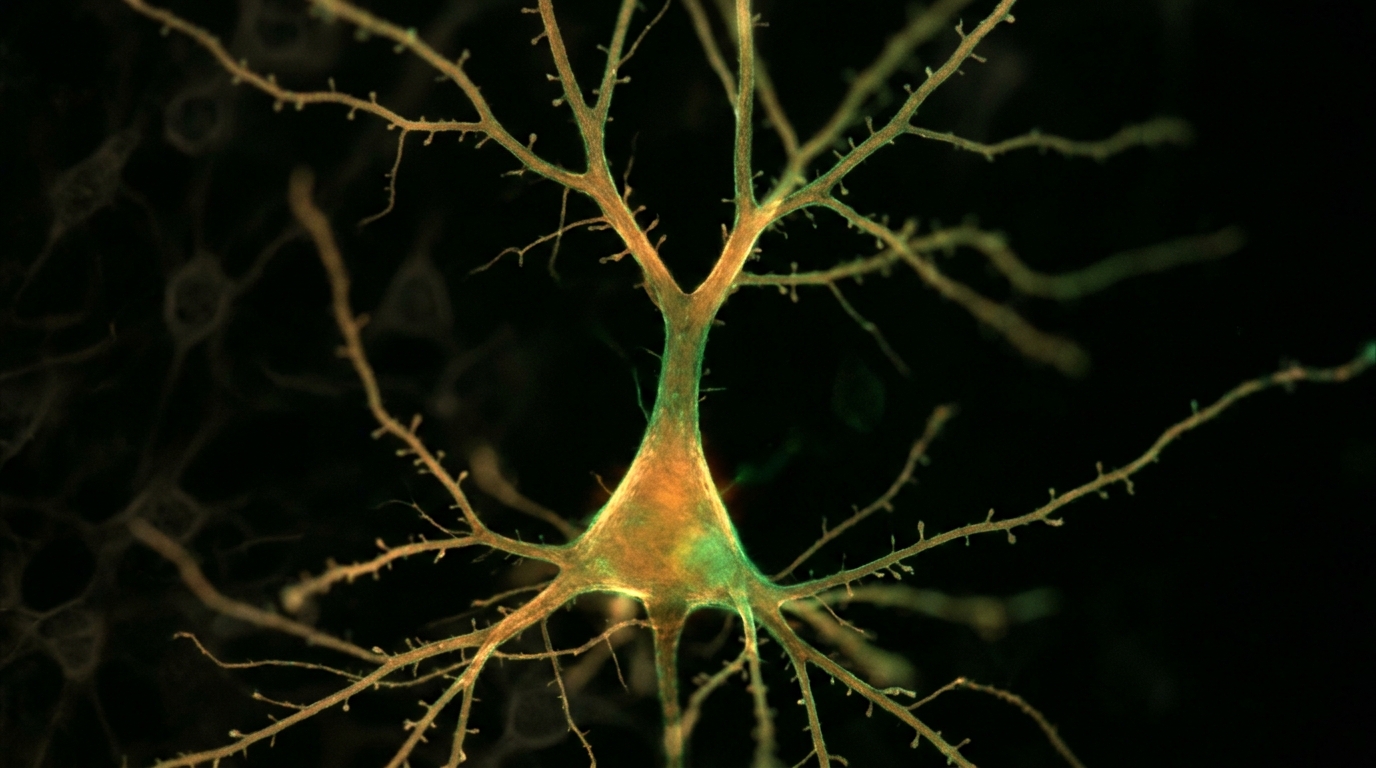
In computational models of human layer 2/3 pyramidal neurons, individual cells can perform complex exclusive-or logic operations through a mechanism termed dendritic depolarization block, according to a study published in PLOS Computational Biology by researchers Yanheng Li, Xiaojuan Sun, and Yunliang Zang. The exclusive-or, or XOR, operation has long served as a canonical benchmark of nonlinear processing capability because it is linearly non-separable and cannot be solved by passive dendritic integration or a single-layer perceptron. Conventionally, implementing such operations was assumed to require multi-layered networks of interconnected cells. Using biologically realistic multi-compartment simulations, the investigation demonstrates that the biophysical properties of voltage-gated calcium channels embedded in active dendrites enable a single neuron to generate spikes in response to moderate inputs along individual pathways while completely silencing output when those pathways are activated concurrently.
Dendrites collect synaptic inputs from thousands of afferents across elaborate arborizations, functioning as rich computational structures rather than passive conduits. In biological neural circuits, nonlinear dendritic events such as local sodium spikes, NMDA spikes, and dendritic calcium action potentials allow dendritic branches to process incoming electrical activity with exceptional spatial and temporal sensitivity. While prior investigations into dendritic processing focused largely on regenerative mechanisms that amplify synaptic responses, Gidon and colleagues previously identified a non-monotonic dendritic response in human layer 2/3 pyramidal neurons, demonstrating that an active dendritic calcium action potential mechanism could support an XOR paradigm. However, whether this non-monotonic relationship remains viable and robust under stochastic in vivo conditions, where synaptic inputs vary in timing and location, had remained unresolved.
To investigate the precise biophysical mechanisms mediating non-monotonic integration, the research team implemented detailed multi-compartment models of three reconstructed human layer 2/3 pyramidal neurons within the NEURON simulation environment version 8.2.6. The biophysical membrane properties were held constant across all three morphologies without morphology-specific tuning, incorporating an axial resistance of 100 ohm-centimeters, a specific membrane capacitance of 0.45 microfarads per square centimeter, and a membrane resistance of 37 kilohm-square centimeters. Somatic compartments contained standard Hodgkin-Huxley style sodium channels with a maximum conductance of 0.1 siemens per square centimeter and potassium channels with a maximum conductance of 0.15 siemens per square centimeter to govern somatic action potential initiation. Dendritic trees were examined in both passive configurations and active configurations incorporating the phenomenological dendritic calcium action potential mechanism, which featured an activation threshold of minus 36 millivolts and localized voltage-dependent scaling.
The researchers systematically evaluated synaptic transmission by modeling colocated excitatory AMPA and NMDA receptor mechanisms across dendritic trees. Synaptic conductances were governed by dual-exponential kinetics, with peak conductances parameterized at 0.73 nanosiemens for AMPA receptors and 1.31 nanosiemens for NMDA receptors, alongside rise and decay time constants constrained by empirical physiological recordings. The NMDA receptor formulation explicitly accounted for magnesium block through a voltage- and concentration-dependent gating factor with an extracellular magnesium concentration of 1 millimolar. Under passive dendritic conditions, dendritic integration of inputs driven solely by AMPA receptors was consistently sublinear across both dispersed and clustered arrangements due to reductions in electrical driving force. The incorporation of NMDA receptors transformed integration into a supralinear regime; however, colocated AMPA-mediated depolarization partially relieved the magnesium block, causing NMDA conductances to recruit more smoothly and attenuating the abrupt threshold transition observed with isolated NMDA conductances.
The study demonstrated that active dendritic conductances fundamentally reshape dendritic input-output transformations from monotonic summation to non-monotonic logic. Under passive dendritic conditions, increasing the number of active synapses produced a monotonic depolarization that eventually reached steady-state saturation. In contrast, incorporating voltage-gated calcium channels established a biphasic response profile. When synapses were activated asynchronously by independent Poisson processes, moderate synaptic drive triggered discrete dendritic calcium spikes. As the total synaptic drive intensified further, excessive excitatory conductance drove the local membrane potential into a sustained, high-voltage plateau. This persistent depolarization prevented the reactivation of calcium spikes by holding the dendritic membrane at an elevated level where subsequent events were initiated from more depolarized potentials, attenuating the voltage-dependent amplitude scaling factor K and shrinking inward calcium currents.
When assessed within a classical two-pathway paradigm, this depolarization block naturally executed an operational XOR-like computation. Two independent input pathways, designated X and Y, were deployed within the same dendritic compartment, each comprising identical numbers of synapses activated by independent Poisson spike trains at defined mean firing frequencies. Activating pathway X alone or pathway Y alone generated moderate depolarization that reliably triggered discrete dendritic calcium spikes. However, when both pathways were activated simultaneously, the combined excitatory conductance sustained an uninterrupted depolarizing plateau, locking the dendrite into depolarization block and abolishing all spike generation. This logical operation operated effectively whether synapses were composed of AMPA receptors alone, NMDA receptors alone, or physiologically realistic AMPA and NMDA receptor combinations, confirming that depolarization block provides a universal substrate for input suppression that does not depend on a specific synaptic receptor composition.
The operational success of single-neuron XOR computation was critically governed by the temporal structure of incoming synaptic activity rather than its spatial distribution across the dendritic tree. Simulations comparing clustered inputs restricted to a single branch against dispersed inputs distributed across an entire dendritic subtree revealed that dendritic depolarization block functioned reliably across both spatial configurations under Poisson-driven asynchronous activation. Conversely, when inputs were delivered synchronously at a single discrete time point, XOR computation failed entirely in both clustered and dispersed conditions. Under synchronous recruitment, synaptic currents produced only a transient membrane excursion before rapidly returning to resting baseline, failing to supply the continuous, sustained inward current required to maintain the prolonged plateau potential that defines depolarization block.
Simulations across diverse activation frequencies uncovered a computational trade-off between the mean firing rate per synapse and the total number of activated synapses required to trigger depolarization block. When inputs were driven at lower asynchronous frequencies, such as 10 hertz, a larger pool of active synapses was required to push the dendritic compartment into depolarization block. As the mean input frequency was elevated to 40 hertz, the number of synapses necessary to suppress spiking decreased substantially. For example, a synaptic complement of 140 synapses permitted active spiking output under 10 hertz stimulation but drove the dendrite directly into depolarization block under 40 hertz drive. This inverse relationship demonstrates that sparse inputs firing at high frequencies and dense inputs firing at lower frequencies are functionally equivalent in engaging depolarization block, establishing a flexible computational bandwidth for single-neuron logic.
To establish whether dendritic depolarization block could govern whole-cell signaling, the researchers evaluated whether local dendritic plateaus propagate to modulate somatic action potential output. In the simulated neurons, voltage-gated calcium channels were restricted exclusively to dendrites, while the soma contained only standard action potential-generating sodium and potassium conductances without local calcium channels or direct synaptic inputs. The simulations demonstrated that sustained dendritic depolarization block propagates electrotonically across the dendritic arbor via dendrite-soma cable coupling. At the soma, this electrotonic current clamped the somatic membrane potential at a stable high-voltage plateau, directly inducing somatic depolarization block by preventing the recovery of sodium channels from inactivation and silencing somatic spike generation. Consequently, activation of an individual pathway evoked somatic action potential trains, whereas concurrent pathway co-activation silenced somatic output, confirming that dendritic depolarization block provides an effective whole-cell output-limiting mechanism.
The authors validated the computational robustness and structural generality of the mechanism across distinct human neuron morphologies. Repeating the asynchronous Poisson stimulation protocols across 20 independent pseudorandom seeds at both 10 hertz and 40 hertz produced the complete XOR-like response pattern in 90 to 100 percent of trials, verifying that the logical operation is not an artifact of a specific random event train. Furthermore, identical active electrical parameters applied to two additional human layer 2/3 pyramidal neuron reconstructions yielded matching results: both cells exhibited reliable somatic XOR computation under asynchronous Poisson drive and experienced consistent logical failure under synchronous activation. These findings establish that dendritic depolarization block can overcome spatial attenuation across diverse dendritic branching patterns, operating as an intrinsic biophysical principle of neural computation that substantially expands the processing capabilities of individual cells beyond classical integrate-and-fire models.
Subject of Research: Single-neuron logical computation and dendritic depolarization block mechanisms
Article Title: Neuronal XOR computation requires temporally activated synaptic information
Article References: Li, Y., Sun, X., & Zang, Y. (2026). Neuronal XOR computation requires temporally activated synaptic information. PLOS Computational Biology, 22(11), e1014971. https://doi.org/10.1371/journal.pcbi.1014971
Image Credits: AI Generated
DOI: 10.1371/journal.pcbi.1014971
Keywords: computational neuroscience, dendritic integration, depolarization block, exclusive-or logic, human cortical neurons, pyramidal neurons, voltage-gated calcium channels, dendritic calcium action potentials, synaptic transmission, AMPA receptors, NMDA receptors, cable theory, dendrite-soma coupling, biophysical modeling, NEURON simulator, action potential generation, neural computation
News Source: Cassandra Pierce. (November 16, 2026). Single Human Neurons Execute Complex Logical Computations Through Dendritic Depolarization Block. Scienmag.