Osteoarthritis is increasingly recognized by biomedical researchers as a multifactorial whole-joint disorder driven by intricate biological networks rather than a passive wear-and-tear degradation of articular cartilage alone. In a comprehensive narrative review published in Molecular Biomedicine, investigators Kai Huang and Haili Cai synthesize evidence demonstrating that osteoarthritis pathogenesis arises from dynamic cross-talk among mechanical loading, cellular senescence, innate inflammation, and metabolic dysfunction across multiple articular tissues. A key conceptual framework evaluated in the work is lipid metabolic coding, which describes how chondrocytes, synoviocytes, and subchondral bone cells interpret lipid-derived substrates and stress signals in context-dependent manners to alter their cellular identity, organelle integrity, and inflammatory responses. The authors emphasize that articular joints represent complex physiological units wherein cartilage, synovium, subchondral bone, ligaments, and menisci interact continuously. The synthesis establishes that while mechanical overload and injury remain crucial initiating events, systemic and local metabolic disturbances actively reprogram tissue homeostasis, transforming what might otherwise be temporary adaptive repair responses into self-reinforcing, chronic joint pathology.
Epidemiological data highlighted in the review underscore an expanding worldwide burden characterized by prominent demographic and anatomical heterogeneity. According to the Global Burden of Disease Study 2021 cited by the authors, approximately 595 million individuals were living with osteoarthritis globally in 2020, representing 7.6 percent of the world population and marking a 132.2 percent surge in absolute case numbers since 1990. Among adults aged 30 years and older, approximately 14.8 percent are affected, illustrating that the condition causes significant disability during prime working years rather than exclusively in late senescence. Projections indicate that between 2020 and 2050, osteoarthritis cases will rise by 49 to 95 percent across various anatomical sites, with knee osteoarthritis remaining the single largest contributor and projected to exceed 600 million affected individuals globally. The demographic distribution exhibits distinct sex-specific patterns, with women comprising roughly 60 percent of all individuals living with the disease and frequently reporting greater pain and functional limitation compared to men displaying equivalent radiographic structural severity. Furthermore, while knee osteoarthritis predominates across most global regions, hand osteoarthritis accounts for a substantially higher proportion of total cases in certain areas, including Central Asia and Eastern Europe.
The whole-joint perspective of osteoarthritis emphasizes that tissue degradation extends across all anatomical compartments of the synovial joint. Healthy articular cartilage relies on chondrocytes to sustain an extracellular matrix composed predominantly of type II collagen and aggrecan, orchestrated by the master transcription factor SOX9. During osteoarthritic progression, chondrocytes undergo phenotypic alterations, losing anabolic matrix-preserving functions and acquiring prehypertrophic, hypertrophic, or inflammatory states characterized by upregulated RUNX2, COL10A1, and matrix metalloproteinases such as MMP13. Parallel to cartilage erosion, the synovial membrane experiences sustained low-grade infiltration by activated macrophages and fibroblast-like synoviocytes that secrete interleukin-1 beta, tumor necrosis factor alpha, and interleukin-6. This synovial inflammation generates catabolic mediators that diffuse through the synovial fluid into cartilage, while breakdown products from damaged cartilage stimulate further synovial immune responses, forming a persistent inflammatory circuit. Concurrently, subchondral bone exhibits altered remodeling, trabecular sclerosis, microvascular invasion, and osteocyte signaling abnormalities that compromise mechanical support and alter biochemical communication across the osteochondral boundary.
Beyond cartilage and subchondral plate remodeling, soft tissue structures such as menisci, ligaments, and neurovascular networks actively dictate joint structural stability and clinical symptoms. Longitudinal imaging analyses cited in the review reveal that meniscal tears and meniscal extrusion fundamentally disrupt normal joint load distribution, functioning as active biomechanical drivers of accelerated cartilage loss rather than incidental secondary radiographic findings. At the osteochondral junction, pathological neurovascular ingrowth allows sensory nerves and blood vessels to invade normally avascular and aneural tissue zones. This neurovascular remodeling couples local structural deterioration to peripheral nociceptor activation, which is further amplified by nerve growth factor, TrkA receptor signaling, prostaglandins, and localized chemokines. The authors observe that peripheral and central pain sensitization mechanisms frequently diverge from radiographic joint destruction, providing a clear biological explanation for why patients with relatively modest structural loss can suffer severe chronic pain, while individuals exhibiting substantial joint damage may present with minimal symptoms.
At the center of cellular metabolic dysregulation in osteoarthritis is the emerging concept of lipid metabolic coding, which distinguishes itself from simple lipotoxicity and generic systemic metabolic syndrome. While conventional lipotoxicity denotes acute cellular damage caused by excess lipid mass, lipid metabolic coding focuses on how joint cells translate specific lipid inputs, subcellular routing, and biochemical flux into precise phenotypic outcomes. Articular joints are exposed to diverse lipid sources, including circulating lipoproteins, infrapatellar and periarticular adipose tissues, local de novo lipogenesis, and bioactive lipid species carried within synovial fluid. Saturated free fatty acids, particularly palmitate, directly trigger chondrocyte endoplasmic reticulum stress, mitochondrial dysfunction, and inflammatory cytokine transcription, synergizing with interleukin-1 beta to accelerate matrix catabolism. Conversely, monounsaturated species like oleate can mitigate palmitate-induced mitochondrial injury, demonstrating that cellular outcomes depend strictly upon lipid saturation and molecular species rather than indiscriminate lipid abundance.
Fatty acid flux actively regulates chondrocyte fate through an interconnected biochemical pathway involving cellular respiration, acetyl-coenzyme A generation, and post-translational protein modification. Exposure to elevated free fatty acids stimulates chondrocyte expression of fatty acid uptake transporters, including CD36, FATP5, and FABP3, which drives heightened mitochondrial fatty acid beta-oxidation. Excessive fatty acid oxidation elevates cellular ATP production and suppresses adenosine monophosphate-activated protein kinase activity. Because active adenosine monophosphate-activated protein kinase normally phosphorylates and stabilizes SOX9, its inhibition permits increased ubiquitination and proteasomal degradation of SOX9 protein without necessarily reducing SOX9 messenger RNA levels. Loss of stable SOX9 protein directly impairs transcription of critical structural matrix components, such as type II collagen and aggrecan. Concurrently, surplus fatty acid-derived acetyl-coenzyme A alters cellular acetylome profiles, including the hyperacetylation of mitochondrial enzymes like HADHA and modifications to histone acetylation marks, illustrating how nutrient flux directly represses cartilage-preserving transcriptional machinery.
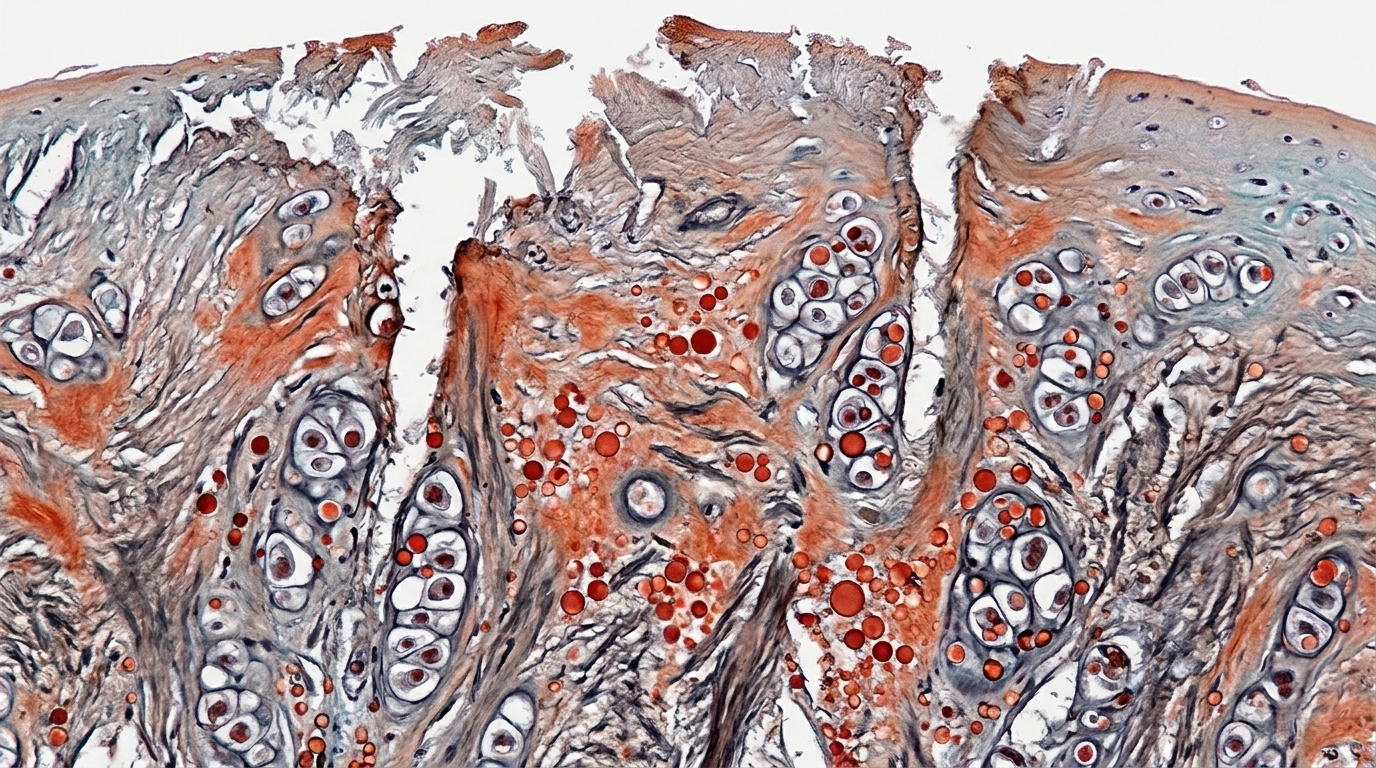
In parallel to extracellular fatty acid import, chondrocytes actively synthesize and store endogenous lipids via de novo lipogenesis and specialized lipid droplet dynamics. Cytosolic acetyl-coenzyme A is converted into fatty acids through the sequential enzymatic activities of acetyl-coenzyme A carboxylase alpha and fatty acid synthase. Under physiological conditions, the PPAR alpha-regulated cytosolic enzyme ACOT12 restricts lipogenesis by hydrolyzing acetyl-coenzyme A; however, downregulation of ACOT12 in osteoarthritic cartilage provokes lipid accumulation and matrix-degrading enzyme synthesis. Furthermore, the circular RNA CircRREB1 accumulates in senescent chondrocytes, where it prevents ubiquitin-mediated degradation of fatty acid synthase while enhancing RanBP2-mediated SUMOylation, thereby locking chondrocytes into a persistent lipogenic state characterized by elevated p21 expression and MMP13 production. Neutral lipids stored in cytoplasmic lipid droplets require intact microtubule trafficking and chaperone-mediated autophagy mediated by PLIN3, HSC70, and LAMP2A. Excessive mechanical stress disrupts this clearance network, resulting in pathological lipid droplet accumulation that sustains chronic intracellular lipotoxic signaling.
Cholesterol homeostasis represents another critical module within osteoarthritic joint metabolism because chondrocytes and synovial cells cannot catabolize sterols directly, relying entirely upon controlled uptake and efflux pathways. Protective cholesterol export requires the AIBP, ABCA1, and ApoA1 axis under the control of liver X receptors to clear cellular sterol excess. When this efflux mechanism fails, intracellular cholesterol accumulates and is converted by CH25H and CYP7B1 into oxysterols that activate ROR alpha transcriptional programs, promoting matrix catabolism. Furthermore, cholesterol stress triggers inter-tissue organelle transfer between subchondral bone and cartilage: subchondral osteocytes experiencing cholesterol overload exhibit pronounced mitochondrial dysfunction and project intercellular nanotubular structures to chondrocytes. These nanotubes deliver damaged osteocyte mitochondria and fragments of mitochondrial DNA into the chondrocyte cytosol, which activates the cGAS-STING innate immune sensing pathway, precipitating severe inflammatory activation and cartilage breakdown. Experimental restoration of osteocyte mitochondrial competence using pantethine through the NUDT8-CoA pathway preserves respiration and attenuates disease in preclinical models.
Based on these mechanistic pathways, the review proposes four candidate lipid-associated osteoarthritis endotypes that serve as hypothesis-generating biological models rather than clinically approved diagnostic classifications. The first endotype represents a fatty-acid-flux-dominant state marked by elevated transporter expression, hyperactive beta-oxidation, and adenosine monophosphate-activated protein kinase suppression leading to loss of SOX9. The second is a lipogenic-senescence-associated state driven by circular RNA-mediated stabilization of fatty acid synthase and sustained matrix degradation. The third encompasses a lipid-droplet-clearance-defective state caused by mechanical disruption of chaperone-mediated autophagy and microtubule transport. The fourth comprises a cholesterol-handling and osteochondral relay state defined by impaired ABCA1 efflux, oxysterol signaling, and osteocyte-to-chondrocyte mitochondrial transfer. The authors emphasize that these endotypes are dynamic, overlapping, and stage-dependent rather than mutually exclusive, and they mandate a three-tiered biomarker evaluation system moving from accessible synovial-fluid profiles to tissue-level pathway markers and advanced spatial multi-omics.
Translating these complex biological discoveries into clinical treatments remains an urgent yet challenging priority in orthopedic medicine. Standard conservative therapies such as structured exercise, muscle strengthening, and weight reduction remain foundational because they lower biomechanical joint stress and ameliorate systemic inflammation. While systemic disease-modifying therapies like sprifermin and lorecivivint have demonstrated localized biological activity or cartilage thickening in clinical trials, they have struggled to deliver consistent, durable pain relief across unstratified patient cohorts. Similarly, metabolic treatments like metformin and glucagon-like peptide-1 receptor agonists such as semaglutide demonstrate encouraging pain reductions and weight loss in patients with obesity and knee osteoarthritis, but whether these outcomes stem from direct cartilage protection or indirect biomechanical offloading remains unproven. Consequently, future clinical success will require targeted therapies, including cartilage-penetrating carriers and intra-articular modulators designed to restore organelle buffering capacity, clear lipid droplets, and selectively re-establish metabolic homeostasis before structural joint deterioration becomes irreversible.
Subject of Research: Whole-joint molecular pathogenesis, epidemiological trends, and lipid metabolic coding mechanisms in osteoarthritis
Article Title: Osteoarthritis: epidemiology, risk factors, molecular pathogenesis, therapeutic progress, and future perspectives
Article References: Huang, K., & Cai, H. (2026). Osteoarthritis: epidemiology, risk factors, molecular pathogenesis, therapeutic progress, and future perspectives. Molecular Biomedicine, 7(1), Article 246. https://doi.org/10.1186/s43556-026-00658-3
Image Credits: AI Generated
DOI: 10.1186/s43556-026-00658-3
Keywords: Osteoarthritis, Lipid metabolic coding, Cartilage degradation, Chondrocyte phenotype, Synovial inflammation, Subchondral bone, Fatty acid oxidation, AMPK-SOX9 axis, De novo lipogenesis, FASN regulation, Lipid droplet turnover, Cholesterol efflux, cGAS-STING pathway, Osteochondral crosstalk, Molecular endotypes, Post-translational modifications, Disease-modifying therapies, Global burden of disease
News Source: Drew Townsend. (November 16, 2026). Osteoarthritis Pathogenesis Involves Whole Joint Remodeling and Lipid Metabolic Coding Mechanisms. Scienmag.