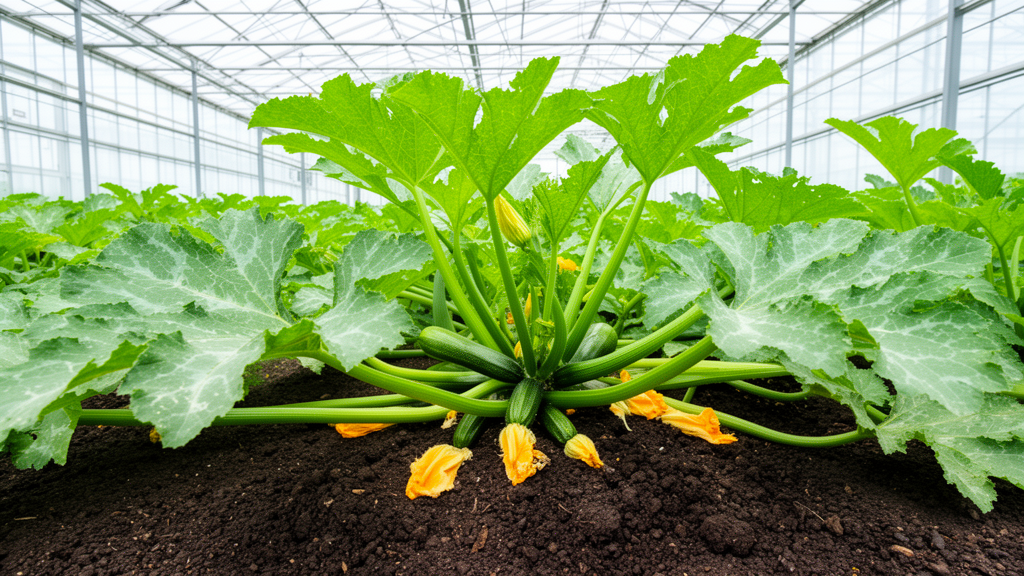
Applying heavy amounts of nitrogen fertilizer in greenhouse vegetable production paradoxically diminishes harvestable crop yields while dramatically multiplying environmental pollution through gaseous emissions and water leaching. In a field study investigating facility-grown zucchini in South Korea, researchers demonstrated that escalating total nitrogen inputs to elevated levels failed to enhance plant productivity and instead prompted substantial agronomic inefficiency alongside severe nutrient escape. The investigation evaluated how varying nutritional regimens alter the comprehensive balance between external fertilizer additions, crop uptake across separate plant organs, and losses across atmospheric and aquatic pathways. Agricultural facilities like plastic houses and greenhouses provide controlled microclimates designed to sustain long cropping cycles, yet intensive nutrient loads applied within these confined spaces frequently exceed the physiological assimilation capacity of the plants, undermining agricultural sustainability.
Facility cultivation systems throughout East Asia, particularly in South Korea, have expanded rapidly to account for a substantial proportion of horticultural and vegetable production. While these enclosed structures protect crops from external weather extremes and allow continuous cropping, they typically involve heavy irrigation and frequent fertilization regimes. Because crops are grown repeatedly inside relatively small, enclosed soil volumes, excess chemical and organic elements can accumulate or escape into the wider ecosystem far more rapidly than in conventional open-field cultivation. Although growers routinely apply surplus nitrogen under the assumption that greater nutrient availability ensures higher yields, agricultural research has shown that excessive fertilization decreases nitrogen use efficiency and can directly lower crop productivity. Compounding the issue, agricultural nitrogen surplus contributes approximately five percent of global anthropogenic greenhouse gas emissions, driving groundwater contamination via nitrate leaching and accelerating atmospheric pollution through ammonia volatilization and nitrous oxide release.
To rigorously examine nitrogen dynamics under intense production practices, an agronomic trial was established in three facility cultivation houses located in Daegok-myeon, Jinju-si, Gyeongsangnam-do, Republic of Korea. Each facility had been dedicated to continuous zucchini (Cucurbita pepo) production for more than five years, representing typical long-term greenhouse operations in the region. Within each greenhouse site, three experimental plots were laid out, establishing nine monitored plots across three distinct nitrogen regimes designated as low, medium, and high nitrogen inputs over a complete growing season. Seedlings were transplanted in late September and cultivated through early July of the following year. Before the initiation of the experiment and immediately after the final harvest, soil samples were extracted from each plot at depths between zero and fifteen centimeters to establish baseline physiochemical profiles. Initial testing across the silt loam soils indicated pH values ranging from 6.9 to 7.5, total carbon between 18.3 and 24.3 grams per kilogram, total nitrogen between 1.62 and 2.93 grams per kilogram, and available phosphorus concentrations between 648 and 2974 milligrams per kilogram.
The three experimental fertilization treatments delivered total nitrogen inputs of 238.1 kilograms of nitrogen per hectare in the low treatment, 337.9 kilograms in the medium treatment, and 720.5 kilograms in the high treatment. Nutrient sources included livestock compost, inorganic fertilizers delivered via fertigation, and commercial organic fertilizers. Compost and organic fertilizers were applied prior to transplanting and thoroughly incorporated into the soil profile through plowing, whereas inorganic fertilizers dissolved in water were applied through fertigation lines immediately following transplanting. Notably, livestock compost formed the vast majority of the nutrient loading in the high treatment, supplying 672.8 kilograms of nitrogen per hectare alone. This application rate exceeded the standard recommended rate of 200 kilograms of nitrogen per hectare for greenhouse zucchini cultivation by more than 3.3 times. In contrast, inorganic fertilizer applications contributed modest shares across all treatments, providing between 32.8 and 48.4 kilograms of nitrogen per hectare, representing only 6.6 to 20.3 percent of total nitrogen additions.
Quantifying the fate of the applied nitrogen required monitoring atmospheric gas fluxes, estimating subsurface water losses, and measuring plant tissue nutrient assimilation. Nitrous oxide emissions were tracked weekly throughout the growing season using static closed acrylic chambers permanently set into the soil between plants, with gas samples extracted at three set times daily and analyzed by gas chromatography with electron capture detection. Ammonia volatilization was quantified using static acid-trap chambers containing glycerol- and phosphoric acid-treated polyurethane foams, from which ammonium was extracted with potassium chloride and measured via indophenol blue colorimetry. Nitrogen leaching was estimated indirectly following Intergovernmental Panel on Climate Change guidelines by applying a default nitrogen leaching coefficient of 0.24 to total inputs. Harvested zucchini fruits were sampled monthly, while aboveground vegetative biomass and root tissues were collected at final crop termination, dried at 70 degrees Celsius, ground, and analyzed for total nitrogen content using elemental analyzers to calculate total nutrient removal.
Harvest measurements revealed marked yield penalties when nitrogen applications rose to excessive levels. Fruit yield, representing the primary economic commodity, was highest in the low nitrogen treatment at 2751 kilograms per hectare, outyielding the medium treatment (2549 kilograms per hectare) by 7.9 percent and exceeding the high treatment (1855 kilograms per hectare) by 48.3 percent. Root biomass showed a parallel decline with increasing input, yielding 444 kilograms per hectare under low nitrogen, 426 kilograms under medium nitrogen, and falling to 328 kilograms under high nitrogen, reflecting a 35.4 percent drop in the heavily fertilized plots. Aboveground vegetative biomass peaked under medium nitrogen at 3917 kilograms per hectare compared to 3542 kilograms in low nitrogen and 3225 kilograms in high nitrogen. In terms of overall total yield, the low and medium treatments performed comparably at 6737 and 6892 kilograms per hectare, whereas total yield under high nitrogen plummeted by 20.6 percent to 5408 kilograms per hectare, demonstrating that hyper-fertilization triggers physiological penalties that curtail vegetative and reproductive growth.
Plant nitrogen absorption efficiency experienced a dramatic collapse as external nutrient inputs expanded. Total crop nitrogen uptake reached 189.5 kilograms of nitrogen per hectare under low nitrogen and 191.4 kilograms under medium nitrogen, but dropped to 162.5 kilograms under high nitrogen. While nitrogen content per unit of tissue mass was highest in the high nitrogen plots, the proportion of applied nitrogen actually absorbed by the plants dropped precipitously. The nitrogen absorption ratio was recorded at 79.6 percent in the low nitrogen treatment and 56.7 percent in the medium treatment, but crashed to only 22.5 percent under high nitrogen. Fruit nitrogen uptake specifically attained its highest level under low nitrogen at 100.2 kilograms per hectare, compared to 93.8 kilograms in medium nitrogen and 73.1 kilograms in high nitrogen, showing that excessive feeding severely impaired the crop’s ability to direct acquired nutrients into productive harvestable biomass.
While crop assimilation dwindled under excessive fertilization, environmental dissipation pathways expanded substantially. In the high nitrogen treatment, environmental losses accounted for 63.4 percent of all quantified nitrogen outputs, leaving plant uptake responsible for only 36.7 percent. Conversely, plant uptake represented the dominant removal route in the low and medium treatments, comprising 69.4 percent and 61.3 percent of outputs, respectively, with environmental losses remaining secondary at 30.5 to 38.7 percent. Cumulative nitrous oxide emissions totaled 2.2 kilograms of nitrogen per hectare under low nitrogen and 3.1 kilograms under medium nitrogen, but surged to 9.0 kilograms under high nitrogen—an increase of approximately 4.1-fold over the low treatment. Ammonia volatilization displayed an identical upward trajectory, rising from 19.4 kilograms of nitrogen per hectare in low plots and 30.5 kilograms in medium plots to 83.6 kilograms under high nitrogen, representing a 4.3-fold surge in atmospheric ammonia loading. Water leaching losses expanded proportionally with input, escalating from 57.1 kilograms per hectare under low nitrogen to 172.9 kilograms under high nitrogen.
Evaluating the apparent nitrogen balance—defined as total inputs minus total quantified outputs—demonstrated severe nutrient loading disparities across the three management systems. The low nitrogen treatment exhibited a negative balance of minus 20.0 kilograms of nitrogen per hectare, where crop uptake and baseline environmental losses slightly exceeded fertilizer inputs, reflecting soil nutrient drawdown. The medium treatment maintained a modest positive balance of 41.2 kilograms of nitrogen per hectare. In contrast, the high nitrogen treatment generated a massive apparent surplus of 300.9 kilograms of nitrogen per hectare. This unaccounted fraction reflects substantial nutrient saturation within the confined facility system, driving secondary salinization, soil acidification, and extensive surplus pools vulnerable to prolonged environmental release. Even in the low nitrogen treatment where a negative balance occurred, combined atmospheric and leaching losses still removed 78.8 kilograms of nitrogen per hectare, indicating that background nutrient losses persist and require targeted mitigation regardless of application scale.
Principal component analysis confirmed that crop productivity and nitrogen utilization are structurally dissociated from gross fertilizer additions. The primary axis, accounting for 82.8 percent of total dataset variance, correlated strongly in the positive direction with nitrogen uptake, fruit yield, and absorption ratio, while input levels, nitrate leaching, ammonia volatilization, and nitrous oxide emissions aligned in the opposing negative direction. This multivariate distribution illustrates that agricultural productivity in facility cultivation depends upon internal uptake capacity and nitrogen use efficiency rather than bulk fertilizer supply. Once nutrient applications exceed the metabolic threshold of the crop, additional inputs simply accelerate environmental dissipation without delivering agronomic benefits. The researchers noted that study limitations include its execution over a single growing season and its focus on a localized geographic area, highlighting the necessity of multi-site replications and multi-year trials to evaluate long-term soil microbial dynamics, but concluded that optimizing compost application rates according to realistic crop requirements remains paramount to safeguarding environmental quality while sustaining facility crop yields.
Subject of Research: Nitrogen balance, crop yield, and environmental losses in facility zucchini cultivation
Article Title: Optimizing nitrogen balance in facility cultivation for higher productivity and lower environmental losses under excessive N fertilization
Article References: Khan, M. I., Sarfraz, R., Kim, P. J., & Kim, G. W. (2026). Optimizing nitrogen balance in facility cultivation for higher productivity and lower environmental losses under excessive N fertilization. Journal of Agriculture and Food Research, 32, Article 103450. https://doi.org/10.1016/j.jafr.2026.103450
Image Credits: AI Generated
DOI: 10.1016/j.jafr.2026.103450
Keywords: Nitrogen balance, Facility cultivation, Greenhouse agriculture, Zucchini cultivation, Nitrogen use efficiency, Nitrous oxide emissions, Ammonia volatilization, Nitrate leaching, Livestock compost, Fertilizer management, Agricultural sustainability, Soil nutrient saturation, Crop yield response, South Korea agriculture, Greenhouse gas emissions, Environmental nitrogen loss
News Source: Alan Morgan. (November 16, 2026). Excessive Greenhouse Nitrogen Fertilization Reduces Zucchini Yield While Multiplying Environmental Losses. Scienmag.