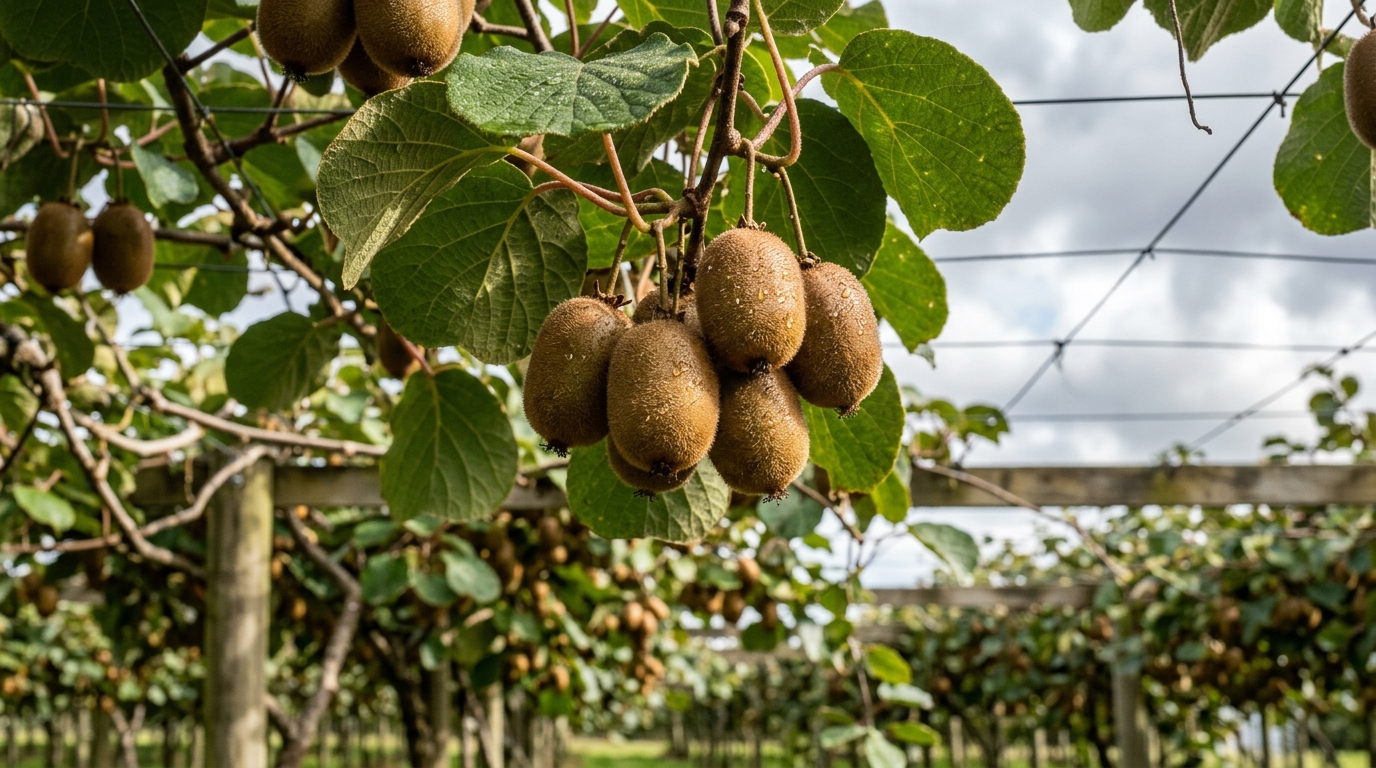
A multiyear field study evaluating forty-seven diverse kiwifruit accessions across four consecutive growing seasons has demonstrated that while genetic heritage fundamentally determines fruit traits, yearly meteorological shifts represent the primary driver of overall fruit quality fluctuation. Researchers tracked the performance of commercial varieties, wild selections, and interspecific hybrids from 2021 through 2024 to understand phenotypic diversity, multiyear stability, and the influence of seasonal weather on postharvest characteristics. The resulting dataset indicates that dry matter accumulation at commercial harvest serves as a reliable predictor of ripe fruit sweetness, while sensory traits such as titratable acidity and sugar-to-acid balances fluctuate markedly in response to temperature variations and rainfall events occurring during narrow developmental stages.
Understanding the interplay between genetic potential and environmental variability is vital for selecting resilient germplasm and breeding climate-adaptive cultivars. Kiwifruit, belonging to the genus Actinidia, comprises dozens of species exhibiting wide phenotypic divergence in flesh color, single-fruit weight, nutrient density, and flavor profiles. Although prior investigations frequently conducted single-season evaluations across multiple cultivars or tracked single varieties across different production regions, systematic multiyear trials tracking broad collections under standardized orchard conditions have remained scarce. This experimental gap limited the ability of researchers to distinguish inherently stable genotypes from lines heavily swayed by seasonal weather, and obscured how distinct microclimatic factors during specific growth stages regulate ripening attributes.
To investigate these questions under uniform cultural conditions, researchers conducted trials in a commercial orchard located in Danjiangkou city, Hubei Province, China. The experimental cohort encompassed forty-seven accessions, predominantly consisting of Actinidia chinensis varieties alongside hybrids with Actinidia rufa and Actinidia eriantha. In 2017, scions from each accession were grafted onto ‘Miliang No. 1’ rootstock derived from Actinidia chinensis variety deliciosa, ensuring a shared root system framework. Each accession was represented by three biological replicates consisting of five to ten healthy vines under identical orchard management across the four consecutive seasons. Fruit samples were harvested when soluble solids content reached approximately 7.0 percent, allowing investigators to capture standardized baseline maturity measurements before postharvest cold storage and final ripening evaluations.
Maturity indices were recorded immediately at harvest using thirty fruits per accession, dividing ten fruits across each biological replicate to measure fresh fruit weight, flesh firmness, soluble solids content, and dry matter percentage. Fruit firmness was determined using a penetrometer fitted with a 7.9-millimeter probe operated at five millimeters per second to a depth of 7.9 millimeters after removing one millimeter of peel. Dry matter was measured by dehydrating a two-millimeter equatorial slice at 65 degrees Celsius for at least twenty-four hours to calculate dried mass as a percentage of fresh weight. Fruits were then transported to laboratory facilities at the Wuhan Botanical Garden within twenty-four hours of harvest, packed in plastic bags, and maintained in cold storage at 1 to 2 degrees Celsius for eight to twelve weeks until softening approached. Fruits were subsequently conditioned at 20 degrees Celsius for up to seven days to reach an edible firmness range averaging 5.2 Newtons before undergoing destructive biochemical assessments.
Biochemical profiling on fully ripened fruit focused on eight core quality traits, comprising single-fruit weight, dry matter, ripe soluble solids content, total soluble sugars, titratable acidity, ripe soluble solids to acid ratio, sugar-to-acid ratio, and vitamin C concentration. Total soluble sugars were quantified using the 3,5-dinitrosalicylic acid method following hydrochloric acid hydrolysis of nonreducing sugars at 80 degrees Celsius, expressed as glucose equivalents. Titratable acidity was determined by neutralizing extract solutions to a pH of 8.2 with sodium hydroxide under an automated titrator, calculating values as citric acid percentages. Vitamin C content was determined through 2,6-dichloroindophenol titrimetric analysis, recorded as milligrams per 100 grams of fresh fruit weight. Three maturity indicators—harvest firmness, harvest soluble solids, and ripe firmness—were set aside during final composite modeling to concentrate strictly on internal eating and nutritional properties.
The evaluation revealed substantial phenotypic variation across the germplasm collection, with individual traits displaying contrasting degrees of variability. Vitamin C exhibited the widest dispersion, ranging from 13.56 to 561.28 milligrams per 100 grams with a coefficient of variation of 100.75 percent. Fruit weight varied from 27.10 grams to 112.20 grams with a mean of 67.17 grams and a variation coefficient of 40.29 percent. In contrast, dry matter and ripe soluble solids content proved exceptionally stable across the four years, recording average values of 18.39 percent and 15.17 percent, respectively, and displaying variation coefficients around 9 percent. Genetic background exerted a visible influence on trait boundaries: accessions derived from Actinidia eriantha hybrids exhibited extreme vitamin C concentrations near 500 milligrams per 100 grams alongside small fruit size near 30 grams, whereas Actinidia rufa hybrids produced small fruit with minimal vitamin C, typically measuring between 13 and 40 milligrams per 100 grams.
Hierarchical clustering analysis and principal component analysis based on four-year grand means segregated the forty-seven accessions into four distinct clades reflecting quality composition rather than exterior skin or flesh pigmentation alone. Clade I gathered germplasm characterized by elevated dry matter and high ripe soluble solids. Clade II separated primarily by fruit dimension, splitting into large-fruited lines with moderate vitamin C and a small-fruited subgroup of Actinidia rufa hybrids exhibiting reduced vitamin C. Clade III was defined by elevated titratable acidity, while Clade IV gathered Actinidia eriantha hybrids distinguished by exceptionally elevated vitamin C. In the principal component analysis, the first two dimensions accounted for 72.83 percent of total variance, with dry matter, ripe soluble solids, and soluble sugars grouping tightly together, whereas vitamin C projected onto an independent axis, indicating that nutritional concentration varied largely independent of flavor profiles.
Linear regression modeling demonstrated that dry matter content at harvest serves as an early indicator of final fruit sweetness across diverse genetic backgrounds. Across the four-year dataset, dry matter was positively correlated with ripe soluble solids content with a coefficient of determination of 0.66, and moderately associated with total soluble sugars with a determination coefficient of 0.46. The resulting generalized predictive model, formulated as ripe soluble solids equal to 2.13 plus 0.71 multiplied by dry matter, indicates that when fruit dry matter reaches or exceeds 16.8 percent at harvest, ripe soluble solids content is predicted to meet or exceed 14.0 percent, a common benchmark for consumer acceptability. Pearson correlation analysis showed dry matter was strongly correlated with ripe soluble solids at 0.81 and total sugars at 0.66, whereas sugar-to-acid ratios correlated inversely with titratable acidity at negative 0.77 to negative 0.82.
Multiyear stability evaluations based on variation coefficients demonstrated that environmental differences between years accounted for greater phenotypic dispersion than differences within individual seasons. With the exception of ripe soluble solids, between-year coefficients of variation exceeded within-year variation coefficients across the evaluated traits. Total variation coefficients among accessions ranged from 11.1 percent in accession S3 to 27.2 percent in S28, with a population mean of 18.6 percent. Ranking consistency over time showed that cultivars at the extreme tiers maintained stable performance across seasons, whereas intermediate-ranked accessions experienced noticeable year-to-year shifts. A subset of elite genotypes—specifically accessions S1, S9, S16, S18, and S43—consistently combined superior composite quality scores with low between-year variability, proving that high commercial fruit quality and strong environmental stability can be unified within single genotypes.
To connect environmental variability directly to trait performance, researchers extracted one hundred derived meteorological variables across two critical phenological stages: fruit development at 30, 40, 50, and 60 days after anthesis, and preharvest maturation at 10, 20, 30, and 40 days before harvest. Nonparametric Spearman rank correlation analysis identified stage-specific associations between weather conditions and five quality indices. Dry matter was positively associated with maximum air temperature and diurnal temperature range during late development, peaking at 60 days after anthesis with a correlation coefficient of 0.384, while minimum temperatures during development correlated negatively, reaching negative 0.310. Conversely, sugar content correlated positively with temperature variability at 50 days after anthesis at 0.411, but correlated negatively with effective growing degree days and temperature-humidity indices during earlier development.
Titratable acidity and derived sugar-to-acid ratios exhibited the highest sensitivity to microclimatic conditions, linking significantly to twenty-four distinct weather metrics. Mean temperatures and effective heat accumulation early in fruit development, specifically at 30 to 40 days after anthesis, correlated positively with final titratable acidity with coefficients ranging from 0.322 to 0.460, whereas early temperature fluctuations correlated negatively, reaching negative 0.462. Furthermore, total rainfall and effective precipitation during preharvest maturation periods were negatively associated with final fruit acidity and positively associated with sugar-to-acid balances, reaching a correlation of 0.513 between sugar-to-acid ratio and temperature variability at 30 days after anthesis. These patterns indicate that moderate early warmth combined with preharvest precipitation reduces excessive acidity while enhancing overall flavor balance.
The authors noted important limitations regarding the explanatory reach of the climate data. Bivariate linear regressions relating key traits to their most influential meteorological variables explained modest portions of observed variance, generating coefficients of determination between 0.11 and 0.14 despite highly significant monotonic trends with Spearman coefficients between 0.38 and 0.47. These modest regression values confirm that meteorological conditions act as secondary modulating factors rather than primary determinants, with genetic background, soil properties, and localized vine physiology governing the overarching baseline of fruit quality. The researchers concluded that multi-environment trials across contrasting geographic regions will be required to validate whether the climate associations and stable elite germplasms identified in Hubei perform consistently under wider commercial production regimes.
Subject of Research: Genetic diversity, quality stability, and meteorological drivers in a diverse kiwifruit collection
Article Title: Multiyear evaluation of fruit quality diversity, stability, and climatic drivers across a diverse Actinidia germplasm collection
Article References: Huang, W., Han, F., Yang, J., Ran, X., Shen, S., Zhang, Q., Ye, N., Lü, H., & Zhong, C. (2026). Multiyear evaluation of fruit quality diversity, stability, and climatic drivers across a diverse Actinidia germplasm collection. Horticulture Advances, 4(1), Article 31. https://doi.org/10.1007/s44281-026-00117-7
Image Credits: AI Generated
DOI: 10.1007/s44281-026-00117-7
Keywords: Actinidia, kiwifruit, fruit quality, dry matter, soluble solids content, vitamin C, titratable acidity, phenotypic diversity, germplasm evaluation, meteorological drivers, diurnal temperature range, postharvest quality, Danjiangkou orchard, Actinidia chinensis, Actinidia eriantha, Actinidia rufa, stability analysis
News Source: Alan Morgan. (November 17, 2026). Four-Year Kiwifruit Study Links Specific Weather Patterns to Postharvest Fruit Quality. Scienmag.