Protein is the fundamental substance of life. The genetic code directing protein synthesis is stored in DNA. When a cell is instructed, the code information transfers from DNA to mRNA. Then, information on mRNA is further transferred to protein.
There are two sets of protein translation systems in mammalian cells – the cytoplasmic translation system and the mitochondrial translation system – both of which are composed of ribosome, tRNAs and translation factors. The translation system translates mRNA into biologically competent protein according to the information on mRNA. However, the coordination mechanism between the cytoplasmic translation system and the mitochondrial translation system has been a mystery.
A research article entitled "Mammalian Elongation Factor 4 Regulates Mitochondrial Translation Essential for Spermatogenesis" was published online in the journal Nature Structural & Molecular Biology on April 11, 2016. It describes the crosstalk mechanism between mitochondrial translation and cytoplasmic translation.
Mitochondrial translation elongation factor 4 (mtEF4) is a quality control factor in protein translation. Although protein is highly conserved in evolution, previous mtEF4 gene knockouts in some model organisms did not show significant phenotypic change.
In this study, by using a systemic mtEF4 gene knockout mouse model, researchers found that mtEF4 knockout damages the oxidative phosphorylation function in germ cells of male mice, thus causing male sterility.
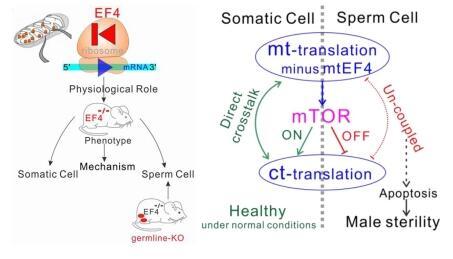
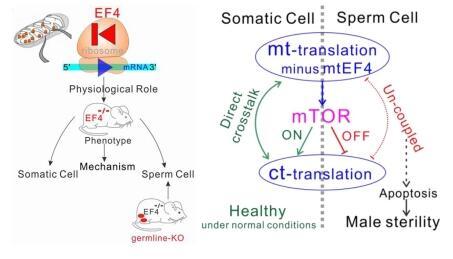
Further study found that the rate of mitochondrial protein translation increased after mtEF4 was knocked out. However, the price was a lower "qualified rate" for protein and a shorter protein half-life. In order to keep step with the "quickened" mitochondrial translation, somatic cells activated the mTOR signaling pathway in order to accelerate cytoplasmic translation and balance mitochondrial translation. In this way, somatic cells successfully resolved the negative impact of high-speed mitochondrial translation.
In contrast, the mTOR signaling pathway could not be activated in germ line cells, because the mitochondrial complex assembly of germ cells failed to assemble, and the sperm maturation process stagnated at the round sperm stage, ultimately resulting in male sterility.
This study reveals a new information exchange mechanism within the cell (see figure below): The mTOR signaling pathway balances the dynamic between mitochondrial translation and cytoplasmic translation. When the mitochondrial translation rate increases, the mTOR signaling pathway is activated, which causes the increase in the cytoplasmic protein translation rate to counteract pressure from the increased mitochondrial translation, thus representing a new evolutionary adaptation mechanism. In addition, this study revealed a new reason for male infertility and is of great value for the clinical treatment of male infertility.
This research involved cooperation by many institutions, including the Institute of Biophysics (IBP), the Institute of Zoology, the Academy of Military Medical Sciences, the Tianjin University of Science and Technology, and other institutes. The Institute of Biophysics and the University of the Chinese Academy of Sciences are the first and the second institutions, respectively. Prof. QIN Yan (IBP) is the corresponding author. GAO Yanyan and BAI Xiufeng are the co-first authors of this paper. This work was also supported by the Chinese Ministry of Science and Technology, the National Natural Science Foundation and Key Projects of the Chinese Academy of Sciences.
###
Media Contact
Qin Yan
[email protected]
http://english.cas.cn/