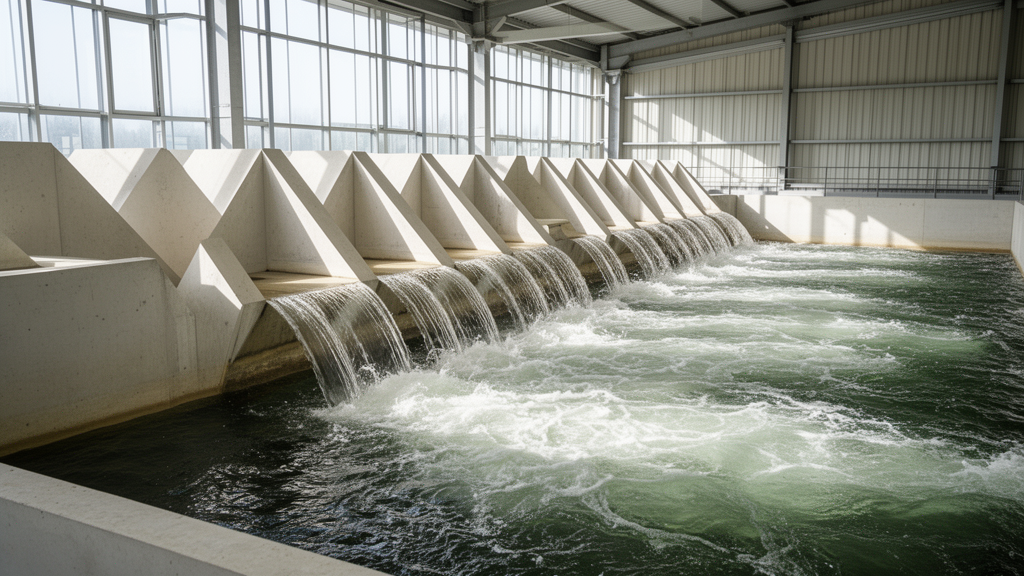
Hydraulic engineering researchers have developed predictive models using Support Vector Regression and Gene Expression Programming to determine the discharge coefficient of triangular labyrinth weirs across multiple cyclic configurations. Labyrinth weirs are linear overflow structures engineered with repeating geometric layouts, such as triangular or trapezoidal folds, to increase the total crest length within a fixed channel width. This extended crest allows the structure to pass higher flow volumes and reduce upstream water levels compared to conventional straight weirs. In an experimental investigation conducted at the Advanced Hydraulics Laboratory in the Civil Engineering Department at Aligarh Muslim University, investigators evaluated the performance of twelve steel triangular labyrinth weirs. By combining physical flume measurements with soft computing techniques, the study produced high-accuracy numerical predictions and a practical closed-form algebraic design equation based on a comprehensive dataset of 195 experimental runs.
Traditional linear weirs discharge water according to a basic hydraulic relationship governed by the crest length, gravitational acceleration, upstream head, and an empirical discharge coefficient. When labyrinth geometries are employed, the discharge coefficient accounts for complex three-dimensional flow phenomena that depart from idealized conditions, including streamline curvature, contraction, local turbulence, and approach velocity dynamics. Prior research explored single-cycle triangular labyrinth weirs or multi-cycle trapezoidal arrangements, but the interaction of multiple cycles in triangular setups remained insufficiently quantified. In earlier studies, equations derived from genetic programming were often excessively complex and filled with numerous nested operators, limiting their practical adoption by field engineers. The present investigation resolved this gap by testing configurations with three, four, and five cycles across diverse geometric sidewall angles, explicitly incorporating the cycle count into machine learning formulations.
The laboratory experiments were conducted inside a rectangular masonry flume featuring a smooth cement-plastered finish, measuring 15 meters in length, 0.75 meters in width, and 0.60 meters in depth. Water was delivered to the channel from an overhead supply tank through a 170-millimeter-diameter pipe fitted with an overflow arrangement to maintain a steady upstream head. After passing through the test section, the water emptied into an underground collection sump, where dedicated pumps recirculated it back to the overhead storage tank to sustain continuous, uninterrupted flow. Head measurements over the weir crest were acquired 1.0 meter upstream of the model using a pointer gauge with a reading precision of plus or minus 0.1 millimeters. Discharge measurements were obtained at the downstream terminus of the flume using a calibrated rectangular sharp-crested weir in strict accordance with United States Bureau of Reclamation standards.
Experimental accuracy and measurement repeatability were carefully controlled throughout the laboratory campaign. The uncertainty associated with total head measurement remained below 0.5 percent, while the estimated uncertainty for channel discharge measurements remained under 2.0 percent. To evaluate the repeatability of the hydraulic data, investigators repeated several representative experimental runs under identical flow conditions, observing maximum deviations in the measured discharge coefficient of less than 2.0 percent. All experimental runs operated in a fully turbulent regime with Reynolds numbers exceeding 10,000, and Weber numbers remained above 100, confirming that viscous and surface tension forces were negligible in the analysis.
Dimensional analysis established that the discharge coefficient could be represented by four primary dimensionless parameters: the ratio of upstream head to weir height, the sidewall angle, the relative cycle width to weir height, and the integer number of weir cycles. The investigated models included four sidewall angles—15, 25, 30, and 40 degrees—tested systematically across three-, four-, and five-cycle assemblies. The complete experimental set of 195 observations was divided into a training dataset comprising 70 percent of the observations (137 data points) and an independent testing dataset comprising 30 percent (58 data points). Hyperparameter optimization was conducted strictly within the training portion using five-fold cross-validation to prevent data leakage, ensuring that the testing subset functioned as an authentic validation of out-of-sample generalization.
For the Support Vector Regression models, the Radial Basis Function kernel was chosen after preliminary comparisons showed a 12.7 percent reduction in Root Mean Square Error relative to polynomial kernels. Hyperparameter tuning via Bayesian optimization identified the optimal regularization parameter, kernel parameter, and epsilon margins. The four-input Support Vector Regression model, designated SVRM4, achieved superior accuracy across both training and testing phases. During testing, this model recorded a coefficient of determination of 0.96 and a Mean Absolute Percentage Error of 1.14 percent, with a training Root Mean Square Error of 0.0116 and a testing Root Mean Square Error of 0.0164. The regularization parameter of 7.41 effectively controlled model complexity, preventing overfitting and yielding consistent error metrics between training and testing subsets.
Parallel developments using Gene Expression Programming aimed to generate an explicit, human-readable algebraic formulation suitable for direct field design. The algorithmic framework utilized multigenic chromosomes with an optimal population size of 50 individuals, an addition linking function, and a chromosome architecture defined by a head length of 8 and four genes per chromosome. The terminal set comprised the identified dimensionless geometric parameters, while the function set was restricted to basic arithmetic operators and elementary mathematical transformations to avoid excessive algebraic complexity. Increasing population sizes beyond 50 or extending the head length failed to provide measurable accuracy gains while markedly increasing computational run times, confirming the adopted architecture as an optimal computational compromise.
The optimal Gene Expression Programming model, designated GEPM4, incorporated all four dimensionless governing parameters to maximize physical completeness. In evaluation, GEPM4 achieved a Mean Absolute Percentage Error of 5.68 percent on the training dataset and 6.29 percent on the unseen testing dataset, with an out-of-sample coefficient of determination of 0.68. The resulting explicit expression relates the discharge coefficient directly to the square root of the difference between 0.207 and the inverse sidewall angle, coupled with fractional terms involving the relative cycle width and upstream head ratios. Qualitative comparisons using scatter diagrams and violin plots confirmed that while Support Vector Regression closely tracked experimental values, the explicit gene expression formula remained well within acceptable industrial design thresholds.
A comparative synthesis reveals that Support Vector Regression captures the intricate nonlinear interactions governing multi-cycle triangular labyrinth weir flow more accurately than closed-form expressions. The kernel-based mapping in Support Vector Regression accommodates these multidimensional coupling effects effectively. Conversely, the Gene Expression Programming formulation delivers a practical and transparent tool for preliminary hydraulic sizing and routine field engineering where rapid computational execution without dedicated modeling software is desired.
The authors emphasize specific operational boundaries for applying the developed predictive models. Because the formulations were calibrated against a flume dataset of 195 runs, their validity is strictly limited to the tested geometric bounds: sidewall angles between 15 and 40 degrees, cycle numbers of three, four, and five, and free-flowing, fully ventilated nappe conditions. Applying either the Support Vector Regression model or the explicit gene expression equation outside these hydraulic and geometric limits is not recommended. Future research avenues identified include expanding the experimental envelope to incorporate submerged flow conditions, additional cycle configurations, and integrating physics-informed machine learning architectures to enhance model generalizability.
In developing the computational frameworks using DTREG software, the investigators evaluated four distinct input parameter combinations to isolate the influence of individual geometric variables. While an alternate three-parameter formulation, GEPM3, achieved marginally lower training error, the researchers selected the four-parameter GEPM4 model because it explicitly incorporated cycle number alongside weir height and width ratios. This inclusion ensured that multi-cycle hydraulic behavior was physically represented rather than treated as a constant geometry. Individual chromosome fitness during the gene expression programming search was evaluated through a mean square error function scaled inversely to discrepancy values, guiding the translation of linear chromosomes into structural expression trees bounded by an eight-node depth.
The dimensional formulation also rested on specific hydraulic criteria that justified omitting classical dimensionless numbers from the final predictive input sets. Because flume runs maintained low approach velocities characterized by Froude numbers under 0.3, the velocity head was directly incorporated into total upstream head measurements, rendering separate Froude terms redundant. Within the support vector regression architecture, the radial basis function mapped inputs into a high-dimensional feature space, where second-order optimization resolved weight vectors and bias values within an epsilon-insensitive error band. According to statistical classification benchmarks on the Lewis scale, all evaluated support vector and gene expression model variations achieved performance ratings within the highly accurate category.
The investigation builds upon earlier soft-computing applications in water resources engineering, which previously explored genetic programming for trapezoidal labyrinth weirs and single-cycle geometries. Earlier efforts, such as gene expression models trained on 123 observations from single-cycle experiments or 300 data points from trapezoidal layouts, demonstrated predictive utility over conventional non-linear regressions but produced intricate equations with numerous nested mathematical operators. By systematically testing twelve sharp-crested steel models across three, four, and five cycles, the present research expands empirical validation into multi-cycle triangular designs while preserving an interpretable mathematical structure.
Subject of Research: Discharge coefficient prediction in multi-cycle triangular labyrinth weirs using machine learning
Article Title: Support vector machines and gene expression programming for discharge coefficient prediction in triangular labyrinth weirs
Article References: Mustafa, M. D., Mansoor, T., & Muzzammil, M. (2026). Support vector machines and gene expression programming for discharge coefficient prediction in triangular labyrinth weirs. Discover Fluid Mechanics, 2(1), Article 19. https://doi.org/10.1007/s44369-026-00019-1
Image Credits: AI Generated
DOI: 10.1007/s44369-026-00019-1
Keywords: triangular labyrinth weirs, discharge coefficient, support vector regression, gene expression programming, hydraulic engineering, open-channel flow, weir hydraulics, water resources engineering, crest length magnification, experimental fluid mechanics, machine learning in hydraulics, radial basis function kernel, bayesian optimization, head-to-weir height ratio, sidewall angle, cycle number, relative cycle width
News Source: Teresa Odom. (November 16, 2026). Machine Learning Models Predict Discharge Coefficients in Multi-Cycle Triangular Labyrinth Weirs. Scienmag.