LAWRENCE — According the Environmental Protection Agency, the declining health of pollinators reported for the past decade is tied to a mix of factors, including habitat loss, pests, pathogens, viruses, poor nutrition and pesticides.
"Insect pollinators are incredibly important for agricultural ecosystems," said Kathy Denning, doctoral student in ecology and evolutionary biology at the University of Kansas. "A huge variety of crops require insect pollination, but it's also important for native ecosystems. Almost 90 percent of flowering plants on Earth need animal pollination, mostly by insects. So, we have this decline in pollinators, along with their incredibly important role in our ecosystem."
For these reasons, a better understanding of how pollinators interact with plants is key to untangling, and possibly mitigating, the decline in pollinator health. However, traditional methods of surveying plant-pollinator interactions mostly depend upon visual observation.
"A researcher might go out to the prairie with a clipboard and observe a certain species of bumblebee visiting a certain kind of flower," said Denning, who works with the Kansas Biological Survey. "Those are the data points used to construct a network. But that's just a snapshot in time. That's just one interaction."
To improve upon this "snapshot," Denning has earned a $19,404 grant from the National Science Foundation to support her doctoral work. Rather than visual observation, Denning's research centers on molecular genetic analysis of pollen grains recovered from bees across 10 prairie sites in Kansas.
"I've captured these native bees, and I can scrape pollen off their bodies and sequence it to figure out what plant species the pollen belongs to — it can be one, two or more there. It's a historical record of all the plants that bee has visited on its current foraging trip."
Working with KU professors Bryan Foster and Mark Mort, Denning will use the data to assess multiple facets of plant-bee networks in heavily human-modified landscapes within the tallgrass prairie ecosystem.
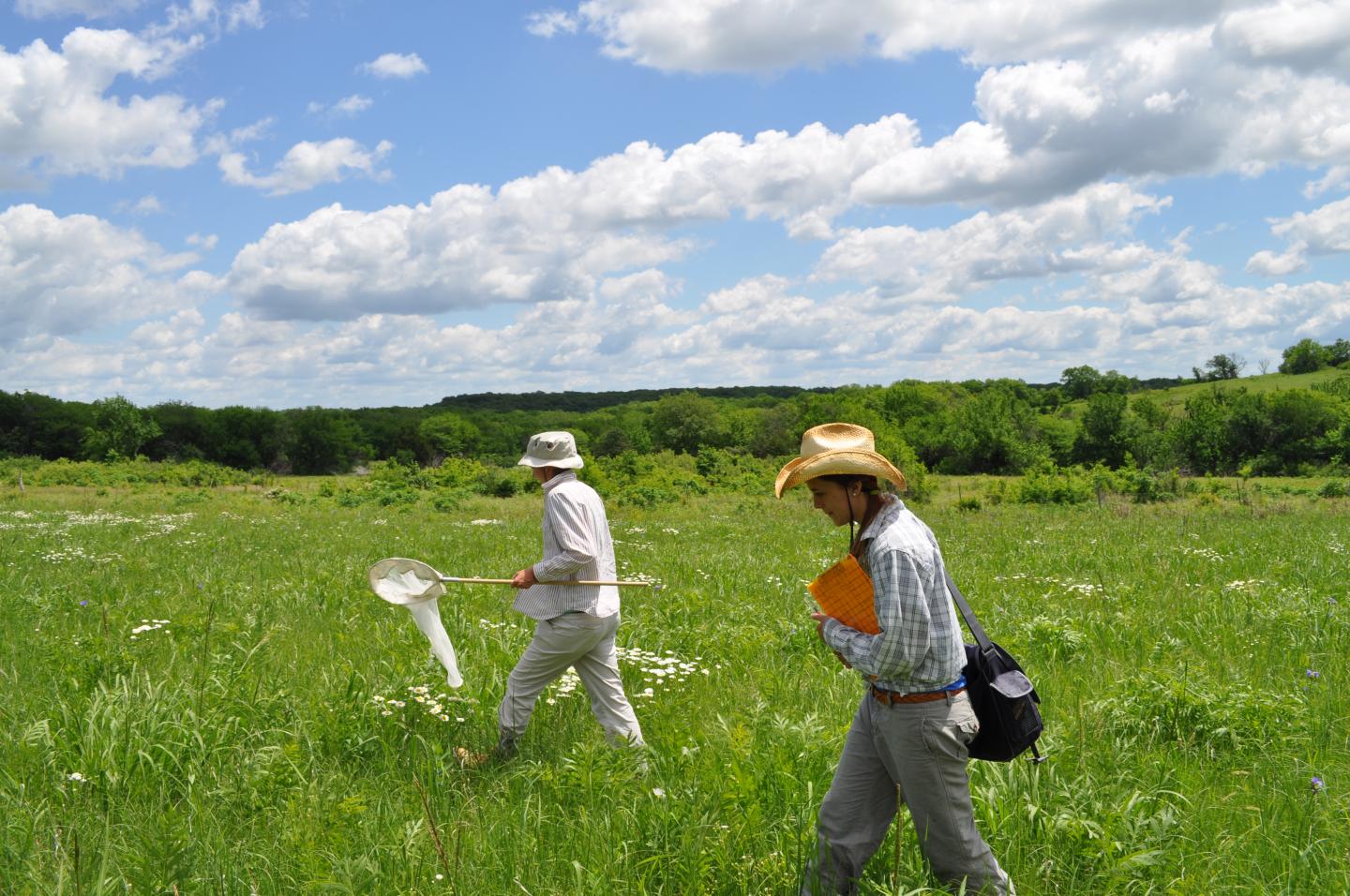
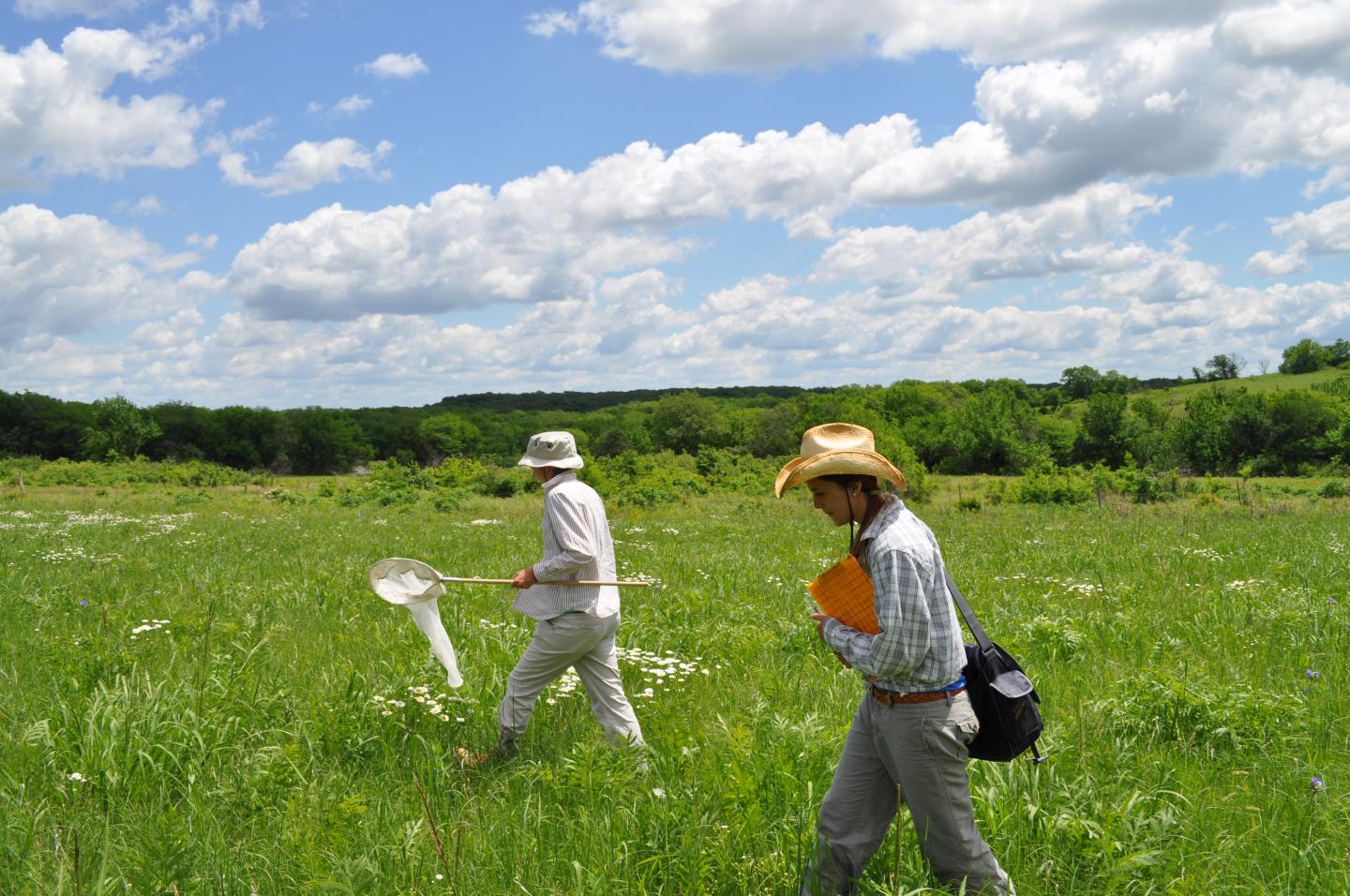
"On a typical day I'd travel to a site and start sampling by midmorning," Denning said. "I have three types of sampling. I set a stopwatch for 60 minutes, then walk around the site with an undergraduate assistant and capture any insect I see in contact with a flower — butterflies, bees, beetles or flies. The second thing I do is set up four 20-meter tape measures called transects, walk slowly along the transects and capture any insect I see contacting any flower that is open. The last thing I do is a survey of currently flowering plants along the transects to get a picture of what's currently in bloom and its phenology at that time of year."
Denning's work under the new NSF grant also will benefit younger students. The KU researcher and her colleagues will conduct a series of workshops focused on pollinator ecology for middle and high school students who aspire to be first-generation college graduates.
"I'm really passionate about sharing the importance of pollinators with students," Denning said. "I've been doing this the whole time I've been at KU. I'm hoping to do a minisampling with the Upward Bound students to teach the importance of pollinators in a classroom setting, then go out to survey pollinators, just as I do in my fieldwork. The idea is to get them excited about pollinators and see a day in the life of a biologist — what we do and how we carry out fieldwork. We want to show students a career they could investigate in their own lives."
###
Media Contact
Brendan M. Lynch
[email protected]
785-864-8855
@KUNews
http://www.news.ku.edu