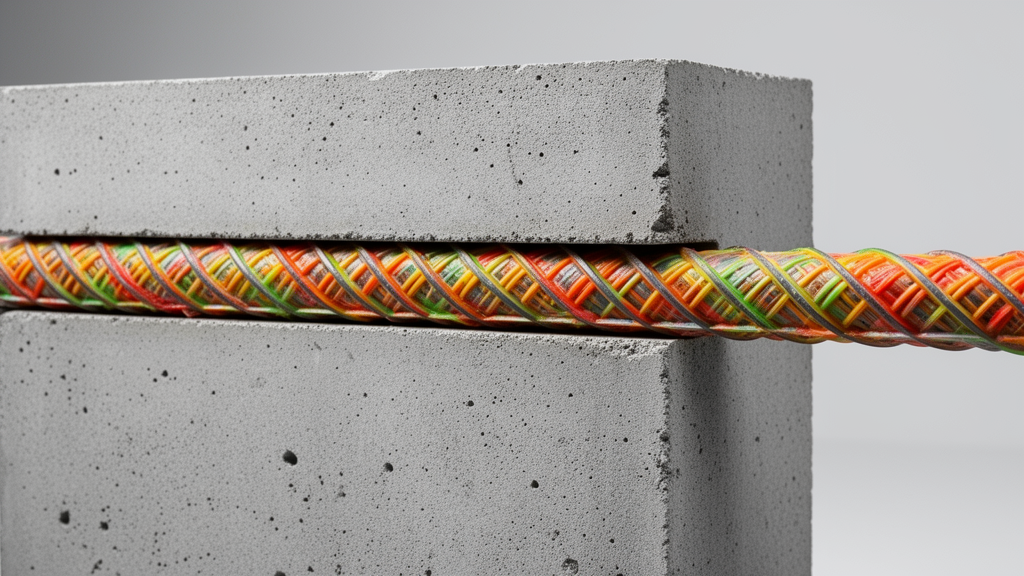
Surface properties govern the bond strength of glass fiber-reinforced polymer bars in concrete, yet existing international design provisions fail to adequately reflect these effects through their limited surface coefficients, according to a systematic review published in Discover Applied Sciences. Consequently, standard development-length equations remain generally conservative, particularly for modern glass fiber-reinforced polymer products and well-confined concrete reinforcement, while potentially yielding unconservative predictions under specific design conditions.
Researchers Szabolcs Szinvai, Tamás Kovács, and Jiao-Long Zhang conducted a structured literature evaluation using the Web of Science database to assess bond behavior and code provisions. Their comprehensive assessment selected and examined 60 relevant publications to critically evaluate experimental and theoretical findings across the international engineering literature.
Glass fiber-reinforced polymer bars have seen increasing adoption as internal concrete reinforcement primarily due to their corrosion resistance and non-magnetic characteristics. However, their physical differences from conventional steel reinforcement—specifically lower elastic stiffness, brittle structural behavior, diverse surface treatment options, and distinct bond mechanisms—continue to complicate the structural detailing of lap splices, anchorages, and overall beam reinforcement.
The review systematically evaluated several core structural parameters, including interfacial bond mechanisms, failure modes, and existing bond stress–slip formulations. The authors also assessed the specific impacts of rebar surface treatments, concrete material properties, transverse confinement, development and lap-splice lengths, bent-bar detailing configurations, and long-term bond durability.
The authors reported that most major international design guidelines continue to rely on empirical average bond-stress concepts. These standard design formulations do not explicitly account for non-uniform bond-stress distributions that occur along the bonded length of the polymer reinforcement.
A primary driver of this excessive conservatism in design standards is insufficient experimental knowledge regarding bond strength degradation caused by environmental exposure, sustained loads, and long-term service loading. To resolve these design challenges, the authors outlined research priorities focused on rigorous surface characterization, structural confinement, non-uniform bond modeling, environmental exposure, sustained loading behavior, and bent-bar detailing.
Subject of Research: Bond behavior and design guidelines for glass fiber-reinforced polymer reinforced concrete
Article Title: Bond behavior and design challenges in GFRP reinforced concrete beams with research directions
Article References: Szinvai, S., Kovács, T., & Zhang, J.-L. (2026). Bond behavior and design challenges in GFRP reinforced concrete beams with research directions. Discover Applied Sciences. https://doi.org/10.1007/s42452-026-09867-5
Image Credits: AI Generated
DOI: 10.1007/s42452-026-09867-5
Keywords: glass fiber-reinforced polymer, GFRP reinforcement, concrete beams, bond behavior, bond strength, development length, lap splices, concrete confinement, surface treatment, bond stress-slip models, non-uniform bond stress, bent-bar detailing, corrosion resistance, structural detailing, international design guidelines, environmental exposure, sustained loading
News Source: Denise Maddox. (November 15, 2026). Current Concrete Guidelines Overestimate GFRP Development Lengths in Structural Applications. Scienmag.