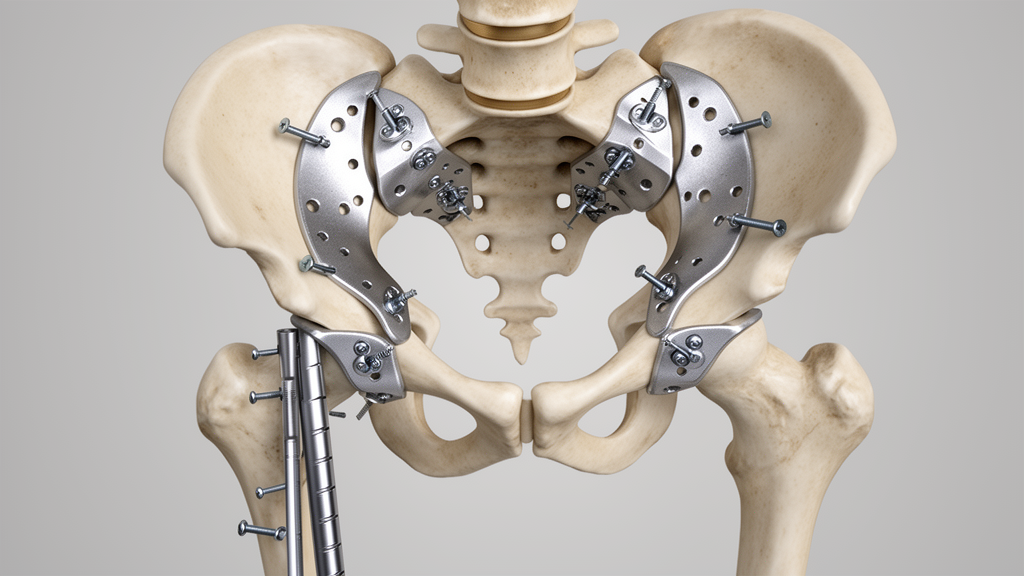
A staged surgical strategy combining temporary external fixation with a subsequent Ganz approach successfully restored hip joint stability in a 48-year-old woman suffering from a rare Pipkin type IV floating hip injury, according to a case report published in BMC Musculoskeletal Disorders.
Floating hip injuries involving simultaneous ipsilateral femoral shaft, femoral head, and acetabular fractures present severe clinical difficulties because the shaft fracture abolishes the mechanical lever arm required for closed hip reduction. The authors noted that no consensus currently exists regarding the optimal order in which reduction and fixation should be undertaken for these complex trauma cases.
The patient presented to the emergency department four hours after a motor vehicle accident, having sustained a right posterior hip dislocation, femoral head and posterior acetabular wall fractures, and an ipsilateral femoral shaft fracture. Under a single general anesthetic, surgeons closed-reduced the femoral shaft and stabilized it with a temporary external fixator within 20 minutes, restoring the lever arm necessary for hip manipulation.
With femoral continuity established, an Allis reduction of the dislocated hip was completed within a further 30 minutes, achieving successful joint reduction five hours after the initial traumatic event.
Definitive surgery was performed on day seven, consisting of plating of the femoral shaft followed by surgical hip dislocation using the Ganz approach. The femoral head fragment was secured with headless compression screw fixation, while the small, anatomically reduced posterior acetabular wall fragment was directly assessed and left unfixed.
Fracture union was confirmed at three months, at which time the patient was ambulating with partial weight-bearing on crutches. At an 18-month follow-up, radiographic, CT, and MRI evaluations revealed no evidence of femoral head osteonecrosis, classified as Ficat-Arlet stage 0, with a Harris hip score of 93, though the authors emphasized that findings from a single patient cannot determine a standard treatment protocol for such severe injuries.
The report by Gangqiang Jiang and Zhenshan Yuan combines the single patient presentation with a narrative literature review to examine the clinical challenges surrounding Pipkin type IV floating hip injuries. Because traumatic injuries involving simultaneous hip dislocation, ipsilateral femoral shaft, femoral head, and acetabular fractures are rare and difficult, the authors noted that no consensus currently exists regarding the optimal order in which reduction and fixation should be undertaken.
In addressing the mechanical disruption caused by the injury, the authors explained that a femoral shaft fracture abolishes the skeletal lever arm on which closed reduction of a dislocated hip depends. To overcome this obstacle, the surgical approach prioritized restoring femoral continuity early so that the mechanical lever arm was once again available. Under a single general anesthetic, surgeons closed-reduced the shaft and applied a temporary external fixator within 20 minutes, which subsequently enabled the Allis reduction of the hip to be completed within an additional 30 minutes, five hours after the initial accident.
Definitive treatment of the intra-articular and shaft injuries was delayed until a second stage on day seven to facilitate planned surgical reconstruction. The procedure began with plating of the femoral shaft, followed by surgical hip dislocation performed through the Ganz approach to gain direct access to the joint. Surgeons secured the femoral head fragment using headless compression screw fixation. The accompanying posterior acetabular wall fragment was found to be small and anatomically reduced upon direct assessment, leading the surgical team to leave it unfixed.
Fracture union was confirmed at 3 months, at which point the patient was already walking with partial weight-bearing on crutches. Long-term follow-up at 18 months confirmed that plating the shaft and opening the hip via the Ganz approach achieved a congruent, stable joint. Advanced imaging via radiographs, computed tomography, and magnetic resonance imaging demonstrated no signs of femoral head osteonecrosis, corresponding to Ficat-Arlet stage 0, while functional assessment demonstrated a Harris hip score of 93.
In their concluding remarks, the authors observed that reducing the dislocated hip early, restoring femoral continuity to provide the necessary lever arm, and managing intra-articular fractures at a second stage worked well in this patient. However, they explicitly emphasized the inherent methodological limitations of the report, noting that an outcome observed in a single patient cannot determine whether this strategy represents the correct approach for treating floating hip injuries. Furthermore, the report specified that trial registration was not applicable to the study.
Subject of Research: Surgical management of Pipkin type IV floating hip injuries
Article Title: Ipsilateral femoral shaft and femoral head fractures with hip dislocation: a case report and literature review
Article References: Jiang, G., & Yuan, Z. (2026). Ipsilateral femoral shaft and femoral head fractures with hip dislocation: a case report and literature review. BMC Musculoskeletal Disorders. https://doi.org/10.1186/s12891-026-10756-6
Image Credits: AI Generated
DOI: 10.1186/s12891-026-10756-6
Keywords: floating hip injury, Pipkin type IV fracture, femoral shaft fracture, femoral head fracture, posterior hip dislocation, acetabular fracture, Ganz approach, surgical hip dislocation, temporary external fixation, Allis reduction, headless compression screws, femoral lever arm, femoral head osteonecrosis, Ficat-Arlet staging, Harris hip score, orthopedic trauma, fracture union
News Source: Ophelia Keating. (November 14, 2026). Staged Fixation Restores Joint Function in Complex Floating Hip Case Report. Scienmag.