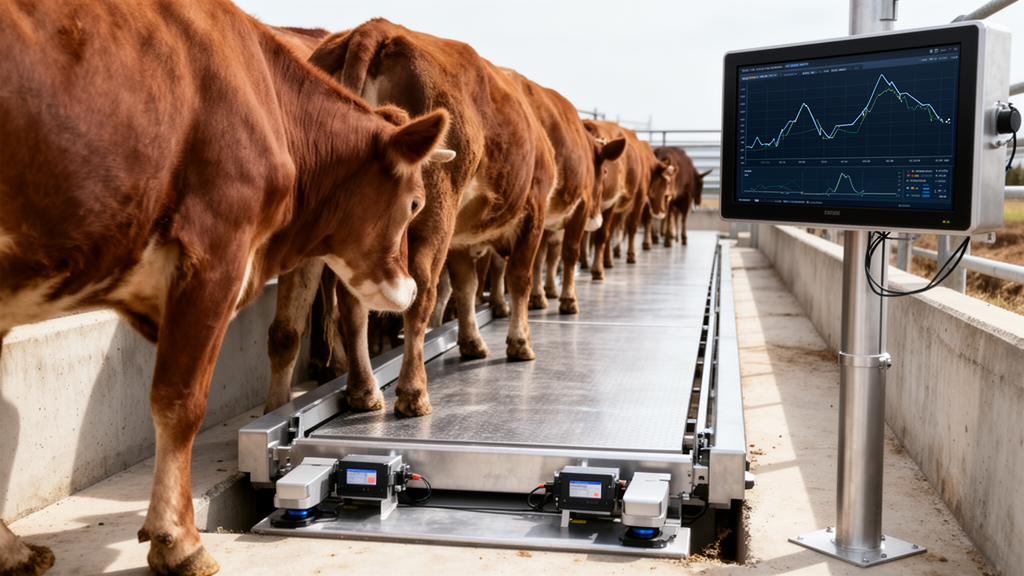
Agricultural engineers have developed an automated dynamic weighing system that accurately calculates the body weight of cattle as they walk continuously across an arrayed platform scale without manual handling or physical restraint. Body weight provides an essential measurement for evaluating the physiological performance and economic returns of beef and dairy operations, serving as a primary operational indicator of herd welfare and nutritional management. Traditional methods of animal weighing depend heavily on static chutes where farm operators must drive cattle onto single-platform scales, isolate individuals behind mechanical barriers, and wait until motion subsides before obtaining a stable reading. This conventional procedure consumes extensive labor and imposes acute physical stress on the livestock. Emerging machine vision alternatives attempt contactless measurement using overhead or lateral optical cameras, yet these optical systems often degrade in industrial barns due to unpredictable animal posture, shifting lighting conditions, background dust, and physical camera obstructions. In response, a research team from China Agricultural University engineered a multi-sensor passage that captures continuous hoof contact dynamics across segmented plates, resolving the signal mixing that has long constrained livestock weighing systems.
Conventional dynamic weighing platforms rely on single integrated scales that record only an aggregate weight curve over time, failing to capture the spatial distribution of load across separate hooves. Because cattle naturally exhibit gregarious, herd-following behavior, individuals frequently follow one another onto walkways without leaving empty space between them. On single-piece dynamic platforms, this close consecutive walking blends the weight signals of adjacent animals into an inseparable compound measurement, forcing agricultural operators to install narrow S-shaped gates or mechanical turnstiles to enforce strictly spaced, one-by-one transit. When livestock slow down or balk in front of these restrictive mechanisms, movement efficiency drops sharply. Conversely, if animals are allowed to move unhindered, overlapping hoof loads distort traditional mathematical regression models, which struggle to untangle the volatile, non-stationary signals generated by dynamic movement. The research team addressed this design bottleneck by shifting from an integrated weighing floor to an arrayed modular structure capable of registering discrete hoof contacts sequentially, thereby decoupling compound signals while allowing cattle to walk forward at natural speeds.
The physical system was constructed using a dedicated dynamic weighing channel coupled to an industrial processing station. The channel incorporates protective side guardrails, inclined entry and exit ramps, and a modular platform floor composed of ten small rectangular weighing plates arranged in a grid of five successive rows and two parallel columns. Each individual plate rests upon an independent pressure sensor possessing a load capacity of five hundred kilograms and a metrological accuracy classification of C3. To prevent hoof slippage and erratic balance reactions that could corrupt the dynamic load signals, every plate was covered with an anti-slip mat of identical dimensions. All analog output cables from the ten sensors run into an environmental control cabinet, where an analog-to-digital converter digitizes the multi-channel load curves at a sampling frequency of ten hertz, providing complete ten-plate force updates every one hundred milliseconds. An industrial microcomputer equipped with dedicated control software converts the raw electronic responses into calibrated weight values in real time, incorporating automatic baseline compensation and manual zeroing algorithms to eliminate signal drift caused by dirt accumulation or ambient temperature fluctuations.
Experimental validation of the prototype platform took place at an operational pastoral ranch situated in the Hailar District of Hulunbuir City within the Inner Mongolia Autonomous Region of China. The experimental study cohort comprised sixty-seven healthy, non-lame female Sanhe cattle, a dual-purpose regional breed adapted to local grassland environments. The live body weights of the selected cattle ranged from 274 kilograms to 516 kilograms, with a cohort mean weight of 388.6 kilograms and an overall standard deviation of 59.0 kilograms. The existing ranch infrastructure included a funnel-shaped sorting pen and a standard static weighbridge enclosed by heavy fencing. Because ranch workers weighed the cattle monthly in this chute, the animals were acclimated to the physical boundaries of the raceway. To acquire reference data, the researchers mounted their experimental arrayed dynamic channel directly onto the exit chute of the static weighbridge, establishing a linear corridor that guided the cattle from a holding pen through a transition zone, over the static scale, and finally across the multi-sensor test platform.
Data collection was organized into two distinct experimental rounds to evaluate both isolated and continuous livestock movement. In the first round, farm personnel led each cow individually onto the static weighbridge, closed the entrance and exit gates, and held the animal stationary for several seconds until electronic readings settled, recording these values as experimental ground-truth weights. Once static recording concluded, the exit gate opened, allowing the animal to walk alone across the dynamic weighing channel to establish baseline single-animal dynamic records. Sixty-seven individual movement datasets were recorded during this phase. In the second round, researchers removed the chute dividers and opened all access doors, permitting the herd to pass freely and continuously through the raceway without human pacing or physical interception. This unhindered movement yielded thirty-nine continuous multi-animal raw data segments. A synchronized visible-light video camera, operating at thirty frames per second with a resolution of 1280 by 720 pixels, recorded all walking transits from a fixed vantage point one meter above the ground and one and a half meters beside the chute.
To prevent the collection of empty baseline data between animal passages, the data acquisition software incorporated an automatic energy-saving sleep algorithm. When the summed weight across all ten plates remained at zero for three consecutive sampling intervals, the computer suspended data writing; once a non-zero signal reappeared, file storage automatically resumed. Analysis of the synchronized video recordings and raw signals identified three basic movement patterns during herd transit: unobstructed single-cattle passage, continuous multi-cattle passage where following animals stepped onto the platform before leading animals fully exited, and crowded parallel passage where two or more animals jammed side-by-side into the raceway. Of the sixty-seven cattle tracked during the free-passage test, fifty-six animals traversed the walkway in either single or continuous sequential configurations, representing approximately 83.6 percent of total passages. Four data recordings captured crowded parallel movements involving nine animals, and a single recording captured a hybrid movement containing two crowded cattle followed immediately by a sequential animal. Parallel crowding signals exhibited severe spatial and temporal interference and were removed as invalid, leaving sequential movements for automated segmentation.
The engineering team devised an automated trajectory segmentation algorithm to isolate individual cattle profiles from continuous multi-animal datasets. The mathematical rule designates the sum of the first four inlet plates as entrance weight W1 and the sum of the final four outlet plates as exit weight W2. When an approaching animal first steps onto the inlet plates, W1 transitions from zero to a positive value, marking entry into the array. When the animal moves forward and its hind hooves fully clear the final plates, W2 drops from a positive value back to zero, defining exit completion. In continuous multi-animal streams where both W1 and W2 simultaneously register positive values at an initial sampling instant, the system identifies that the trailing animal has entered while the leading animal is still vacating. The algorithm splits the raw continuous recording at the exact sampling timestamp where W2 first drops to zero, discarding the overlapping front segment and preserving the subsequent cleanly isolated signal for the following animal. Applying this automated logic to fifty-six continuous cattle passages yielded fifty-four segmented data blocks, successfully isolating fifty-three individual animals with an overall segmentation accuracy of 94.64 percent.
Only one continuous dataset failed segmentation during testing, involving a tight trio of cattle walking with minimal inter-animal spacing. In that instance, the second cow stepped onto the inlet plates before the hind hooves of the first animal cleared the front zone, and the third cow immediately repeated the close pattern, causing persistent signal overlap that led the program to merge three animals into a single record. Once clean individual signals were isolated, researchers applied a threshold filtering equation to remove transient impact spikes generated during entry and exit strides. Setting a filtering threshold factor at 0.8 times the maximum observed total load discarded entry and exit boundary frames, leaving only the stable mid-channel walking phase where all four hooves bore down upon the platform plates. Combining the filtered records from both experimental rounds produced a final development dataset of 115 valid single-cow dynamic records, which were subsequently partitioned at an eight-to-two ratio into ninety-two training samples and twenty-three validation samples for neural network development.
To convert complex time-series force patterns into accurate static weight estimates, the researchers implemented a Gated Recurrent Unit neural network. Gated Recurrent Units employ reset and update gates to selectively retain long-term dependencies while discarding irrelevant high-frequency force vibrations caused by joint impacts and hoof strikes, requiring fewer training parameters and converging faster than standard Long Short-Term Memory architectures. Because deep recurrent hyperparameters interact nonlinearly, the team integrated a Bayesian optimization framework utilizing Gaussian Process Regression as a surrogate model and Expected Improvement as the acquisition function across forty optimization cycles. Bayesian tuning searched a predefined hyperparameter space including layer counts, neuron numbers, batch sizes, and learning rates, minimizing validation mean absolute error. The automated search converged at the seventy-first overall optimization iteration to an optimal configuration comprising a single hidden layer with 103 neurons, an initial learning rate of 0.008341, and a training batch size of 24, outperforming comparative runs using random search, grid search, and sparrow search algorithms.
Evaluated on the twenty-three independent validation samples, the optimized model achieved a coefficient of determination of 0.9625, a mean absolute error of 7.64 kilograms, a root mean squared error of 10.17 kilograms, and a mean absolute percentage error of 2.15 percent. Comparative benchmarking against other common modeling techniques demonstrated the clear performance advantages of the gated recurrent framework. An empirical wavelet transform model exhibited an average absolute error of 14.70 kilograms and a percentage error of 4.04 percent, systematically underestimating heavy cattle weights because multi-frequency decomposition dispersed low-frequency energy components across disparate wavelet bands. A support vector regression model optimized via sparrow search achieved an error of 16.42 kilograms and a percentage error of 4.98 percent, demonstrating sensitivity to rapid gait fluctuations among lighter cattle. A Bayesian-optimized long short-term memory model produced competitive results with an error of 8.55 kilograms and a percentage error of 2.33 percent, but proved slightly less stable than the gated recurrent unit network, which reduced mean absolute error by 10.64 percent relative to the memory network.
Visual analysis of the validation error distribution demonstrated that approximately 83 percent of model predictions fell within the root mean squared deviation boundary of plus or minus 10.17 kilograms, clustering symmetrically around the zero-bias axis without systematic skew toward overestimation or underestimation. The four validation instances exhibiting larger estimation errors corresponded directly to video sequences where cattle moved at abnormally high speeds or exhibited uneven stepping gaits across the platform surface, confirming that irregular walking dynamics represent the primary source of remaining prediction variance. In addition, the experimental cattle cohort was restricted to sixty-seven female Sanhe cattle examined within a single ranch raceway, and individual cows contributed signals from two separate passes across the experimental array. The authors noted that future deployments must expand across multiple commercial cattle breeds, body sizes, and ambient pen conditions to verify generalizability, while suggesting that multi-plate force mapping could eventually be adapted to monitor uneven hoof load distributions and detect early subclinical lameness.
Subject of Research: Automated dynamic cattle weighing using arrayed pressure sensor platforms and deep learning
Article Title: Research on a dynamic weighing method for cattle based on the arrayed weighing platforms
Article References: Han, Y., Zhang, Y., Zeng, X., Li, Z., & Liu, G. (2026). Research on a dynamic weighing method for cattle based on the arrayed weighing platforms. Smart Agricultural Technology, 15, Article 102715. https://doi.org/10.1016/j.atech.2026.102715
Image Credits: AI Generated
DOI: 10.1016/j.atech.2026.102715
Keywords: Dynamic Cattle Weighing, Arrayed Weighing Platforms, Gated Recurrent Unit, Bayesian Optimisation, Precision Livestock Farming, Sanhe Cattle, Body Weight Prediction, Hoof Pressure Sensors, Walking Trajectory Reconstruction, Data Segmentation, Animal Welfare, Time Series Analysis, Walk Over Weighing, Gaussian Process Regression, Continuous Passage Monitoring, Non Stationary Signals
News Source: William Thompson. (November 14, 2026). Arrayed Platform Scales and Gated Recurrent Units Accurately Predict Moving Cattle Weight. Scienmag.