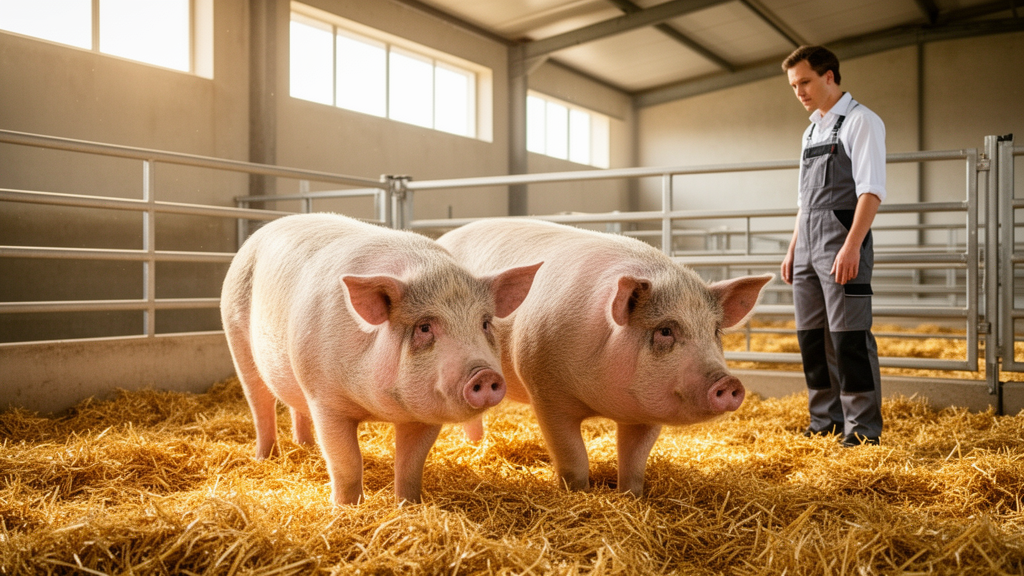
A new simulation study published in Genetics Selection Evolution demonstrates that assortative mating can improve the commercial genetic merit of boars in swine breeding programs, provided that inbreeding rates are strictly managed using optimum contribution selection. The research, led by Tobias A. M. Niehoff and colleagues, investigates how mating genetically similar animals affects genetic gain, diversity, and the accuracy of genomic predictions in the context of commercial nucleus breeding programs. The study specifically addresses the challenge of balancing short-term commercial outputs, such as the sale of semen, with the long-term investment of maintaining genetic diversity through the introduction of external alleles.
Commercial breeding programs face a dual objective: improving the genetic level of the nucleus breeding population and delivering competitive genetic products to production farms. However, managing genetic diversity often reduces the selection pressure available for immediate improvement. The researchers aimed to test whether assortative mating, which involves pairing the best males with the best females, could artificially increase the variance of breeding values in the next generation. This increased variance is expected to elevate the genetic level of the top animals, specifically the artificial insemination boars whose semen is marketed to producers. The study was particularly focused on programs that invest in diversity introduction by bringing lost or lowly related alleles from lower-performing sources into the elite nucleus.
The study utilized stochastic simulations to model a genomic selection swine breeding program. The simulation involved 2,400 animals per generation, generated from 40 sires and 400 dams, using the R package MoBPS. All animals were genotyped with a 20k SNP chip and phenotyped for a trait with a heritability of 0.3. The genomic prediction training set included data from the current generation and the previous five generations, totaling 14,400 genotyped and phenotyped animals. The researchers tested two specific assortative mating strategies: a ‘maximum’ strategy that aimed to increase genetic variance as much as possible, and a ‘tuned’ strategy that aimed to increase variance only as much as needed to match the genetic gain of a hypothetical competitor using random mating.
In the first simulation, which compared truncation selection and optimum contribution selection without diversity introduction, assortative mating increased genetic gain. When combined with truncation selection, which lacks inbreeding control, assortative mating resulted in higher genetic levels of AI boars by up to 0.6 genetic standard deviations compared to random mating. However, this approach led to a significantly faster decrease in genetic diversity. The inbreeding rate under truncation selection with assortative mating reached 2.22% per generation, compared to 1.30% for random mating. This elevated inbreeding rate caused a faster loss of genetic variance over time, eventually diminishing the initial gains in genetic merit.
When assortative mating was combined with optimum contribution selection, the results differed markedly. OCS is a selection method that optimizes the contributions of selected animals to maximize genetic gain while constraining the inbreeding rate. In the simulations, OCS kept the inbreeding rate close to the targeted value of 1% regardless of the mating strategy. Specifically, the inbreeding rates for random, disassortative, and assortative mating under OCS were 0.93%, 0.91%, and 0.96% per generation, respectively. Despite the similar inbreeding rates, assortative mating with OCS led to a higher variance of breeding values among selection candidates. This resulted in a higher genetic level of the elite boars from which semen was marketed, achieving a comparable population average genetic gain to random mating.
The second simulation examined the effects of assortative mating in multi-layer breeding programs that include diversity introduction. In these programs, a fraction of the resources is dedicated to backcrossing diversity donors to upgrade their genetic level before they are reintroduced into the elite population. The researchers found that when investing 10% of resources in diversity introduction, both tuned and maximum assortative mating had a small beneficial effect on commercial genetic gain in the short term. However, the benefit was not large enough to overcome the lower competitiveness associated with the reduced size of the elite population caused by diverting resources to diversity introduction.
Genomic prediction accuracies were also evaluated to determine if assortative mating introduced biases or reduced the reliability of estimated breeding values. Contrary to initial hypotheses, the study found no negative effects on prediction accuracy or biases due to the mating strategy. The within-family accuracy, which measures the correlation between true and estimated Mendelian sampling terms, remained similar across mating strategies. This suggests that the increase in overall accuracy observed under assortative mating was driven by the increased variance of parent average breeding values rather than a fundamental improvement in the model’s ability to predict individual genetic merit.
The ‘tuned’ assortative mating strategy, designed to limit anticipated negative effects on genomic prediction, was ultimately outperformed by the ‘maximum’ strategy. The researchers concluded that since no negative effects on prediction accuracy were observed, the complexity of the tuned strategy was unnecessary. They advised that if the inbreeding rate is under control, breeding program managers should use the maximum assortative mating strategy. The tuned strategy, which required calculating specific correlations between estimated breeding values of sires and dams, added procedural complexity without providing additional benefits in the simulated environment.
The study assumes that OCS can perfectly control the inbreeding rate, a condition that may not be perfectly attainable in practice. Furthermore, the study treated selection and mating as independent subsequent steps, whereas solving these problems simultaneously might yield additional benefits. The findings suggest that the benefits of assortative mating are highly dependent on the accuracy of genomic predictions and the genetic variance among selected animals.
The research highlights the importance of inbreeding control when implementing assortative mating. Without such control, the strategy leads to a rapid depletion of genetic diversity, which limits long-term genetic gain. The study concludes that assortative mating is a promising method to increase between-family variance and thereby improve commercial genetic gain, but only when paired with robust inbreeding management tools like optimum contribution selection. This approach allows breeding programs to capture the short-term benefits of increased genetic variance without the long-term costs of accelerated inbreeding.
The implications for commercial swine breeding are significant. By using assortative mating in conjunction with OCS, programs can enhance the genetic merit of the boars sold for artificial insemination. This is particularly relevant for programs that are investing in diversity introduction, as it helps to mitigate the short-term reduction in selection intensity caused by the smaller elite population size.
Future research should explore the simultaneous optimization of selection and mating strategies to potentially realize greater benefits. Additionally, the impact of using diversity donors from different breeds or lines, rather than the same breeding line as in this study, on genomic prediction accuracy requires further investigation. The study underscores the need for careful management of genetic diversity in the face of increasing reliance on genomic selection and commercial pressures for rapid genetic gain.
The mathematical framework underpinning the tuned mating approach reveals why certain breeding configurations proved unworkable. In their variance derivations, the authors noted that the correlation between sire and dam true breeding values cannot exceed the product of their respective estimated breeding value accuracies. When testing an earlier configuration that diverted 25% of breeding resources to diversity introduction, the correlation between parental breeding values mathematically required to match competitor performance frequently exceeded 1.0, an impossible threshold that forced the researchers to lower the resource allocation to 10%. To implement mate allocation in practice, the researchers sampled values from a bivariate normal distribution calibrated to the target correlation, ranking and pairing individuals according to their sampled positions across the distributions.
Beyond elite candidate performance, the simulations demonstrated notable differences in how diversity introduction affected long-term genetic connectedness across generations. Sires active ten generations prior to evaluation showed markedly higher genomic prediction accuracies—rising from approximately 0.35 in standard programs to 0.57 in diversity-introduction schemes—because backcrossing established stronger ties between historical ancestors and the evaluation training set. Incorporating diversity introduction also improved the efficiency of genetic conversion, yielding 0.92 to 0.95 genetic standard deviations of gain per percentage point increase in kinship, compared to 0.82 to 0.84 under random mating and maximum assortative mating without diversity introduction. Furthermore, evaluating old sires in diversity schemes exhibited less dispersion bias and diminished overestimation of past breeding values.
The study also revealed distinct temporal dynamics in parental breeding value relationships as new generation records accumulated. For instance, when matings were assigned in generation 19, the correlation between parental estimated breeding values stood at 0.47 for tuned mating and 0.96 for maximum assortative mating, but dropped to 0.33 and 0.71 once offspring phenotypes entered the training set in generation 20. Under random mating, researchers observed a persistent slight positive correlation of about 0.04 between sire and dam estimated breeding values after offspring data were incorporated, an artifact linked to dams producing multiple full-sibling piglets per litter.
Subject of Research: Effects of assortative mating on genetic gain and diversity in swine breeding programs using optimum contribution selection
Article Title: Restructuring breeding programs 2: Assortative mating for improved commercial genetic gain when using optimum contribution selection and diversity introduction
Article References: Niehoff, T. A. M., ten Napel, J., Pook, T., & Calus, M. P. L. (2026). Restructuring breeding programs 2: Assortative mating for improved commercial genetic gain when using optimum contribution selection and diversity introduction. Genetics Selection Evolution, 58(1), Article 32. https://doi.org/10.1186/s12711-026-01049-6
Image Credits: AI Generated
DOI: 10.1186/s12711-026-01049-6
Keywords: assortative mating, optimum contribution selection, swine breeding, genetic gain, genomic selection, inbreeding control, diversity introduction, stochastic simulation, estimated breeding values, commercial genetic merit, nucleus breeding, genetic variance, artificial insemination, breeding program design, genomic prediction accuracy, Mendelian sampling, kinship management, upcycling strategy, selection intensity, genetic diversity
News Source: Juliet Wilcox. (November 14, 2026). Assortative mating boosts pig breeding gains with inbreeding control. Scienmag.