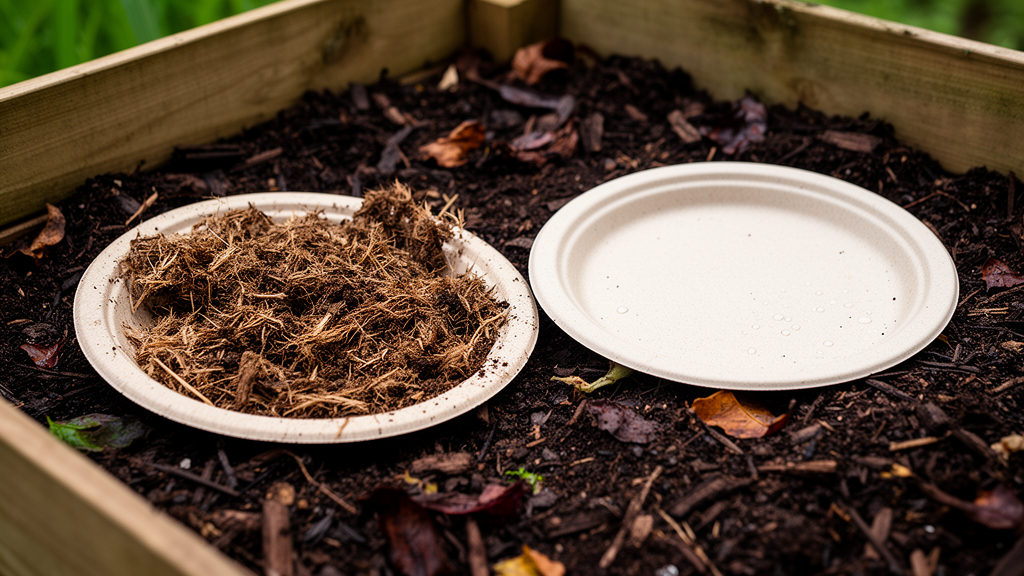
Bagasse foodware plates achieved complete disintegration and total mass loss within ten weeks of composting, whereas cornstarch-based plates failed standard compostability criteria by a wide margin over a twelve-week testing period. In experimental evaluations, the cornstarch plates attained only 21.05 percent dry mass disintegration and biodegradation mass loss by weight after twelve weeks of treatment. This performance fell far short of the established 90 percent disintegration threshold required by standard testing frameworks for satisfactory material breakdown, demonstrating a pronounced divergence in how different commercial bio-based materials degrade under composting conditions.
The investigation focused on bio-based alternatives to conventional plastic foodware, which are increasingly adopted as a primary intervention to reduce the environmental accumulation of persistent fossil-based polymers. Unlike conventional plastics that endure indefinitely in natural environments, bio-based polymers are specifically engineered for biological reintegration through designated end-of-life treatments such as composting. Nevertheless, although numerous commercial single-use items in the Philippine marketplace are actively marketed as compostable, many of these products have entered consumer circulation without localized, standards-based verification of their degradation behavior, particularly when placed in non-industrial or community composting environments.
To resolve this gap in empirical validation, the researchers conducted an experimental assessment of disposable plates fabricated from sugarcane bagasse and cornstarch under rigorous standardized criteria. The experimental methodology followed established international and national protocols, specifically aligning with ISO 16929, ISO 17088, and Philippine National Standard PNS/BAFS 183:2020. Across a twelve-week experimental period, the authors systematically measured physical material disintegration, recorded mass loss as an indicator of biodegradation, and evaluated the chemical characteristics and agronomic quality of the resulting compost matrices.
The degradation trials revealed sharp contrasts in the disintegration kinetics and biological breakdown rates of the two foodware materials. Bagasse plates underwent rapid and comprehensive disintegration, attaining 100 percent dry mass loss by weight by the tenth week of the composting cycle. Conversely, the cornstarch-based alternatives resisted breakdown throughout the entire monitoring period, concluding the twelve-week test with only 21.05 percent total dry mass disintegration. Because the cornstarch material failed to achieve the mandatory 90 percent mass reduction mark, it did not satisfy the fundamental criteria for compostable designation under the tested framework.
Beyond assessing the structural disappearance and mass loss of the foodware, the study analyzed the chemical composition of the final compost to determine its safety and value as an organic soil amendment. Both the bagasse and cornstarch compost mixtures conformed to established standards regarding essential macronutrient content—specifically nitrogen, phosphorus, and potassium (NPK)—and maintained heavy metal concentrations within permissible regulatory thresholds. However, the compost mixture derived from bagasse exhibited a slightly lower carbon-to-nitrogen ratio than optimal, indicating that initial organic feedstock mixtures must be adjusted to ensure appropriate nutrient balancing during practical composting applications.
Based on these experimental results, the authors concluded that certain commercial bio-based foodware products are unsuitable for unmanaged home composting systems and likely demand controlled industrial conditions to accomplish full biological degradation. The researchers noted that these findings provide critical empirical data to help guide waste management frameworks and consumer protection policies. Specifically, the authors emphasized the urgent necessity for regulatory standards that explicitly differentiate between home compostability and industrial compostability, preventing misleading commercial claims and ensuring bio-based foodware undergoes appropriate end-of-life processing.
Subject of Research: Compostability evaluation of bio-based bagasse and cornstarch foodware plates
Article Title: Investigation of the compostability of bio-based alternatives to conventional plastic foodware
Article References: Domingo, C. K. B., Jaudalso, X. A. D. M., Sadie, N. T., & Diola, M. B. L. D. (2026). Investigation of the compostability of bio-based alternatives to conventional plastic foodware. Clean Technologies and Environmental Policy, 28(12), Article 288. https://doi.org/10.1007/s10098-026-03634-1
Image Credits: AI Generated
DOI: 10.1007/s10098-026-03634-1
Keywords: bagasse foodware, cornstarch plates, compostability, biodegradation, bio-based alternatives, plastic foodware, ISO 16929, ISO 17088, PNS/BAFS 183:2020, material disintegration, mass loss, home composting, industrial composting, organic soil amendments, carbon-to-nitrogen ratio, waste management policy, Philippine market
News Source: Denise Maddox. (November 14, 2026). Bagasse Plates Degrade Fully in Compost While Cornstarch Alternatives Fall Short. Scienmag.