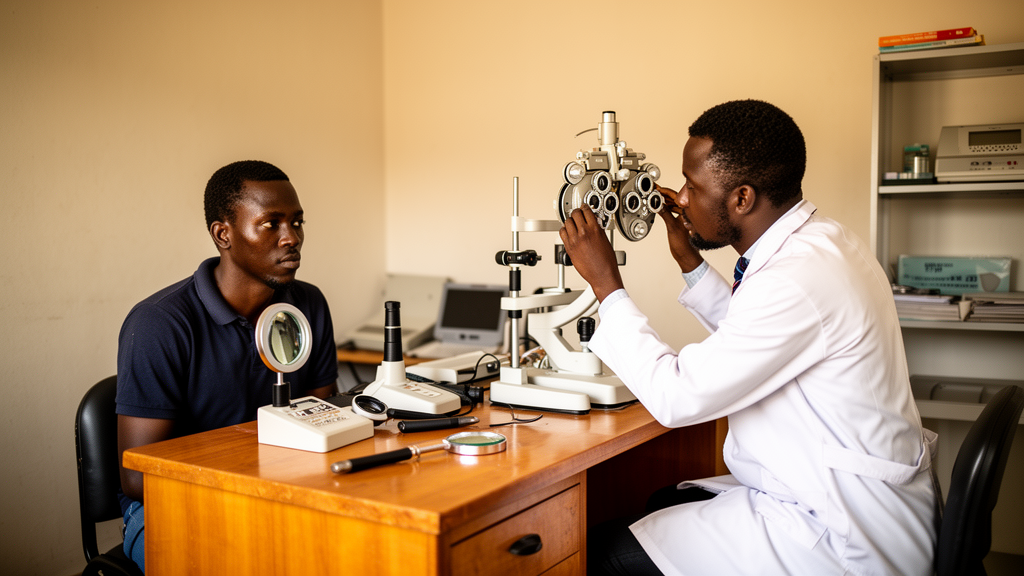
A qualitative evaluation examining two decades of human resource development for low vision care and rehabilitation in Ghana has revealed that while targeted training initiatives successfully upgraded practitioner competencies, substantial service-level obstacles severely limited sustained clinical provision. Although participating optometrists acquired specialized diagnostic and rehabilitative skills, follow-up assessments indicated that only 31.8 percent were actively delivering low vision services at the time of their interview. Conducted using the Context–Input–Process–Product evaluation model, the study underscores that educational interventions alone cannot secure long-term eye health delivery without direct alignment with operational clinical environments.
Low vision care and rehabilitation services in Ghana have historically relied upon a small cluster of specialized training programmes designed to close critical clinical voids. Researchers noted that these educational efforts primarily emerged in response to an identified undergraduate skills gap within conventional optometric curricula as well as specific health programme objectives. Over the twenty-year span from 2004 to 2024, non-governmental organizations and training bodies sought to expand the national eye care workforce, yet the degree to which these donor-supported workshops translated into permanent clinical practice across healthcare facilities remained largely unmeasured.
To systematically evaluate the trajectory of these human resource investments, investigators conducted a qualitative training evaluation using the Context–Input–Process–Product framework. Methodologically, the CIPP model was employed following data collection as an inductive analytic framework rather than as a prospective instructional design tool. Data were gathered through semi-structured interviews exploring original training objectives, instructional content, educational delivery, ongoing support structures, post-training professional experiences, and specific barriers encountered in clinical environments. Verbatim interview transcripts were subsequently coded and synthesized into thematic categories utilizing QDA Miner Lite software.
The scope of the investigation encompassed five distinct training organizations and six individual low vision training programmes carried out over the twenty-year review period. Across these initiatives, a total of 35 optometrists received specialized low vision instruction, with 22 of these trainees participating in detailed interviews alongside representatives from all five training entities. To guarantee historical precision, the investigators cross-referenced participant training narratives against official institutional archives. Participant interviews were conducted through face-to-face sessions, telephone conversations, or online videoconferencing according to individual preference.
In analyzing the input and process dimensions of the initiatives, the researchers determined that training models typically relied on short, donor-funded practical courses accompanied by equipment support. Programmes supported by non-governmental organizations supplied hands-on clinical instruction, essential diagnostic devices, and structured community outreach assistance. Furthermore, several programmes integrated follow-up refresher courses or mentorship opportunities to help optometrists consolidate their technical proficiencies following their initial educational training.
Despite demonstrable gains in practitioner skills, systemic workplace constraints impeded the translation of training into active patient care. Trainees and organizational representatives highlighted pervasive barriers, including compressed training durations, shifting donor or project priorities, insufficient access to low vision devices and clinical space, excessive general patient workloads, lack of remuneration, low public awareness of services, and disruptive institutional staff transfers. Consequently, while active low vision care practice rose from 13.6 percent—representing 3 of the 22 interviewed optometrists prior to training—to 31.8 percent, or 7 of 22 practitioners at the time of interview, the net gain of 18.2 percentage points demonstrated that workforce sustainability ultimately depends on post-training service conditions, protected clinical capacity, supportive deployment policies, institutional recognition, and continuing professional development.
In their concluding assessment, the researchers emphasized that improving the long-term delivery of low vision care and rehabilitation across Ghana requires moving beyond isolated educational workshops toward a coordinated national workforce strategy. Because individual competency gains did not automatically translate into routine healthcare provision, the study authors highlighted the necessity of tying clinical instruction directly to stable equipment supplies, formal institutional recognition, and protected service capacity within local health facilities.
The evaluation further concluded that sustaining specialized services depends heavily on supportive professional environments following training. According to the study findings, aligning donor and training initiatives with structured deployment policies and continuing professional development opportunities will be essential to ensure optometrists can maintain active clinical rehabilitation practice amid competing routine workloads and evolving organizational priorities.
Subject of Research: Qualitative evaluation of low vision care and rehabilitation training outcomes in Ghana
Article Title: A twenty-year review of human resource development for low vision care and rehabilitation in Ghana: a qualitative training evaluation using the CIPP framework
Article References: Abraham, C. H., Morny, E., Darko-Takyi, C., Mohammed, H., Ampong, J. A., Osei, K. O., Osafo, G. A., Botchway, E., Yinemi, D. K., & Mensah, T. O. (2026). A twenty-year review of human resource development for low vision care and rehabilitation in Ghana: a qualitative training evaluation using the CIPP framework. BMC Health Services Research. https://doi.org/10.1186/s12913-026-16124-3
Image Credits: AI Generated
DOI: 10.1186/s12913-026-16124-3
Keywords: Ghana, low vision care, vision rehabilitation, optometry, optometrists, CIPP framework, human resource development, qualitative training evaluation, health workforce, continuing professional development, clinical practice barriers, health services research, donor-funded training, semi-structured interviews, QDA Miner Lite, undergraduate skills gap, refresher training, equipment support
News Source: Ophelia Keating. (November 13, 2026). Training Increases Low Vision Practice in Ghana but Systemic Barriers Persist. Scienmag.