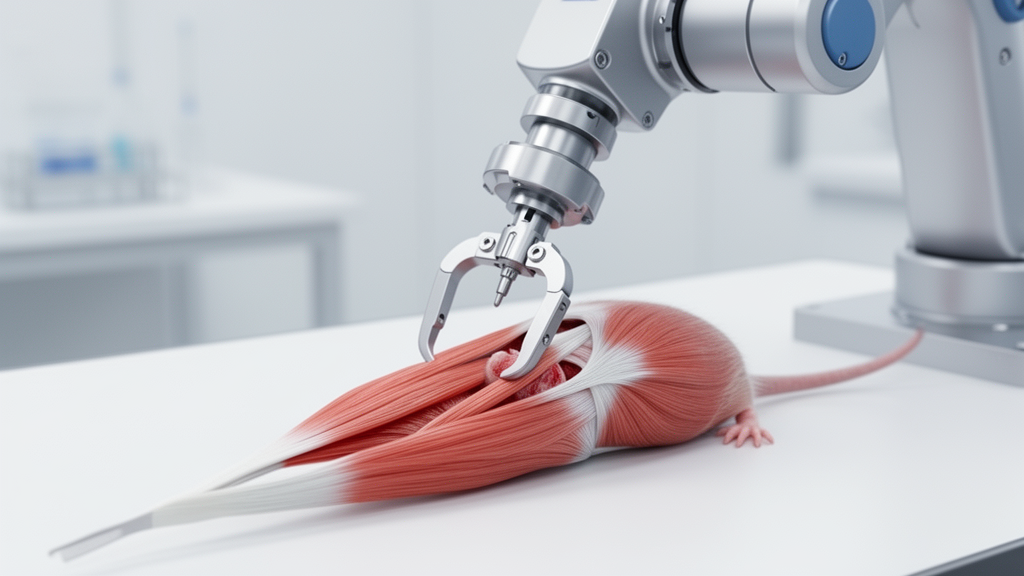
Biomedical researchers have engineered a vision-guided desktop robotic platform that delivers closed-loop mechanical stimulation to rodent muscle tissue while simultaneously quantifying real-time tissue deformation through high-frequency ultrasound imaging. Developed through a collaborative effort between Southern Medical University and Guangdong University of Technology, the automated system addresses a long-standing challenge in preclinical mechanotherapy research: the lack of standardized, reproducible mechanical dose delivery across experimental animal models. In an exploratory evaluation published in Frontiers in Bioengineering and Biotechnology, investigators tested the apparatus across twenty-four male Sprague-Dawley rats and twenty-four male C57BL/6 mice subjected to graded mechanical loading regimens over a two-week period. By integrating three-dimensional surface localization, millinewton-level dynamic force regulation, and immediate acoustic measurement of tissue displacement, the platform demonstrated that applied external forces produce distinct, measurable tissue-level physical deformations and structural biological responses without causing overt local or systemic tissue injury.
Mechanical signals serve as critical regulators of skeletal muscle physiology, driving intracellular biochemical pathways through mechanosensitive structures such as integrin-based focal adhesions, stretch-activated ion channels, cytoskeletal filaments, and nuclear mechanotransduction complexes. These cellular events modulate extracellular matrix remodeling, inflammatory signaling, and tissue adaptation during muscular repair and functional regeneration. Therapies such as manual massage and compressive mechanotherapy seek to harness these mechanical cues to accelerate tissue healing. However, translational investigation has historically been impeded by operator-dependent variability in manual administration, where compressive force magnitudes, contact surface geometries, anatomical trajectories, and intervention durations vary widely across experimental sessions. Previous mechanized devices, including cyclic compressive apparatuses and motor-driven manipulators, partially mitigated these inconsistencies by automating mechanical delivery. Yet, earlier technologies typically relied on static, predefined positioning or lacked integrated adaptive feedback, failing to combine spatial anatomical localization, continuous force monitoring, immediate structural deformation tracking, and comprehensive systemic tolerability evaluations into a unified experimental architecture.
To overcome these technical constraints, the research team constructed a multi-component desktop platform centered around a programmable robotic arm possessing a mechanical positioning repeatability of zero point two millimeters. Surface imaging and spatial tracking were mediated by an overhead Intel RealSense depth camera capturing color streams at nineteen-twenty by ten-eighty pixels and depth profiles at eight-forty-eight by four-eighty pixels at thirty hertz, situated at an operational working distance of thirty to thirty-two centimeters above the surgical field. Spatial alignment between the optical coordinate space and the robotic manipulator was established through a calibration plate featuring sixteen distinct geometric reference points, each registered twenty consecutive times to calculate an affine coordinate transformation matrix. Following spatial registration, reconstructed color point clouds of animal body surfaces were analyzed using B-spline curve fitting, curvature-constrained optimization, and normalized arc-length models to identify anatomical midlines and determine normal surface vectors for loading-head placement. Localization validation trials revealed mean positioning errors of one point four two three millimeters in rats and one point eight zero seven millimeters in mice, providing sufficient regional accuracy for targeting selected muscular compartments.
Mechanical force was administered through interchangeable hemispherical silicone loading heads with a Shore durometer of fifty HA, linked axially to an end-effector pressure sensor and signal transducer. The force-sensing apparatus sampled normal contact resistance at two hundred hertz with a measurement range reaching nine point eight newtons, demonstrating a full-scale sensor error within plus or minus one percent and an end-to-end response latency of approximately ten milliseconds. During experimental interventions, the robotic manipulator executed a four-stage cyclic pressing-kneading pattern at zero point five hertz, tracing a circular path with an outer swept diameter double that of the contact head. An adaptive control algorithm updated the vertical axis position iteratively at frequencies up to approximately two hundred sixty-two hertz. When measured contact force registered below ninety percent of the target threshold, the system applied larger downward steps, switching to smaller increments as target forces were neared to eliminate mechanical overshoot. In dynamic performance evaluations conducted in mice across zero point one, zero point two, and zero point four newton settings, observed mean peak forces reached zero point zero nine five, zero point one nine three, and zero point three eight seven newtons, achieving target-reaching rates of sixty-eight point eight nine percent, ninety-three point three three percent, and ninety-three point three three percent, respectively.
Geometrical dimensions for the contact interfaces were derived from body-surface-area ratios calculated via the empirical Meeh-Rubner relationship, establishing human-to-rodent scaling references based on an average human thumb contact area of one hundred eighty square millimeters. This proportional framework yielded equivalent contact surface areas of approximately three point nine nine square millimeters for rats and zero point eight four square millimeters for mice, corresponding to hemispherical head diameters of two point three millimeters and one point zero millimeter, respectively. Because body-surface scaling served solely as a geometric reference, operational loading force thresholds were established empirically from prior mechanotherapy literature and preliminary dose-finding tests. In preliminary investigations, forces falling below zero point six newtons in rats and zero point one newtons in mice elicited negligible local biological responses, whereas compressive loads exceeding one point zero newton in rats and zero point four newtons in mice induced visible epidermal trauma. Consequently, six-animal cohorts of male Sprague-Dawley rats received zero point six, zero point eight, or one point zero newtons over the right tibialis anterior muscle, while male C57BL/6 cohorts received zero point one, zero point two, or zero point four newtons bilaterally across the cervical musculature.
To assess internal mechanical transmission directly, investigators utilized a high-frequency B-mode ultrasound imaging system equipped with a thirty-megahertz linear-array transducer aligned to anatomical skeletal landmarks. Preliminary probe repositioning experiments confirmed high repeatability across consecutive acquisitions in both species. During operational loading sessions, two-dimensional B-mode sequences were captured before, during, and immediately after force application, with blinded investigators delineating tissue boundaries on five consecutive frames at peak force to measure the displaced tissue contour area in square millimeters. Acoustic analysis demonstrated that ultrasound-visible deformation increased monotonically alongside applied mechanical force in both biological models. In rats, tibialis anterior deformation area expanded from approximately twenty-four to twenty-nine square millimeters across the tested force gradient, revealing significant overall group differences and a strong linear correlation between applied load and structural displacement. Similarly, mouse cervical deformation areas increased from approximately three point five to eight point zero square millimeters, exhibiting robust linear progression. These acoustic measurements confirmed that prescribed external mechanical loads successfully translated into quantifiable tissue-level compressive strains, even though two-dimensional cross-sectional imaging inherently captures localized planar displacement rather than complete volumetric three-dimensional strain fields.
Systematic behavioral testing conducted before intervention and on days three, seven, ten, and fourteen revealed that repeated mechanical stimulation produced measurable alterations in sensory and motor performance without causing behavioral deterioration. In SD rats, paw withdrawal thermal latencies displayed gradual increases across the fourteen-day timeline without significant interaction between experimental grouping and time. However, paw withdrawal mechanical thresholds measured by electronic von Frey algesiometry and motor endurance latencies recorded on an accelerating five-lane rotarod showed statistically significant group-by-time interactions, with loaded animals demonstrating elevated mechanical withdrawal thresholds and lengthened latency before falling during later testing sessions. Comparable patterns were documented in C57BL/6 mice, where thermal withdrawal latencies exhibited no group-by-time divergence, but mechanical thresholds and rotarod persistence showed significant interactive effects across treatment groups over time. Furthermore, open field exploratory assessments conducted at the trial conclusion revealed statistically significant group differences in both species regarding total walking distance and mean travel velocity. Rather than demonstrating therapeutic clinical efficacy, the researchers emphasized that these behavioral variations serve as evidence of functional physiological responsiveness to repetitive robotic loading regimens.
Comprehensive post-intervention histological examinations confirmed that repeated mechanical loading maintained local structural integrity while stimulating internal tissue remodeling within the targeted muscular compartments. Gross anatomical observation showed transient skin depressions without ulceration, laceration, or visible contusions. Staining of tissue cross-sections with hematoxylin and eosin demonstrated preserved myofiber architecture in both the rat tibialis anterior and mouse cervical muscles, with no statistically significant differences emerging in total wet muscle weight or the proportion of damaged myofibers relative to sham-treated controls. Concurrently, quantitative image analysis revealed significant load-dependent structural remodeling: myofiber cross-sectional area exhibited statistically significant shifts among experimental groups, reaching maximum expansion at zero point eight newtons in rats and zero point two newtons in mice. Masson’s trichrome staining demonstrated progressive increases in collagen-positive area across loaded tissues, while immunofluorescence microscopy revealed significant increases in CD31 endothelial fluorescent intensity, indicating elevated microvascular signal density. The authors noted that while these changes signify load-induced extracellular matrix and vascular remodeling, they do not distinguish beneficial tissue adaptation from early-stage fibrotic deposition or confirm functional capillary angiogenesis in the absence of molecular pathway validation.
Systemic physiological evaluations confirmed that the robotic intervention was well tolerated throughout the fourteen-day protocol across all tested cohorts. Monitored body weights remained stable or followed expected growth trajectories across the two-week intervention window, exhibiting no signs of loading-related wasting or distress. Automated hematological screening and clinical serum biochemistry revealed no consistent pathological abnormalities in markers of renal clearance, muscle tissue damage, or circulating electrolyte homeostasis, including creatinine, blood urea nitrogen, lactate dehydrogenase, creatine kinase, calcium, and phosphorus. Histological inspection of primary systemic metabolic and immune filter organs, including the liver, spleen, and kidneys, displayed well-preserved cellular architecture free of overt structural degeneration or inflammatory necrosis. Enzyme-linked immunosorbent assays examining circulating inflammatory mediators showed species-specific cytokine patterns: rats exhibited statistically significant alterations across interleukin-one beta, tumor necrosis factor alpha, interleukin-ten, and prostaglandin E2 levels, whereas mice demonstrated significant alterations in interleukin-one beta and tumor necrosis factor alpha alongside unchanged concentrations of interleukin-ten and prostaglandin E2. The investigators interpreted these modest biochemical shifts as evidence of systemic inflammatory modulation rather than systemic toxicity.
Despite the successful demonstration of automated force delivery, several experimental constraints define the boundaries of the present findings. The study was conducted as an exploratory feasibility investigation using six healthy young male animals per cohort without formal a priori statistical power calculations, which constrains the statistical precision of secondary biological endpoints and leaves potential variations associated with biological sex, advanced age, or underlying pathology unexamined. Furthermore, while the platform successfully documented acoustic tissue deformation, the two-dimensional nature of B-mode ultrasound precludes full volumetric characterization of three-dimensional tissue strains and shear vectors occurring during circular pressing-kneading motions. Additionally, because manual tissue deformation in human subjects was not measured, the platform did not establish direct deformation-equivalent loading conversions across human and animal tissues, relying instead on surface-area scaling for contact heads and empirical force windows. The investigators concluded that subsequent iterations must integrate three-dimensional ultrasound elastography, finite-element computational modeling, and expanded trials in pathological disease models to rigorously advance mechanized small-animal mechanotherapy toward translational clinical relevance.
Subject of Research: Preclinical robotic mechanical loading and ultrasound tissue deformation assessment in rodents
Article Title: A vision-guided robotic platform for mechanical loading, ultrasound-visible tissue deformation assessment, local and systemic tolerability evaluation in rat and mouse skeletal muscle
Article References: Zhong, W.-X., Lin, Y.-X., Cai, H.-T., Zhang, Z.-S., Yu, Y.-S., Wu, P.-X., Kuang, S.-S., Tang, L.-X., Li, J.-H., & Li, Y.-K. (2026). A vision-guided robotic platform for mechanical loading, ultrasound-visible tissue deformation assessment, local and systemic tolerability evaluation in rat and mouse skeletal muscle. Frontiers in Bioengineering and Biotechnology, 14, Article 2005997. https://doi.org/10.3389/fbioe.2026.2005997
Image Credits: AI Generated
DOI: 10.3389/fbioe.2026.2005997
Keywords: mechanotherapy, robotics, skeletal muscle, ultrasound imaging, closed-loop control, tissue deformation, biomechanics, preclinical models, vision-guided, robotic, platform, mechanical
News Source: Gregory Coleman. (November 13, 2026). Vision-Guided Robotic Platform Standardizes Mechanical Tissue Loading in Rodent Muscle Models. Scienmag.