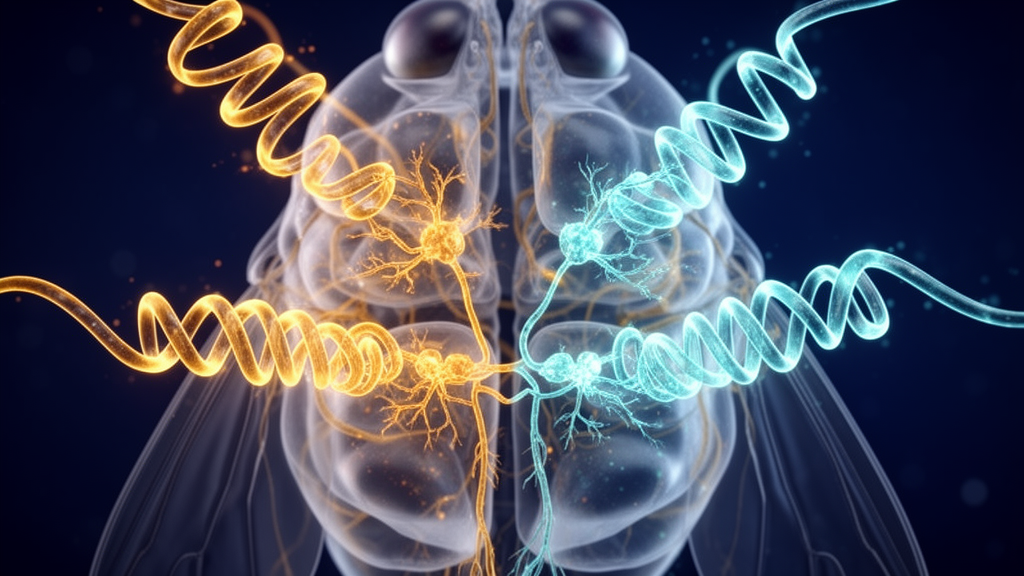
Molecules implicated in host defense can regulate sleep independently of their established roles as immune mediators, according to a study investigating Drosophila fruit flies. While earlier research in mammals established that cytokines such as Tumor Necrosis Factor α (TNF α) and Interleukin-1β (IL-1β) promote sleep, the diverse antimicrobial peptides released during infection in flies have remained largely understudied as sleep modulators. To investigate these immune effectors, a research team including Rahul Kumar, Gokul Madhav, Priyanka Balasubramanian, Ayur Tadimalla, Rhea Lakhiani, and Krishna Melnattur characterized how mutations in different antimicrobial peptides influence sleep parameters and plasticity.
The authors observed that mutations in different antimicrobial peptides caused consistent and notable impairments in sleep behavior. Fruit flies carrying these antimicrobial peptide mutations slept significantly less overall, exhibited a longer sleep latency before falling asleep, and displayed lowered arousal thresholds when exposed to stimuli. In addition, while sleep deficits were widespread across multiple classes of antimicrobial peptides, different sets of mutant flies exhibited distinct disruptions in specific sleep modalities, including disruptions in sleep induced by socialization and sleep induced by rocking.
Among the evaluated strains, Group C mutant flies—doubly mutant for the antifungal peptides Metchnikowin (Mtk) and Drosomycin (Drs)—showed the greatest impairments of all lines tested. In addition to sleeping the least, Group C mutants uniquely exhibited an exaggerated sleep rebound after sleep deprivation, whereas sleep rebound remained unaltered in the other antimicrobial peptide mutants examined. The researchers also traced the cellular origin of this regulation to non-neuronal support cells. Knockdown of Metchnikowin and Drosomycin specifically in glia closely mimicked the sleep phenotypes of null mutants, demonstrating that these antimicrobial peptide genes act from glia to modulate sleep.
To evaluate whether the total amount of sleep and the execution of sleep functions can be dissociated, the researchers evaluated memory retention and quantified synapse abundance in the flies. Intriguingly, despite sleeping the least among all tested strains, Group C mutants uniquely retained normal learning and memory while exhibiting lower synapse abundance. These findings indicate that Group C mutant flies are capable of carrying out essential sleep functions despite severe reductions in sleep duration, revealing that the physiological need for sleep duration can be decoupled from certain cognitive and synaptic outcomes.
In contrast to the preserved cognitive abilities observed in Group C flies, other antimicrobial peptide mutants suffered from distinct impairments in both sleep and memory. Importantly, the researchers demonstrated that these cognitive and sleep defects were fully reversible. When investigators enhanced sleep in Bomanin mutants using either pharmacological agents or behavioral methods, the flies showed clear improvements in learning and memory. Together, the collected data establish that antimicrobial peptides serve as potent modulators of sleep in Drosophila, with different classes of peptides exerting divergent effects on sleep patterns and sleep-dependent plasticity.
Subject of Research: Antimicrobial peptide regulation of sleep and plasticity in Drosophila
Article Title: Mutations in antimicrobial peptides differently affect sleep and plasticity
Article References: Kumar, R., Madhav, G., Balasubramanian, P., Tadimalla, A., Lakhiani, R., Joshi, M., Jaggi, V., Pal, A., Khan, I., & Melnattur, K. (2026). Mutations in antimicrobial peptides differently affect sleep and plasticity. PLOS Genetics, 22(11), e1012363. https://doi.org/10.1371/journal.pgen.1012363
Image Credits: AI Generated
DOI: 10.1371/journal.pgen.1012363
Keywords: Antimicrobial peptides, Drosophila, Sleep regulation, Plasticity, Metchnikowin, Drosomycin, Bomanin, Glia, Sleep latency, Arousal threshold, Sleep rebound, Synapse abundance, Learning and memory, Cytokines, Tumor necrosis factor alpha, Interleukin-1 beta, Immune effectors, Host defense
News Source: Drew Townsend. (November 13, 2026). Antimicrobial Peptides in Fruit Flies Distinctly Regulate Sleep Duration and Plasticity. Scienmag.