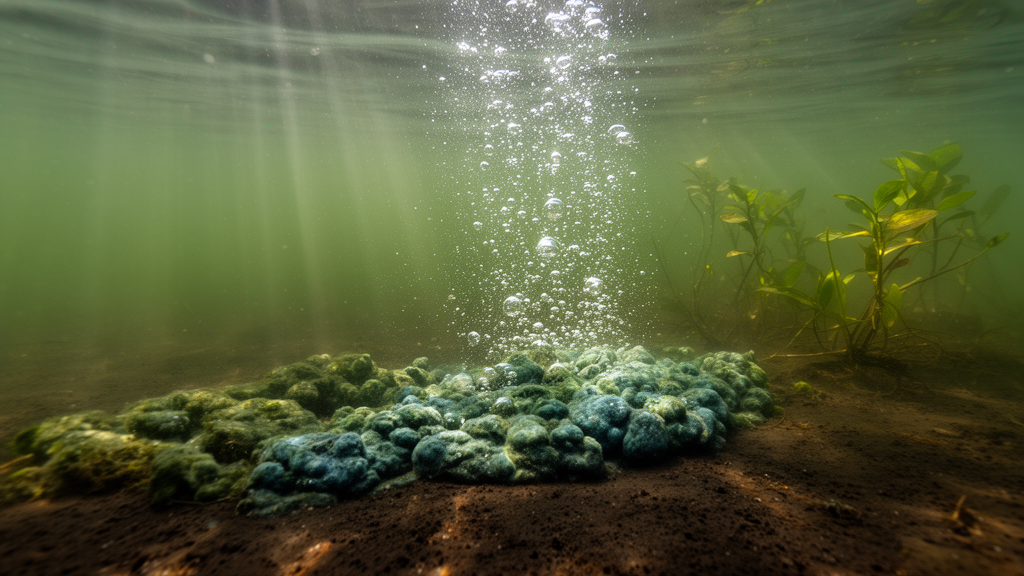
Laboratory incubation experiments examining the decomposition dynamics of freshwater primary producers have revealed that decaying cyanobacteria generate substantially greater greenhouse gas emissions and nutrient releases than submerged macrophytes under anaerobic conditions. In a controlled investigation using microcosms prepared with sediment and water from lake environments, researchers found that cyanobacterial breakdown yielded cumulative methane emissions of 154.79 ± 16.16 milligrams of carbon over a 117-day observation period, whereas cumulative methane emissions from submerged macrophyte species remained between 109.22 and 115.35 milligrams of carbon. The experimental findings also showed that the differences in gas output emerged rapidly during the initial decomposition phases, indicating that the structural composition and carbon availability of senescent organic matter exert a direct control over microbial gas generation in freshwater ecosystems.
Lakes play a pivotal role in global biogeochemical cycles by regulating carbon emissions and nutrient transformations, functioning as natural sources of methane and carbon dioxide despite occupying roughly two percent of Earth’s surface. In shallow freshwater systems such as Taihu Lake in eastern China, environmental conditions can shift between alternative stable states consisting of clear-water regimes dominated by submerged macrophytes or turbid regimes characterized by recurring cyanobacterial blooms. While submerged macrophytes help stabilize sediments and improve water clarity during their active growth, their eventual senescence leads to organic matter decomposition that releases greenhouse gases and dissolved nutrients. Understanding the precise biogeochemical trajectories that distinguish algal decay from macrophyte breakdown is therefore essential for evaluating whether vegetation restoration can mitigate greenhouse gas fluxes or inadvertently contribute to prolonged internal nutrient loading.
To directly compare these decay trajectories under standardized conditions, the research team harvested cyanobacterial biomass from Zhushan Bay, a northern region of Taihu Lake known for frequent blooms, using a 64-micrometer plankton net. In contrast, three representative submerged macrophyte species—Ceratophyllum demersum, Vallisneria natans, and Potamogeton wrightii—were gathered from Xukou Bay, an eastern area of the lake characterized by macrophyte proliferation. Active sediment layers were simultaneously collected down to a depth of approximately ten centimeters, sieved through a 0.15-millimeter mesh to eliminate coarse detritus, and homogenized. In addition, water collected from Caiyue Lake was pre-filtered through a 0.15-millimeter screen to serve as a uniform culture medium for five distinct experimental treatments established in triplicate across 500-milliliter headspace bottles.
The experimental setup consisted of an unamended control group containing only water and sediment alongside four organic matter treatments standardized to introduce approximately 350 milligrams of total organic carbon. These additions corresponded to one gram of cyanobacteria, 1.5 grams of Ceratophyllum demersum, 1.5 grams of Vallisneria natans, and two grams of Potamogeton wrightii. To simulate the oxygen-depleted environments typical of lake sediment degradation, each microcosm was purged with high-purity nitrogen gas for 15 minutes, sealed with butyl rubber stoppers, and flushed a second time 24 hours later to ensure completely anaerobic conditions. The bottles were subsequently incubated in total darkness at a constant temperature of 25 degrees Celsius for 117 days, with gas and water samples retrieved on days 1, 3, 5, 7, 11, 15, 19, 25, 31, 37, 43, 49, 61, and 117 using a destructive sampling procedure.
Analysis of the gaseous headspace revealed pronounced disparities in gas production kinetics between the algal and plant treatments. Gas concentrations measured using an Agilent 7890B gas chromatograph equipped with flame ionization and electron capture detectors demonstrated that cumulative carbon dioxide emissions reached 69.49 ± 7.40 milligrams of carbon in the cyanobacteria treatment, compared to 57.68 to 59.19 milligrams of carbon in the macrophyte treatments. By day 25 of incubation, cumulative methane emissions in the cyanobacteria treatment were 1.37 to 1.89 times higher than those observed in the macrophyte groups. Statistical modeling via generalized additive models confirmed that methane emission trajectories differed significantly between cyanobacteria and the three macrophyte species, while methane fluxes among the macrophyte species themselves showed no statistically significant differences.
Water chemistry analyses further demonstrated that organic matter breakdown generated stark divergences in nitrogen and phosphorus concentrations in the overlying water column. Digestion of water samples revealed that total nitrogen and ammonium nitrogen concentrations in the cyanobacteria treatment escalated continuously throughout the incubation, culminating in final concentrations of 276.42 ± 7.68 milligrams per liter and 276.33 ± 7.67 milligrams per liter, respectively. In contrast, total nitrogen and ammonium concentrations across all three submerged macrophyte treatments remained below 50 milligrams per liter over the entire 117-day experiment, rendering nitrogen-related nutrient levels in the cyanobacteria treatment 5.90 to 7.67 times greater at study completion, while nitrate concentrations remained statistically indistinguishable across all treatments and controls.
Phosphorus dynamics followed distinct temporal trajectories, with the cyanobacteria treatment exhibiting an initial total phosphorus peak of 17.27 ± 1.37 milligrams per liter before declining over time. Among the submerged macrophyte species, initial phosphorus concentrations varied, with Potamogeton wrightii displaying higher starting concentrations than Vallisneria natans, while Ceratophyllum demersum maintained consistently low total phosphorus concentrations below five milligrams per liter throughout the 117-day period. Statistical evaluations identified a significant difference in the phosphorus trend of Ceratophyllum demersum relative to the other treatments, indicating that this species releases phosphorus at a substantially lower rate during tissue breakdown, likely due to differences in tissue composition or reduced microbial degradability.
Carbon fractions in the water column exhibited distinct phase shifts during the degradation process. In the cyanobacteria treatment, total carbon dropped sharply from an initial 709.52 ± 53.50 milligrams per liter to 289.77 ± 13.66 milligrams per liter within the first 19 days, reflecting a 95.03 to 98.85 percent loss of total organic carbon as labile compounds were rapidly metabolized by microorganisms. Subsequently, total carbon increased steadily to a peak of 940 ± 9.26 milligrams per liter by day 117. The macrophyte treatments exhibited an initial rise in total organic carbon over the first seven days, followed by a decline by day 31 and a subsequent secondary increase. Inorganic carbon increased progressively across all treatments, reaching 226.29 ± 1.34 milligrams per liter in the cyanobacteria group, which correlated positively with cumulative carbon dioxide release and pointed to the dissolution of carbon dioxide into bicarbonate as an internal aqueous carbon reservoir.
Correlation analyses using 999 permutations revealed that cumulative methane and carbon dioxide emissions across all treatments were significantly positively correlated with inorganic carbon, total nitrogen, and ammonium nitrogen, while being significantly negatively correlated with total organic carbon, total phosphorus, and nitrate nitrogen. These relationships illustrate how the mineralization of organic matter directly governs greenhouse gas synthesis under anaerobic regimes. Cyanobacterial biomass, which possesses lower carbon-to-nitrogen ratios and lacks complex structural polymers such as lignin and cellulose, decomposes rapidly to provide abundant substrates for methanogenic microorganisms. Conversely, the higher carbon-to-nitrogen ratios and more complex tissues of submerged macrophytes retard microbial degradation, moderating substrate supply and reducing short-term greenhouse gas release.
The study authors emphasize that while submerged macrophytes such as Vallisneria natans and Ceratophyllum demersum demonstrate clear capacity to suppress greenhouse gas production and limit nutrient release compared to cyanobacteria, these observations derive from closed anaerobic laboratory microcosms. The researchers stress that field validation and extended environmental monitoring remain necessary to establish whether these species maintain ecological stability and mitigate greenhouse gas emissions under open lake conditions, where variable hydrology, seasonal temperature fluctuations, dissolved oxygen dynamics, and excessive plant biomass accumulation can introduce competing ecological risks.
Beyond broad contrasts between algae and plants, the trials documented nuanced differences among the macrophyte species, particularly regarding carbon dioxide emissions. The cyanobacteria treatment differed significantly in carbon dioxide release only from Potamogeton wrightii. Early in the incubation, Potamogeton wrightii produced higher carbon dioxide emissions than cyanobacteria before being surpassed, while its overall carbon dioxide output remained significantly greater than that of Vallisneria natans. Because all three submerged macrophytes possessed comparable bulk carbon-to-nitrogen ratios, the authors noted that this interspecific divergence cannot be explained by elemental stoichiometry alone. Instead, variation in tissue architecture, the proportion of readily soluble carbohydrates, or distinctive microbial colonization likely governed early-stage carbon mineralization across different macrophyte species.
The investigation also highlighted contrasting biochemical forms and decoupling behaviors between nitrogen and phosphorus during decomposition. While phosphorus released from decaying cyanobacteria occurs largely as labile peptides that trigger immediate microbial consumption, macrophyte phosphorus remains bound within less accessible aliphatic hydrocarbons and unsaturated structures. Furthermore, highly soluble ammonium remained dissolved in the overlying water, whereas dissolved phosphorus underwent microbial uptake and sediment adsorption. This behavioral difference caused nitrogen and phosphorus dynamics to decouple, driving a progressive increase in the water column’s nitrogen-to-phosphorus ratio, most prominently in the cyanobacteria microcosms.
This rising nitrogen-to-phosphorus ratio carries important consequences for microbial metabolism and internal nutrient cycling. As available phosphorus is depleted, microbial communities experience phosphorus limitation, which can induce the upregulation of oxidative enzymes such as phenol oxidase to acquire organic phosphorus from residual material. This enzymatic shift accelerates organic matter breakdown, creating self-reinforcing feedback loops that sustain carbon mineralization and elevate greenhouse gas production. In contrast, the submerged macrophyte treatments maintained more stable nitrogen-to-phosphorus ratios and released phosphorus with lower bioavailability, helping to preserve balanced microbial nutrient uptake and limiting the internal nutrient cycles that drive eutrophication.
Subject of Research: Freshwater plant and cyanobacteria decomposition impacts on lake greenhouse gas emissions and nutrient cycling
Article Title: Decomposition of cyanobacteria and submerged macrophytes: impacts on carbon emissions and nutrient cycling in lake ecosystems
Article References: Wang, H., Cui, Y., Ma, J., Pei, Z., Bian, G., He, F., Ji, M., & Xu, X. (2026). Decomposition of cyanobacteria and submerged macrophytes: impacts on carbon emissions and nutrient cycling in lake ecosystems. Carbon Research, 5(1), Article 18. https://doi.org/10.1007/s44246-025-00253-1
Image Credits: AI Generated
DOI: 10.1007/s44246-025-00253-1
Keywords: cyanobacteria decomposition, submerged macrophytes, methane emissions, carbon dioxide emissions, lake biogeochemistry, Taihu Lake, Ceratophyllum demersum, Vallisneria natans, Potamogeton wrightii, nutrient cycling, ammonium release, total nitrogen, total phosphorus, internal carbon sink, generalized additive model, anaerobic decomposition, eutrophication management
News Source: Marcus Vaughn. (November 13, 2026). Cyanobacteria Breakdown Triggers Higher Lake Methane Emissions Than Submerged Macrophytes. Scienmag.