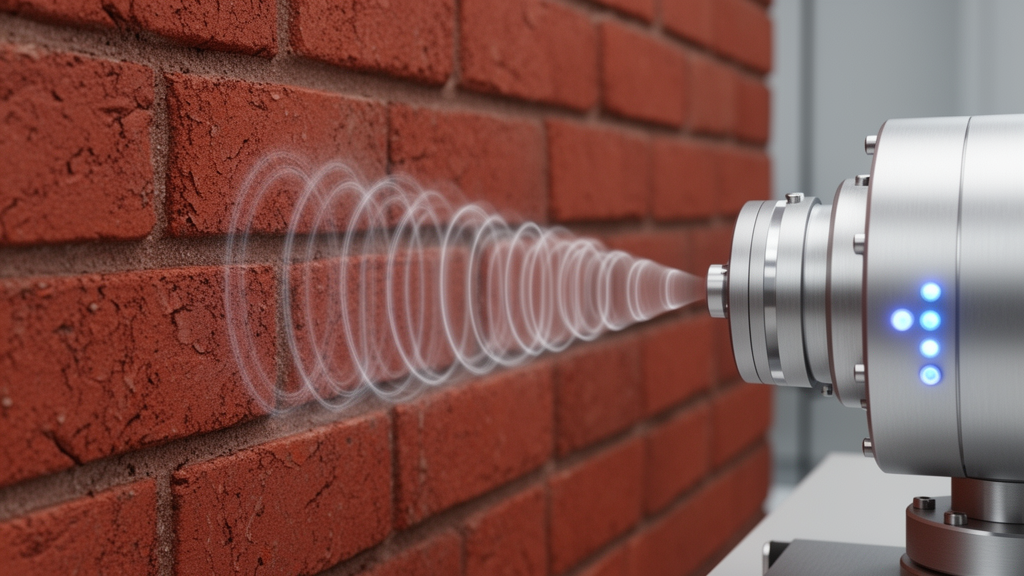
Researchers at the University of Queensland have experimentally transmitted information through a solid brick wall by modulating a gravitational field. Conducted as an experimental study published in Science Advances, the demonstration utilized an elevator and a sensitive gravimeter to send a message without relying on electromagnetic radiation.
The experiment was carried out in the university’s Parnell Building by a team of physicists including Dr Charles Woffinden, Dr Andrew Groszek, Professor Andrew White, and Professor Matthew Davis. To generate the signal, the researchers operated an elevator moving back and forth between two building levels. Moving the elevator shifted its 1.8-tonne counterweight between two distinct vertical positions, which the researchers designated to represent the binary digits zero and one.
To receive the gravitational transmission, the team placed a sensitive classical gravimeter inside an adjacent bathroom on the other side of the brick wall. The instrument measured the minute fluctuations in the local gravitational field produced by the repositioning of the 1.8-tonne counterweight. By recording these gravitational changes over the course of the experiment, the detector successfully decoded the sequence of binary states and translated the transmission into a single English word, ‘Gravity’.
Dr Charles Woffinden, from the University of Queensland’s School of Mathematics and Physics, explained that gravitational communication offers a distinct physical capability compared to conventional transmission technologies. According to Dr Woffinden, gravitational signals cannot simply be screened out or attenuated by placing ordinary physical matter in their path, distinguishing them fundamentally from electromagnetic signals used in standard wireless systems. Dr Woffinden noted that while the experimental apparatus is far from practical in its current form, it confirms the physical possibility of conveying messages through barriers that block conventional wireless reception, such as solid walls or tunnels.
The concept behind the communication test emerged unexpectedly from an earlier engineering project led by Dr Andrew Groszek to design a contactless weighbridge. In that initiative, the research group sought to calculate the mass of large vehicles and freight trucks by measuring their tiny gravitational pull. Dr Groszek stated that once the team proved that gravity-based mass detection was functional, they realized the underlying physical mechanism could also be harnessed to systematically encode and transmit data.
Despite establishing a novel communication channel, the researchers emphasized that severe physical and technical constraints currently limit the technology, chief among them its transmission rate. Professor Andrew White highlighted that the 1950s-era lift used in the Parnell Building moved at a very low speed. Consequently, the experiment achieved a data transfer rate of only one bit per minute, requiring an entire hour of continuous operation to convey the single word ‘Gravity’.
Professor White explained that any future gravitational communication system’s operational speed will ultimately depend on three primary physical factors: the total mass of the transmitter, the velocity at which that mass can be displaced, and the sensitivity of the receiving detector. Drawing a historical parallel, Professor White observed that more than a century elapsed between the invention of the electric telegraph and the development of modern mobile phones, suggesting that gravitational transmission could mature over a long timeframe.
Professor Matthew Davis noted that the experiment successfully proved the core physical principle that information can be encoded into a gravitational field and reliably reconstructed at a receiver. While the team’s trial relied on a classical gravity sensor, their theoretical modeling indicates that advanced quantum sensors operating under ambitious assumptions could eventually support operational ranges of up to approximately 500 metres with transmission rates of around 15 bits per minute. Such quantum-enhanced systems could eventually enable communication across challenging environments where optical signals, radio frequencies, and other conventional electromagnetic waves cannot penetrate.
Subject of Research: Gravitational field communication through physical barriers
Article Title: UQ researchers send an unblockable message using gravity
Article References: UQ researchers send an unblockable message using gravity. Original publication (Bibliographic details unavailable.)
Image Credits: AI Generated
DOI: Not provided
Keywords: gravitational communication, gravimeter, University of Queensland, Science Advances, classical gravity sensor, quantum sensors, binary data transmission, elevator counterweight, Parnell Building, signal penetration, contactless weighbridge, data transmission rate, gravitational field modulation, experimental physics, electromagnetic screening, unblockable communication
News Source: Katie Riggs. (November 19, 2026). Physicists Transmit Binary Message Through Brick Wall Using Gravitational Field. Scienmag.