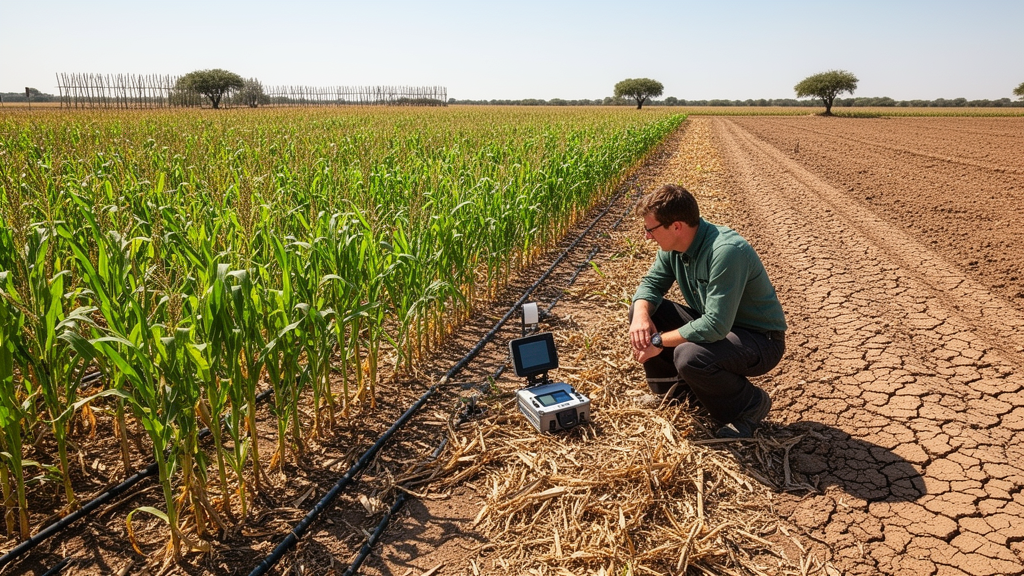
A structured narrative review published in Frontiers in Sustainable Food Systems synthesizes recent empirical and review studies to argue that climate change has shifted from being an external shock to a structural constraint on agricultural production. The authors, YS Yang Shen and Hongqin Tang from Xiamen University, organize the evidence along four primary lines: theoretical pathways, quantitative losses, adaptive practices, and future policy strategies. The central finding is that the effectiveness of climate-adaptive measures is not uniform; rather, it is highly conditional, with clear failure zones and sign reversals depending on the specific shock type, intensity, and regional context.
The review draws on studies indexed in the China National Knowledge Infrastructure and Scopus, supplemented by snowballing from foundational papers in major scientific journals. The search window covered January 2021 to December 2027, prioritizing peer-reviewed empirical work that includes quantitative effect estimates. The authors explicitly state that this is a structured narrative review rather than a systematic review, designed to synthesize mechanism-level, quantitative, and policy-oriented evidence. They grade the strength of evidence based on the breadth of the underlying data and the credibility of the identifying variation, distinguishing between strong, moderate, and indicative findings.
Theoretical pathways linking climate factors to agricultural production are complex and nonlinear. Crop responses to temperature and precipitation are threshold-dependent and state-dependent, meaning that a one-degree Celsius increase can have vastly different consequences depending on the phenological stage of the crop. For instance, rice exposed to sustained temperatures above 35 degrees Celsius during heading and flowering may lose 5% to 20% of its yield. In the United States, county-level data shows that yields for corn, soybean, and cotton rise only up to specific temperature thresholds of 29, 30, and 32 degrees Celsius, respectively, after which declines become steeper than the previous inclines.
Quantitative evidence on yield and welfare losses points in a consistent negative direction, but the magnitudes are highly dispersed across regions, crops, and scenarios. A cross-country panel estimate based on six major staple crops indicates that each 1-degree Celsius increase in global mean surface temperature reduces annual global food production by approximately 121 kilocalories per capita per day. This represents a 4.4% reduction relative to the current recommended per capita intake. However, under a high-emissions scenario, producer adaptation and income growth offset only 23% of global losses by 2050 and 34% by the end of the century, indicating that adaptation delays but does not eliminate these losses.
Conventional accounting methods that rely solely on calorie metrics systematically underestimate the true costs of climate change. Elevated atmospheric carbon dioxide levels, while potentially beneficial for some crop yields, lower the nutritional quality of grains. Free-air enrichment experiments show that wheat grain contains 9.3% less zinc and 5.1% less iron, while protein content in wheat and rice decreases by 6.3% and 7.8%, respectively. Projections suggest that these nutrient declines could leave an additional 175 million people zinc-deficient and 122 million people protein-deficient by 2050, a welfare impact that calorie-based assessments fail to capture.
Climate-adaptive agricultural practices are generally effective, yet their success is bounded by specific conditions. A systematic review of climate-smart agriculture literature finds that four key pathways, including soil carbon sequestration and precision fertilization, can reduce greenhouse gas emissions by 20% to 40% while increasing productivity by 10% to 25%. In Ethiopia, combined adoption of climate-smart practices increased annual per capita food consumption expenditure by 7,684 birr and daily calorie intake by 3,457 kilocalories. However, these benefits are not universal; in some cases, such as soil and water conservation measures in Ethiopia, the estimated effects on food security reversed depending on the identification strategy used, highlighting the sensitivity of results to methodological choices.
Policy instruments such as agricultural insurance and digital technology show state-dependent moderating associations. The buffering effect of agricultural insurance is not constant; it varies with shock type and intensity. Under temperature shocks, insurance and irrigation infrastructure act more like substitutes, whereas under precipitation shocks, they become complements as intensity rises. Digital technologies have demonstrated significant efficiency gains, with smart irrigation raising water use efficiency by up to 96%, but the review notes that these efficiency gains have not yet been conclusively shown to translate into broader climate resilience. The translation of digital efficiency into adaptive capacity depends on institutional intermediation, including land transfer and human capital, which are often weak in developing regions.
There are observable trade-offs between engineered adaptation and mitigation objectives. High-standard farmland construction in China, for example, has a positive effect on climate-smart agriculture indices and food security but a significantly negative effect on carbon mitigation. Similarly, climate warming raises pesticide use intensity, with estimates suggesting a 14% to 17% increase by the end of the century under certain scenarios. This indicates that adaptation measures can inadvertently exacerbate environmental problems if carbon emissions and ecological impacts are not monitored alongside productivity gains.
The review identifies three consistent judgments from the synthesized evidence. First, conventional accounting underestimates the true costs of climate change by ignoring nutritional quality and household welfare. Second, the effectiveness of adaptation measures is conditional, varying with risk intensity, development level, and service accessibility. Third, the marginal effects of single policy instruments are state-dependent, meaning they may weaken or strengthen depending on the specific context. The evidence does not support a uniform monotonic decline in the effectiveness of instruments as risk rises, but rather a complex, nonlinear relationship.
Significant research gaps remain, particularly in the regional distribution of global evidence, which is heavily imbalanced toward high-income and major grain-producing regions. Causal identification of adaptation effects is also insufficient, with most studies relying on correlation rather than robust causal designs. Furthermore, there is a lack of a unified analytical framework for the adaptation-mitigation trade-offs, as few studies simultaneously estimate yield effects and carbon emission effects within the same model. These gaps highlight the need for more rigorous, context-specific research to inform effective policy design.
Future strategies should replace single-policy approaches with instrument mixes tailored to specific shock types. The review emphasizes that policy instruments do not stack additively; their interactions vary by region and disaster type. For instance, the optimal combination of insurance and infrastructure depends on whether the dominant risk is temperature or precipitation. By understanding these conditional relationships, policymakers can design more resilient agricultural systems that balance production stability with environmental sustainability, avoiding the pitfall of treating adaptation as a one-size-fits-all solution.
Beyond field-level harvests, climate change substantially alters economic assessments of agricultural productivity. Decomposing global total factor productivity growth since 1961 shows that anthropogenic climate forcing has reduced global agricultural productivity by approximately 21 percent, equivalent to losing seven years of cumulative productivity growth, with regional contractions reaching 26 to 34 percent in Africa, Latin America, and the Caribbean. Incorporating meteorological conditions directly into production frontier models further modifies measured technical progress. When environmental factors including temperature, precipitation, and drought indices enter provincial data envelopment analysis frontiers in China, average annual agricultural productivity growth drops by 2.42 percentage points and the estimated rate of technological progress declines by 3.05 percentage points. These adjustments demonstrate that conventional economic accounting mistakenly attributes climate-induced output shifts to underlying technological progress.
Climate disruptions also cascade through supply chains and the broader macroeconomy. Macroeconomic simulations combining Earth system projections with provincial computable general equilibrium models for China indicate that overall climate damages could reach 3.6 to 4.3 percent of gross domestic product by 2060, with general equilibrium impacts amplifying direct accounting damages by approximately 136 percent. Direct agricultural productivity losses alone are projected to reduce national gross domestic product by 1.6 to 2.1 percent. Corporate and financial data confirm that weather extremes weaken resilience among downstream food manufacturing and processing enterprises, while extreme rainfall elevates default risks among rural financial institutions, threatening balance sheets across interconnected regional banking networks.
At the household level, climate shocks create severe immediate welfare losses that trigger delayed behavioral adjustments. Microdata from Afghanistan reveal that severe climate shocks reduced real per capita household expenditures and farm income by up to 40 percent, pushing approximately 13 percent of households into acute coping categories. However, longitudinal evidence from the China Family Panel Studies tracking rural households from 2010 to 2022 demonstrates that while immediate climate shocks significantly suppress developmental resilience, two-period and three-period lags turn positive as farming systems adapt. Moreover, technology adoption exhibits progressive distributional effects across rural populations: survey data from the Yellow River Basin show that income gains from climate-adaptive practices concentrate within the lowest income quartiles, actively narrowing internal household income disparities.
Strategic policy design must also navigate development thresholds and competing climate targets. Global trade modeling indicates that pursuing stricter 1.5-degree Celsius warming targets rather than 2.0-degree targets reduces maize price spikes from 70 percent to 50 percent, but doubles output contractions and price increases in the livestock sector, illustrating a sharp trade-off between physical climate risk and regulatory transition risk. Meanwhile, market-based mechanisms face institutional prerequisite hurdles. Empirical evaluations of green finance across Chinese provinces reveal a nonlinear U-shaped association with agricultural resilience, with 43.06 percent of evaluated jurisdictions currently positioned below the developmental turning point required for green credit and subsidy instruments to generate positive protective outcomes.
Subject of Research: Climate change impacts on agricultural production and adaptation strategies
Article Title: Sustainable agricultural production under climate change shocks: an analysis of impacts and adaptation strategies
Article References: Shen, Y., & Tang, H. (2026). Sustainable agricultural production under climate change shocks: an analysis of impacts and adaptation strategies. Frontiers in Sustainable Food Systems, 10, Article 2010053. https://doi.org/10.3389/fsufs.2026.2010053
Image Credits: AI Generated
DOI: 10.3389/fsufs.2026.2010053
Keywords: climate change, agricultural production, climate-smart agriculture, yield loss, nutritional quality, agricultural insurance, digital technology, green finance, adaptation-mitigation trade-off, crop physiology, total factor productivity, policy coordination, food security, carbon emissions, pesticide intensity, risk management, sustainable development, meteorological thresholds, household welfare, supply chain resilience
News Source: Alan Morgan. (November 13, 2026). Climate Adaptation in Agriculture Is Conditional and State-Dependent. Scienmag.