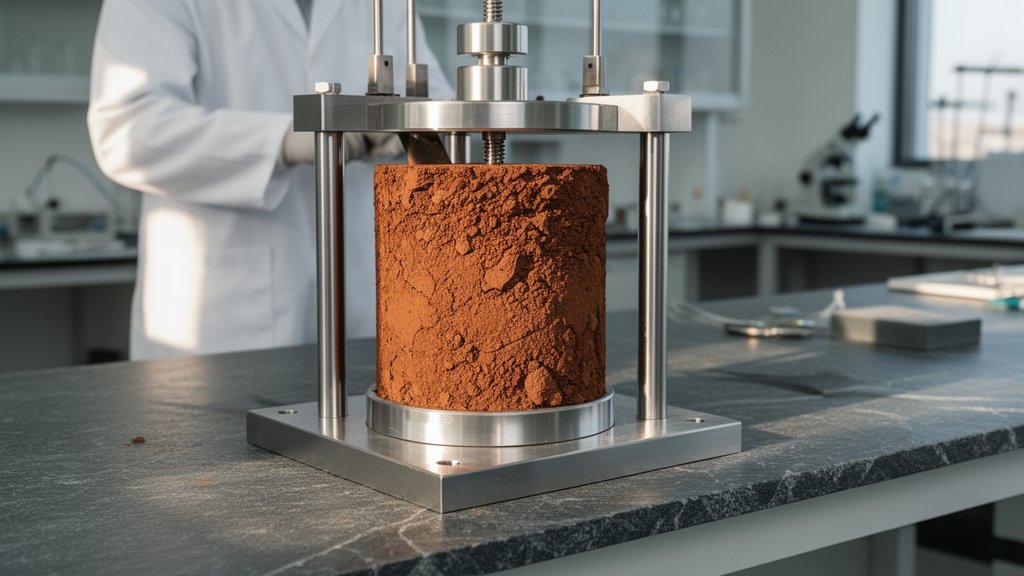
In tropical engineering projects where complex laboratory testing is often restricted by limited access to specialized equipment, researchers have demonstrated that statistical modeling can accurately estimate the mechanical shear strength of lateritic soils using routine physical measurements. Civil engineers working across tropical environments frequently face significant geotechnical uncertainty when designing shallow foundations and earthworks upon lateritic formations. These residual materials originate through prolonged weathering under warm, humid conditions, creating ground profiles that often deviate from standard normative geotechnical frameworks. In the town of Meiganga, situated within the Adamawa region of Cameroon, lateritic deposits serve as both a ubiquitous construction resource and a primary engineering challenge. To address the scarcity of comprehensive mechanical characterization, an investigation evaluated the physical properties and shear strength parameters of local soils, establishing empirical regression models capable of predicting apparent cohesion and internal friction angles from straightforward, economical laboratory indices.
Geotechnical stability in earthworks, roadbeds, and shallow foundation structures fundamentally depends upon soil shear strength, which governs how a ground mass resists sliding along internal failure planes under applied structural loads. Within tropical lateritic formations, shear resistance emerges from a combination of intergranular frictional contact between coarse particles, cohesive bonding supplied by fine clay matrices, and natural cementation formed by deposited iron and aluminum sesquioxides. Conventional determination of shear parameters requires direct shear or triaxial testing, yet systematic execution of these procedures demands substantial financial resources and specialized apparatus that are frequently unavailable in regional laboratories across developing areas. Establishing robust correlations between easily determined index properties—such as moisture content, fine particle percentages, and Atterberg limits—and fundamental strength parameters provides a pragmatic alternative for preliminary geotechnical estimation, provided such mathematical relationships are calibrated to regional pedological settings.
To capture the spatial and seasonal variability across the urban fabric of Meiganga, the field campaign sampled nine representative neighborhoods, comprising Doukouloukou, Gbakoungué, Ngoa-Ekellé, Pitoa, Zandaba, Rue 24, Sabongarie, Yelwa, and Ngassiri. Sampling targeted the loose, uncemented surface horizon at an average depth of approximately 1.2 meters using manual augers across a staggered grid with an approximate spacing of 100 meters. The experimental program gathered 72 soil samples in total, split between 45 reworked specimens for standard physical classification and 27 undisturbed specimens extracted with thin-walled Shelby tubes for mechanical evaluation. To capture seasonal moisture fluctuations, the sampling schedule deliberately spanned both the rainy season during May and June, yielding 20 samples, and the dry season during September and October, yielding 25 samples. Laboratory testing adhered to standard French geotechnical specifications, including NF P 94-050 for natural water content, NF P 94-056 for dry sieving above 0.08 millimeters, NF P 94-051 for Atterberg limits, and NF P 94-074 for mechanical shearing.
Physical laboratory testing demonstrated a marked dominance of fine-grained particles alongside pronounced hydric dispersion throughout the sampled terrain. The proportion of particles smaller than 0.08 millimeters ranged from 28.80 percent to 82.90 percent, exhibiting an arithmetic mean of 52.05 percent and classifying the material predominantly as fine soil. The natural moisture content varied widely between 6.47 percent and 30.10 percent, averaging 17.21 percent with a notable coefficient of variation of 54.91 percent that directly reflected seasonal weather influences. In parallel, the degree of saturation ranged from 12.23 percent to 57.28 percent, averaging 33.33 percent. Evaluation of soil consistency revealed liquidity limits extending from 28.80 percent to 66.00 percent with an average of 50.93 percent, while the plasticity index spanned 16.90 percent to 42.00 percent with an average of 28.02 percent. These parameters categorize the superficial lateritic mantle of Meiganga as plastic to highly plastic clay belonging to Class A3 under French road earthworks classifications, highlighting materials prone to significant volume change and moisture-induced softening.
Mechanical shearing investigations conducted on undisturbed specimens under unconsolidated and undrained conditions without applied back pressure highlighted pronounced spatial heterogeneity across the urban landscape. Tests were performed inside a 60-millimeter square shear box under normal stress levels of 100, 200, and 300 kilopascals at a steady displacement rate of 0.5 millimeters per minute, totaling 216 shearing runs across three specimens per sampled point. Across the entire testing program, apparent cohesion varied between 18.93 kilopascals and 32.05 kilopascals, while the internal friction angle ranged from 19.47 degrees to 31.24 degrees, producing overall arithmetic means of approximately 25.9 kilopascals and 24.9 degrees. Statistical dispersion remained moderate, yielding coefficients of variation between 17 and 19 percent for both parameters. Locations such as Pitoa and Rue 24 displayed superior mechanical performance, exceeding 30 kilopascals in cohesion and reaching approximately 30 degrees in friction angle due to well-developed granular skeletons and ferric cementation, whereas locations such as Yelwa and Gbakoungué exhibited reduced parameters of roughly 20 kilopascals and 20 degrees dominated by plastic clay fractions.
Statistical evaluation of correlation trends between individual physical properties and shear resistance indicators illuminated clear controlling mechanisms governing lateritic behavior. Bivariate Pearson correlation analyses indicated that the internal friction angle is governed primarily by a water and grain-size triad, correlating positively in simple bivariate analysis with natural moisture content at a coefficient of 0.625, fine fraction percentage below 0.08 millimeters at 0.611, and degree of saturation at 0.610. In contrast, apparent cohesion demonstrated its strongest statistical dependence upon soil plasticity and clay matrix abundance. The plasticity index emerged as the single most influential parameter for cohesion with a correlation coefficient of 0.669, followed by the fine particle content at 0.536. Intermediate correlations with cohesion occurred for liquid limit at 0.43 and water content at 0.40, whereas volumetric and mass density metrics, including dry density, void ratio, and porosity, exhibited negligible solitary influence with correlation coefficients below 0.40.
To interpret these empirical relationships within a soil mechanics framework, the researchers examined partial correlations and nonlinear regression behaviors. Although simple correlation showed a positive association between moisture content and friction angle due to covarying granular structure in certain natural samples, isolating the fine particle effect via partial correlation revealed a distinctly negative relationship of minus 0.68 between moisture and friction. This confirmed that water acts as an intergranular lubricant that degrades frictional contact once structural confounding is removed. Polynomial regression between friction angle and moisture content yielded a concave quadratic equation describing a progressive drop in friction at elevated water contents. Similarly, modeling the friction angle against fine content yielded a decreasing quadratic trend reflecting granular decoupling as fines separate coarse particles. For cohesion, a second-order polynomial model based on the plasticity index accounted for 45 percent of observed variance with a root mean square error below 5 kilopascals, demonstrating that electrochemical forces generated by active clay minerals govern cohesive bonding up to an optimal threshold before plastic softening intervenes.
Recognizing that simple single-parameter relationships capture only 29 to 45 percent of the variance in soil strength, the authors formulated multivariate empirical regression equations incorporating interaction terms and quadratic terms to reflect coupled physical mechanisms. The complete dataset of 72 specimens was partitioned using a stratified random selection into a training subset of 57 samples and an untouched validation subset of 15 samples, ensuring balanced geographic representation from all nine urban neighborhoods. The resulting multivariate equations achieved exceptional predictive accuracy, recording coefficients of determination of approximately 0.98 on the training set and 0.97 on the validation set for apparent cohesion, while reaching approximately 0.93 for the internal friction angle. Prediction errors remained minimal, with root mean square errors between 1.1 and 1.4 kilopascals and mean absolute errors below 1.5 kilopascals for cohesion, alongside root mean square errors between 1.0 and 1.1 degrees for friction angle, demonstrating negligible overfitting across independent verification samples.
When compared against generic empirical correlations published in international literature, the site-calibrated models developed for Meiganga demonstrated substantially superior performance. Global equations applied to the experimental dataset yielded markedly lower coefficients of determination and three to four times higher root mean square errors, underscoring the critical necessity of regional calibration for residual tropical soils. The predictive models developed in this investigation derive their operational reliability by directly integrating the specific physical mechanisms operating within Meiganga laterites, where apparent cohesion reflects clay activity and matric suction under unsaturated states, and mobilizable friction depends upon skeletal interlock modulated by fines and moisture. Ten-fold cross-validation conducted on the training subset yielded coefficients of variation below 5 percent for cross-validated root mean square error, confirming statistical stability despite the modest sample size of the underlying experimental dataset.
The study outlines several explicit boundaries governing the validity and practical application of the proposed empirical formulations. Because all underlying experimental data originated from lateritic mantles developed over basaltic bedrock within Meiganga, extrapolating these equations to contrasting geological or climatic settings requires prior recalibration. The mathematical models are formally valid for lateritic soils possessing a fine fraction between 30 percent and 80 percent, a plasticity index between 15 percent and 45 percent, and sheared under unconsolidated, undrained conditions. Because unconsolidated undrained testing reflects rapid loading regimes influenced by matric suction without pore pressure dissipation, the resulting parameters characterize short-term stability rather than long-term drained bearing capacity. Structural design and construction oversight in Meiganga must therefore maintain rigorous moisture control during foundation execution to prevent bearing capacity loss associated with seasonal wetting and suction collapse.
Subject of Research: Geotechnical characterization and statistical modeling of lateritic soil shear strength parameters in Meiganga, Cameroon
Article Title: Statistical modeling of meiganga soils mechanical parameters: regression and correlation approach
Article References: Lindou Ngakoupain, B., Keyangue Tchouata, J. H., Ngôn Ngôn, G. F., Ngapgue, F., Taypondou Darman, J., & Kueda, R. P. (2026). Statistical modeling of meiganga soils mechanical parameters: regression and correlation approach. Discover Civil Engineering, 3(1), Article 235. https://doi.org/10.1007/s44290-026-00633-5
Image Credits: AI Generated
DOI: 10.1007/s44290-026-00633-5
Keywords: Meiganga, Cameroon, lateritic soils, shear strength, apparent cohesion, internal friction angle, direct shear test, unconsolidated undrained, plasticity index, water content, degree of saturation, multivariate regression, geotechnical engineering, foundation design, soil mechanics, fine fraction, Atterberg limits
News Source: Denise Maddox. (November 13, 2026). Statistical Models Accurately Predict Lateritic Soil Shear Strength From Physical Properties. Scienmag.