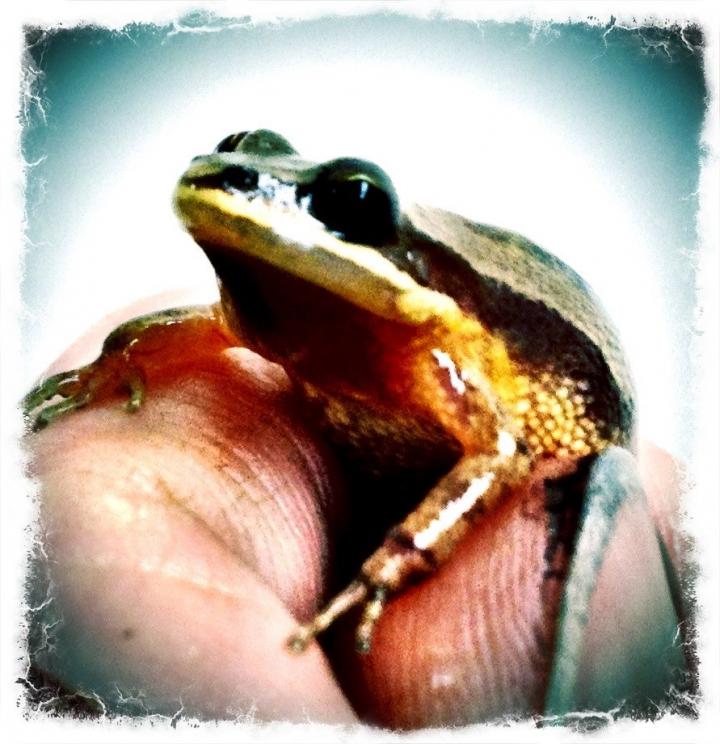
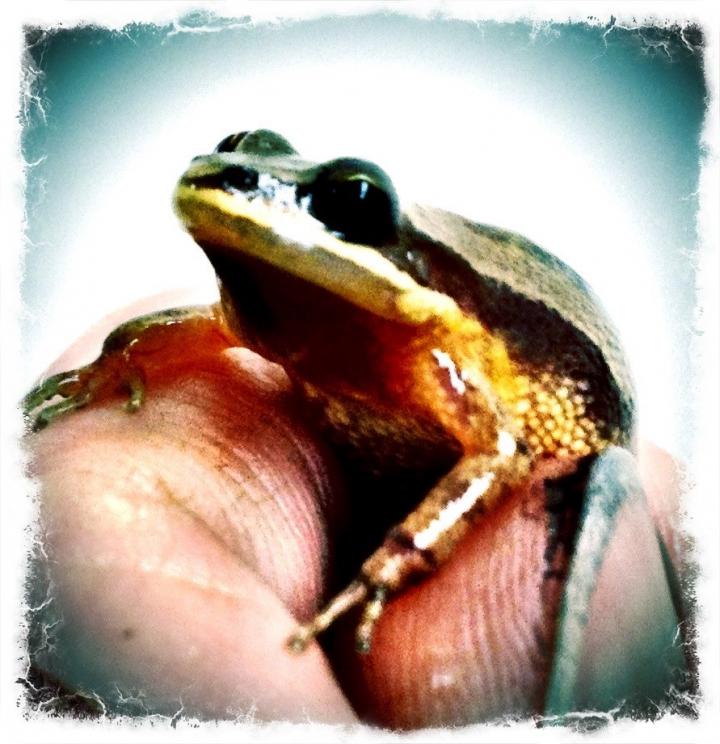
LSU researchers Jeremy M. Brown and Eric N. Rittmeyer, in collaboration with colleagues at Florida State University, are shedding light on how often and where species hybridize through time, thanks to the rediscovery of 40-year-old tissue samples preserved at the LSU Museum of Natural Science, or LSUMNS. In a recent study published in Ecology and Evolution, they show that two species of chorus frogs now form hybrids across a much wider area of Louisiana and Mississippi than they did just 30-40 years earlier. A widening area of hybridization has important implications for the future of these species and suggests that recent alterations to their environment have affected their fitness or dispersal ability.
To understand the dynamics of hybridization, researchers compared genetic sequences of Cajun Chorus Frogs, or Pseudacris fouquettei, and Southern Chorus Frogs, or P. nigrita, from a series of populations in Louisiana and Mississippi. Sequences were taken both from tissues collected starting in 2003 and older collections made in 1976, which were originally thought to be lost. Cajun and Southern Chorus Frogs hybridize along the Pearl River separating Louisiana from Mississippi, within an area known as a hybrid zone. These new findings show that the center of this zone, where the genetic contribution from the two species is roughly equal, has stayed in the same position through the decades. However, the zone has widened substantially, meaning that hybrid individuals can now be found farther east and west of the Pearl River.
Long-term studies of this kind rely on carefully curated museum collections, like those in the LSUMNS. The 40-year-old tissues used in this study were originally collected by Donald Gartside in 1976 while on faculty at the LSU Health Sciences Center in New Orleans, or LSU HSC. Gartside published his results in 1980 and characterized the hybrid zone as steep and narrow, with hybrids restricted to a small range. Gartside's tissues were left in the care of colleague Herbert Dessauer, who was also at the LSU HSC and a research associate with the LSUMNS. However, their location was unknown to the researchers when they began re-examining this hybrid zone in 2003. Fortuitously, Dessauer pioneered the establishment of frozen tissue collections and is considered by many to be one of the "Fathers of Molecular Systematics." Dessauer's collections were eventually absorbed into the LSUMNS Collection of Genetic Resources. Co-author Eric Rittmeyer, an LSUMNS doctoral student and curatorial assistant at the time of this work, had a hunch that Gartside's samples may have made their way to LSU as part of Dessauer's larger collection. In late 2013, he rediscovered the samples in the LSUMNS collections in Foster Hall.
The LSUMNS Genetic Resources collection, established in 1979, is the oldest, largest and most sought after of its kind making the collection a leader in vertebrate tissue preservation. It houses over 100,000 samples from all over the world and supplies more than 1,000 loans per year. This study further emphasizes the importance of museum collections in research that seeks to understand the Earth's biodiversity and the processes that underlie speciation and extinction. The addition of vertebrate tissues, which contain DNA, RNA, proteins, etc., to museum collections has greatly expanded their value and has been critical to research involving forensics, epidemiology, conservation, wildlife management, comparative molecular genetics, phylogenetics and ecology.
###
Media Contact
Alison Satake
[email protected]
225-578-3870
@LSUResearchNews
http://www.lsu.edu