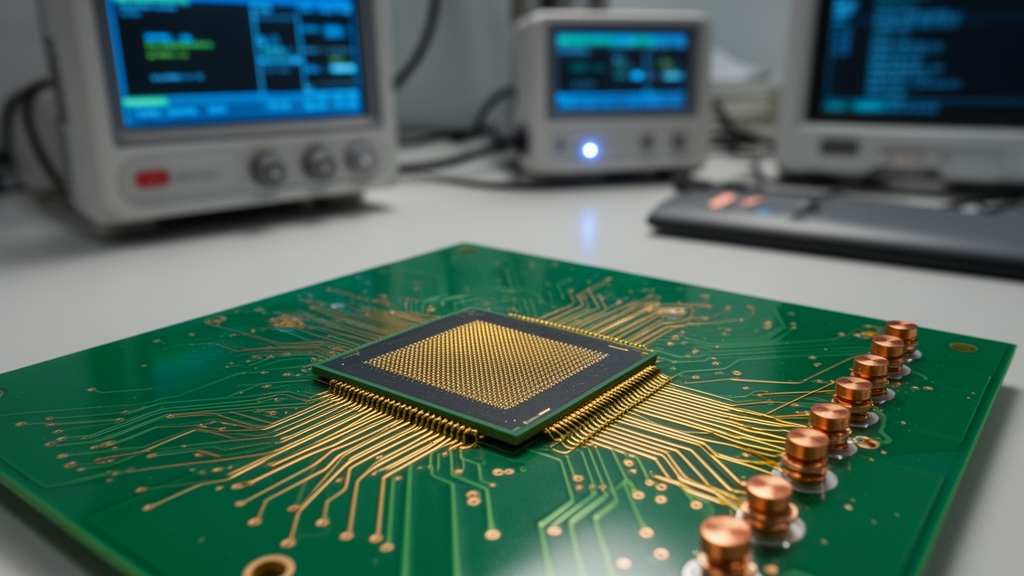
An adaptive radio frequency energy conversion architecture that utilizes machine learning for real-time impedance tuning has achieved a 17.5 percent improvement in power conversion efficiency over conventional static matching networks. Developed by researchers T. Sathiyapriya, V. Gurunathan, Govind Murari Upadhyay, and Shyam Akashe, the system—termed the Adaptive Impedance-Matched RF Energy Conversion Topology, or AIRECT—was detailed in a study published in Discover Applied Sciences. Experimental evaluations revealed that the topology achieved peak power conversion efficiencies of 72.6 percent at 0.915 GHz and 71.2 percent at 2.45 GHz, addressing a persistent efficiency bottleneck in ambient electromagnetic energy harvesting.
Radio frequency rectifiers serve an essential role in collecting ambient electromagnetic energy and transforming it into usable direct current electricity. This ambient power generation is increasingly targeted for low-power electronics, including Internet of Things sensor networks, wearable devices, and smart infrastructure. In conventional implementations, however, rectifiers rely on static impedance-matching networks. These fixed networks suffer from inherently limited power conversion efficiency and demonstrate poor adaptability whenever radio frequency operating conditions fluctuate.
To resolve these operational limitations, the AIRECT design integrates a dual-band voltage doubler rectifier configured for operation at both 0.915 GHz and 2.45 GHz alongside an automated adaptive impedance matching network. The tuning hardware incorporates switched capacitor banks and varactor tuning elements. Control over these components is driven by a Decision Tree model trained on the CART and C5.0 classification algorithms, allowing the system to adjust circuit parameters dynamically based on incoming radio frequency metrics, including input power, the reflection coefficient, and input impedance.
In performance testing, the Decision Tree model demonstrated an inference time of 2.83 milliseconds and attained a prediction accuracy of 98.9 percent. The researchers highlighted that the model maintains low computational complexity, rendering it suitable for direct embedded implementation on resource-constrained platforms. By combining rapid millisecond-scale execution with high predictive accuracy, the adaptive network maintains alignment under varying operational conditions without requiring heavy processing overhead.
The authors reported that the resulting architecture provides a practical and energy-efficient solution for adaptive radio frequency harvesting across low-power Internet of Things networks and biomedical applications. Published as an open-access research article under peer-reviewed acceptance, the study demonstrates a viable pathway for improving energy capture from common ambient wireless transmissions without introducing prohibitive computational burdens.
Subject of Research: Adaptive impedance matching in dual-band radio frequency energy harvesting rectifiers
Article Title: Energy-efficient self-matched RF rectifier with decision tree-based adaptive impedance tuning
Article References: Sathiyapriya, T., Gurunathan, V., Upadhyay, G. M., & Akashe, S. (2026). Energy-efficient self-matched RF rectifier with decision tree-based adaptive impedance tuning. Discover Applied Sciences. https://doi.org/10.1007/s42452-026-09681-z
Image Credits: AI Generated
DOI: 10.1007/s42452-026-09681-z
Keywords: radio frequency energy harvesting, RF rectifiers, AIRECT, adaptive impedance matching, power conversion efficiency, decision tree algorithms, CART algorithm, C5.0 algorithm, voltage doubler rectifier, switched capacitor banks, varactor tuning, dual-band rectifiers, 0.915 GHz, 2.45 GHz, reflection coefficient, Internet of Things, wearable devices, biomedical applications
News Source: Denise Maddox. (November 12, 2026). Adaptive Decision Tree Rectifier Boosts Energy Harvesting Efficiency By 17.5 Percent. Scienmag.