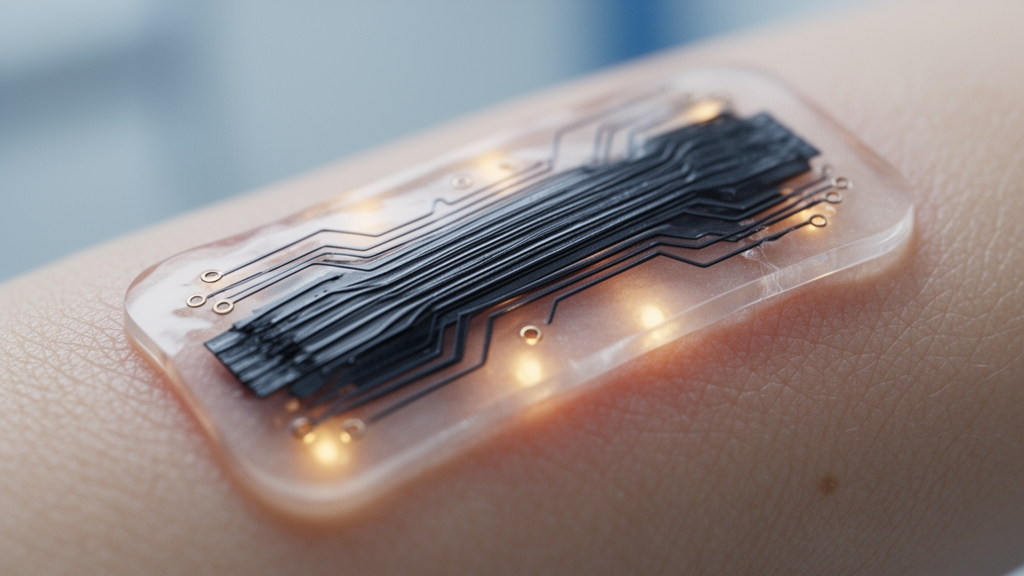
Researchers have developed a flexible bioelectronic wound dressing that produces a spatially uniform electric-field distribution to promote tissue regeneration. The engineered patch integrates eutectic gallium-indium alloy, MXene, and a double-network hydrogel into a sequentially bridged three-layer composite. By stabilizing electrical conduction and charge delivery across damaged tissue, the platform offers a strategy to assist natural healing processes through electric-field modulation.
Flexible conductive systems have attracted substantial interest in regenerative medicine and tissue engineering because of their favorable mechanical characteristics, biocompatibility, and electrical properties. The newly designed system addresses this challenge by pairing strain-tolerant liquid metal with high-surface-area nanomaterials in an integrated electronic dressing.
The composite architecture relies on a specialized three-component structure known as EMH. Within the assembly, eutectic gallium-indium, or EGaIn, provides metallic conductivity that permits rapid charge transfer across the dressing. Above or alongside this conductive alloy, MXene functions as an electrochemically active capacitive layer. MXene possesses abundant redox-active sites and a high surface area, which together facilitate effective charge storage and redistribution across the patch interface.
To achieve physical flexibility and biological integration, the patch incorporates a double-network hydrogel made from hyaluronic acid and polyacrylic acid, designated HPD.
Electrochemical and electromechanical evaluations demonstrated marked performance improvements in the assembled composite over simpler formulations. The EMH composite demonstrated three times the capacitance of an EGaIn-hydrogel formulation lacking the MXene component. The patch features metallic conductivity measured at 775,000 S/m to facilitate swift charge transfer, providing an efficient pathway for electrical flow.
The material also exhibited notable durability during mechanical deformation tests. The EMH patch maintained stable cycling with less than 2 ohms of resistance at 235 percent strain. Furthermore, the integrated architecture sustained operational reliability under extreme physical deformation up to 290 percent strain, effectively uniting the charge-storage attributes of MXene with the strain tolerance of the liquid metal alloy.
When utilized as an electronic wound dressing, the composite patch facilitates endogenous current conduction across healing tissue. This sustained electrical environment suppresses local inflammation while stimulating cell proliferation. Consequently, the bioelectronic intervention enhances both epithelialization and vascularization during tissue reconstruction.
The authors conclude that integrating capacitive nanomaterials with liquid metal conductors within an adhesive hydrogel network provides a promising bioelectronic approach for wound healing. By ensuring uniform electric fields and mechanical resilience, the layered composite establishes a stable platform for modulating tissue regeneration via therapeutic electrical cues.
Subject of Research: Flexible bioelectronic composite hydrogel for electric-field-modulated wound healing
Article Title: MXene conductive hydrogel for uniform electric field wound healing
Article References: Yang, X., Shen, S., Li, Y., Zheng, W., Javanmardi, N., Meng, J., Jiang, H., Qian, H., Lv, Z., Sun, Z., Wang, Y., Wang, Z., Feng, Z.-Q., Bao, N., & Yuan, T. (2026). MXene conductive hydrogel for uniform electric field wound healing. Advanced Composites and Hybrid Materials. https://doi.org/10.1007/s42114-026-02175-x
Image Credits: AI Generated
DOI: 10.1007/s42114-026-02175-x
Keywords: conductive hydrogel, MXene, eutectic gallium-indium, EGaIn, bioelectronics, wound healing, tissue regeneration, electric field stimulation, double-network hydrogel, hyaluronic acid, polyacrylic acid, capacitive biomaterials, flexible electronics, epithelialization, vascularization, regenerative medicine
News Source: Denise Maddox. (November 12, 2026). Layered MXene Composite Patch Delivers Uniform Electrical Stimulation for Wound Repair. Scienmag.