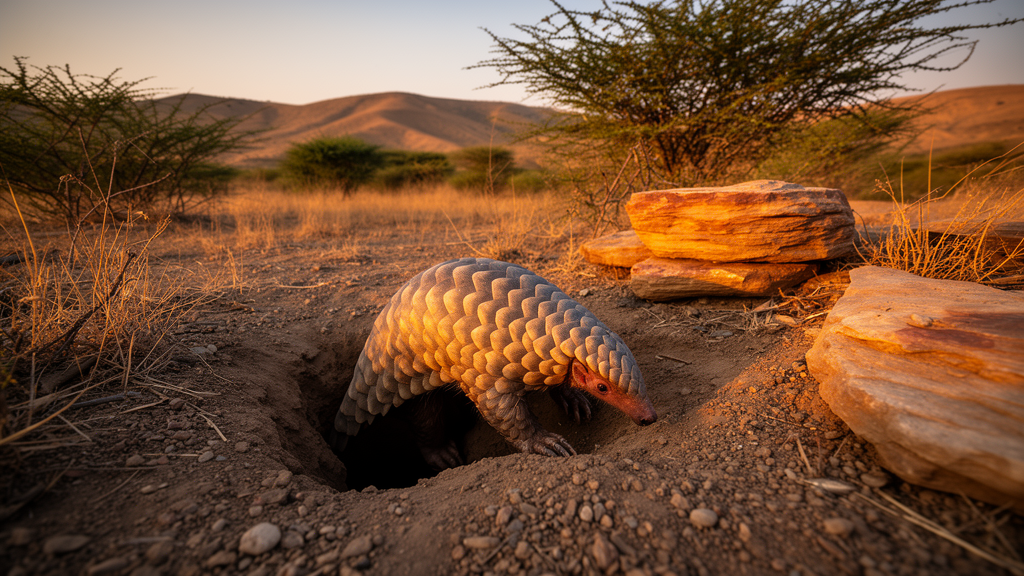
A new study published in BMC Ecology and Evolution provides the first district-level ecological baseline for the Indian pangolin, Manis crassicaudata, in Abbottabad District, Pakistan. The research, conducted from October 2024 to September 2025, assessed the spatial distribution, relative abundance, habitat characteristics, and anthropogenic pressures on this endangered mammal. The findings aim to address the limited ecological information that currently constrains effective conservation planning for the species in the region.
The study employed a stratified, spatially explicit sampling framework to survey the Lesser Himalayas. Researchers established 30 intensively surveyed raster sampling units, each measuring 2 by 2 kilometers. These units represented approximately 120 square kilometers of landscape across four tehsils within the district. To standardize effort, the team surveyed three 1-kilometer belt transects per raster sampling unit, resulting in a total of 90 transects and 90 transect-kilometers of standardized survey effort.
Active living burrows were utilized as indirect indicators of current occurrence and relative abundance rather than as a measure of individual population density. During the survey period, a total of 91 burrows were recorded. This count comprised 9 active living burrows, 55 feeding burrows, and 27 inactive burrows.
The analysis of the 9 active living burrows yielded a relative abundance index of 0.075 active burrows per square kilometer of represented landscape. Additionally, the encounter rate was calculated at 1.00 active burrow per 10 transect-kilometers.
Active burrows were found at elevations ranging from 700 to 1,361 meters. The habitat types associated with these active burrows were primarily low- to moderate-elevation scrub, agricultural-edge habitats, and forest-transition zones.
Statistical analysis revealed significant differences between inactive and feeding burrows in several environmental and structural variables. Specifically, elevation, canopy cover, undergrowth density, distance to water, and burrow dimensions differed significantly between these two categories of burrows, with p-values less than 0.05.
Field observations and community information identified several key conservation pressures affecting the Indian pangolin in Abbottabad District. The primary threats include illegal hunting, habitat modification, and agricultural expansion. Additionally, interactions with domestic dogs and road mortality were noted as significant anthropogenic pressures.
The study establishes a critical ecological baseline for Manis crassicaudata at the district level. The data collected supports the implementation of standardized long-term monitoring programs, targeted habitat management, and threat mitigation strategies. Furthermore, the findings underscore the importance of community-based conservation efforts to address the identified pressures. By providing this foundational data, the research helps guide future conservation actions for this poorly studied and endangered mammal in Pakistan.
Subject of Research: Spatial ecology and conservation threats of the Indian pangolin in Pakistan
Article Title: Spatial ecology, relative abundance and threats to the Indian pangolin (Manis crassicaudata) in Abbottabad District, Lesser Himalayas
Article References: Saad, M. K., & Anuar, S. (2026). Spatial ecology, relative abundance and threats to the Indian pangolin (Manis crassicaudata) in Abbottabad District, Lesser Himalayas. BMC Ecology and Evolution. https://doi.org/10.1186/s12862-026-02610-z
Image Credits: AI Generated
DOI: 10.1186/s12862-026-02610-z
Keywords: Indian pangolin, Manis crassicaudata, Abbottabad District, Lesser Himalayas, Pakistan, spatial ecology, relative abundance, burrow surveys, habitat characteristics, anthropogenic pressures, illegal hunting, agricultural expansion, road mortality, conservation planning, endangered species, BMC Ecology and Evolution, raster sampling units, belt transects, habitat modification, community-based conservation
News Source: Gavin Prescott. (November 12, 2026). Study Maps Indian Pangolin Burrows and Threats in Pakistan. Scienmag.