Particle-specific properties and longitudinal transport distance dominate microplastic dynamics in running waters, while aquatic vegetation modulates retention depending on stream position and particle identity, according to experiments in replicated stream channels. Evaluating streambed accumulation across experimental conditions revealed that deposition was significantly affected by particle type and distance (p < 0.001), whereas vegetation density alone showed no significant overall effect (p = 0.903).
Rivers and streams function as key transport conduits carrying microplastic particles from terrestrial sources toward marine environments. Although submerged macrophytes are widely expected to influence short-term microplastic retention by altering local hydrodynamics and physically trapping particles, their actual role in broader longitudinal transport processes has remained unclear.
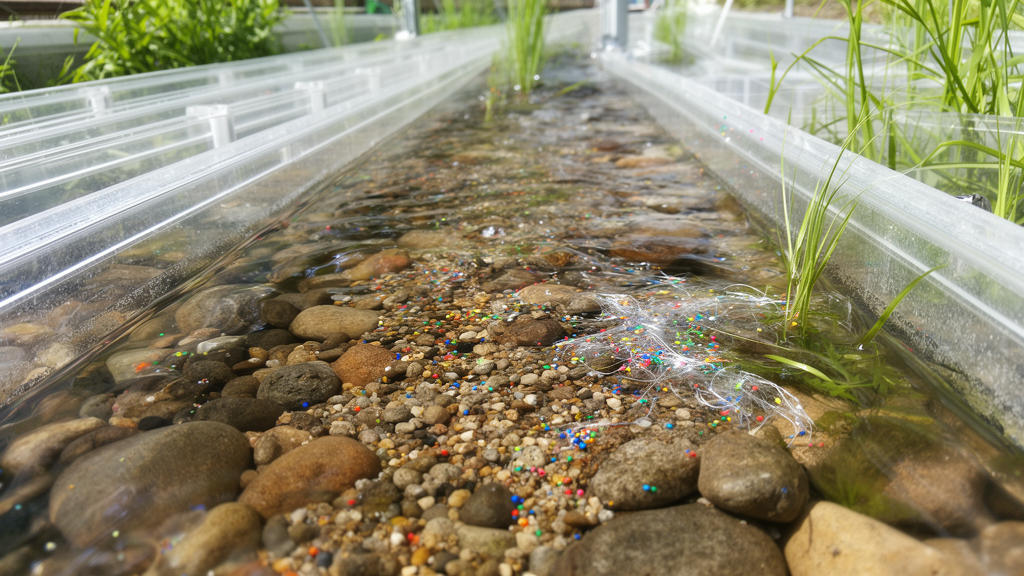
To investigate these transport and retention mechanisms, researchers examined three distinct polymer types—polystyrene (PS), polyethylene terephthalate (PET), and tire wear particles (TWP)—within replicated 45-meter stream mesocosms. The experimental streams featured controlled vegetation densities of the submerged macrophyte Elodea nuttallii established at 0 percent, 25 percent, or 100 percent cover across three replicates per treatment.
Following a controlled pulse release into the mesocosms, researchers quantified microplastic concentrations across three environmental compartments: the water column, the sediment, and macrophyte biomass. Retention within the macrophyte biomass proved to be strongly particle-specific (p = 0.007). Tire wear particles accumulated at the highest concentrations, with spatial variability decreasing under the high vegetation density treatment (T100), whereas polystyrene and polyethylene terephthalate consistently exhibited low accumulation across all treatments.
Measurements of apparent distance-decay rates demonstrated consistent particle-specific transport patterns across both water and sediment compartments. In both media, polystyrene concentrations declined markedly with increasing distance from the release location. Polyethylene terephthalate concentrations exhibited a moderate decrease and persisted further downstream, while tire wear particles remained constant across distance and across both compartments.
Although vegetation density did not show an overarching main effect on streambed accumulation, significant interaction terms were observed. Specifically, significant vegetation-by-distance and vegetation-by-particle interactions demonstrated that the influence of plant cover depended directly on position along the stream channel and the specific physical properties of each particle type.
These findings highlight the role of small, vegetated streams with limited filtration capacity as temporary, particle-specific sinks for microplastics. Because these systems can temporarily retain particles and subsequently remobilize them, they may function as secondary sources within fluvial networks, shaping downstream transport timing and magnitude, with important implications for catchment-scale plastic budgets and terrestrial-to-marine transfers.
Subject of Research: Particle-specific microplastic transport and retention dynamics in vegetated stream mesocosms
Article Title: Hold me back! Does vegetation density shape the particle-specific fate of microplastics in stream mesocosms?
Article References: Schmitt, T. G., Bollinger, E., Schulz, R., Wieczorek, M., Oster, S., McKie, B. G., & Bundschuh, M. (2026). Hold me back! Does vegetation density shape the particle-specific fate of microplastics in stream mesocosms?. Microplastics and Nanoplastics. https://doi.org/10.1186/s43591-026-00252-y
Image Credits: AI Generated
DOI: 10.1186/s43591-026-00252-y
Keywords: microplastics, stream mesocosms, macrophytes, Elodea nuttallii, tire wear particles, polystyrene, polyethylene terephthalate, vegetation density, streambed accumulation, water column, sediment retention, distance-decay rates, fluvial networks, catchment-scale plastic budgets, longitudinal transport, hydrodynamics, secondary sources
News Source: Violet Maxwell. (November 12, 2026). Particle Type and Distance Dominate Microplastic Retention in Stream Mesocosms. Scienmag.