A research team led by Professor Jinyang Liang at the Institut national de la recherche scientifique in Quebec, Canada, has developed an ultrafast three-dimensional imaging method capable of recording dynamic events at speeds reaching 150,000 frames per second. Reported in the journal Nature Communications, the peer-reviewed investigation establishes a new world record in three-dimensional profilometry. Conducted at the INRS Énergie Matériaux Télécommunications Research Centre, the study introduces an imaging framework designed to capture and measure high-speed, non-repeatable physical processes that previously exceeded the observational capabilities of standard diagnostic tools.
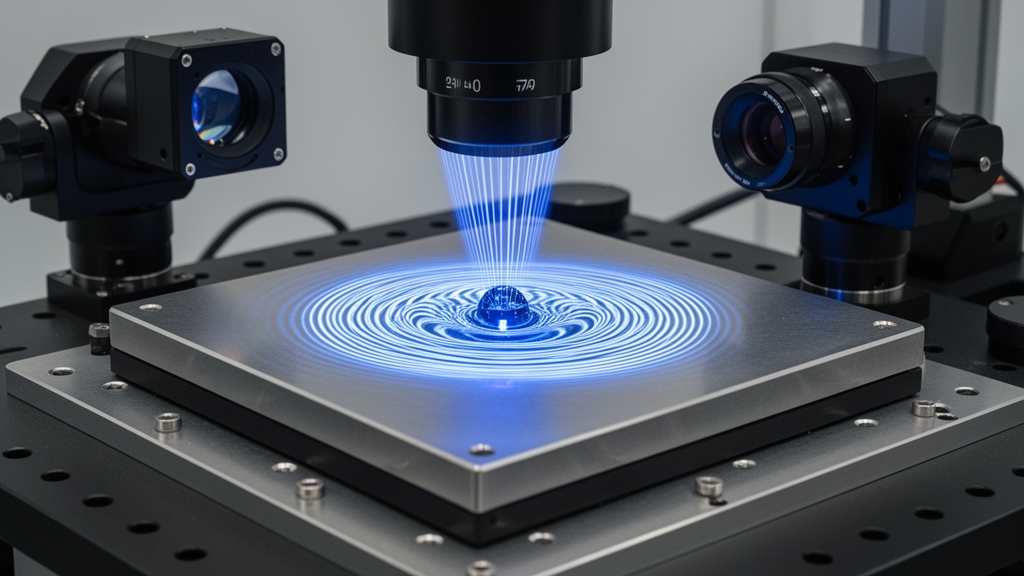
The imaging platform, designated as chromatically band-limited illumination profilometry, or C-BLIP, addresses longstanding barriers in high-speed optical diagnostics. Conventional ultrafast three-dimensional imaging systems frequently confront trade-offs involving restricted frame rates, substantial computational overhead during spatial reconstruction, and the prohibitive expense of specialized hardware. To circumvent these constraints, the INRS team engineered a hardware and algorithmic configuration that integrates an accessible optical setup, eye-safe light-emitting diode illumination, and a computationally streamlined reconstruction workflow.
Experimental validations published in the study demonstrated the ability of C-BLIP to record a diverse array of rapid transient physical events in three dimensions. The researchers successfully imaged and quantified the mechanical impact between a projectile and a turbofan blade, tracking spatial deformation as the collision unfolded. In aerodynamic assessments, the platform documented the descent dynamics of a falling maple samara seed, providing quantitative depth measurements of its rotation and drift. The team also applied the technique to examine high-frequency mechanical oscillation, recording the three-dimensional surface vibrations of an active loudspeaker membrane.
By tracking these surface ripples, the system extracted embedded acoustic signals, enabling the investigators to reconstruct an audible spoken message directly from the optical data. First author Cheng Jiang, a postdoctoral researcher in energy and materials sciences at INRS, noted that visualizing previously imperceptible ultrasonic oscillations and isolating spoken audio from surface movement illustrates the practical utility of the platform across diverse scientific domains.
Lead investigator Jinyang Liang, Professor at INRS and Canada Research Chair in Ultrafast Computational Imaging, emphasized that C-BLIP provides continuous capture of rapid, non-repeatable three-dimensional occurrences that researchers previously struggled to measure accurately.
Looking ahead to operational refinements, the authors indicated that work is underway to integrate graphics processing unit acceleration into the computational pipeline. This architectural improvement aims to streamline data handling and eventually facilitate real-time three-dimensional visualization of high-speed events. The authors anticipate that the combination of accessible hardware, reduced computational demands, and high frame rates will enable deployment in diverse experimental environments, including mechanics, aerodynamics, microfluidic analysis, additive manufacturing, and high-rate structural materials testing.
The study brings together interdisciplinary methodologies spanning optical engineering, digital signal processing, and computational imaging. The research was supported through funding from the Natural Sciences and Engineering Research Council of Canada, the Canada Research Chairs Program, the INRS Chair in Nanobiophotonics, the Fonds de Recherche du Québec–Nature et Technologies through the Centre d’Optique, Photonique, et Lasers, and Mitacs internship programs.
The experimental breakthrough emerged from the specialized research environment at the Institut national de la recherche scientifique, an institution established in 1969 with a distinct mandate dedicated exclusively to graduate education and research in strategic sectors for Quebec. Ranking first in Quebec for research intensity, the university conducts its scientific activities across five interdisciplinary research and training centres located in Quebec City, Montreal, Laval, Varennes, and Charlevoix. These hubs concentrate on targeted scientific domains, including Water, Earth and Environment; Urbanization, Culture and Society; Armand-Frappier Santé Biotechnologie; Ruralités durables; and Energy, Materials and Telecommunications. Across these diverse research facilities, the academic community encompasses nearly 1,500 graduate students, postdoctoral fellows, faculty members, and institutional staff contributing to regional economic, social, and cultural development.
In addition to its provincial mission, the university has maintained membership in the Pasteur Network since 2005, contributing to an international research collective focused on advancing global health initiatives through collaborative discovery. The published investigation represents a primary collaboration between lead author Cheng Jiang, a postdoctoral researcher in energy and materials sciences, and corresponding author Jinyang Liang, who directs the laboratory’s ultrafast computational imaging initiatives.
Detailed project support was administered through specific grant mechanisms, including the Natural Sciences and Engineering Research Council of Canada award RGPIN-2024-05551 and the Canada Research Chairs Program award CRC2022-00119. Supplemental research assistance was provided by the Fonds de Recherche du Québec–Nature et Technologies under grant 203345 via the Centre d’Optique, Photonique, et Lasers, alongside training allocations from the Mitacs Business Strategy Internship Program and the Mitacs Globalink Research Internship Program.
Subject of Research: Ultrafast three-dimensional profilometry imaging
Article Title: INRS develops the world’s fastest 3D profilometry
Article References: INRS develops the world’s fastest 3D profilometry. Original publication (Bibliographic details unavailable.)
Image Credits: AI Generated
DOI: Not provided
Keywords: ultrafast imaging, 3D profilometry, C-BLIP, Jinyang Liang, Cheng Jiang, INRS, Nature Communications, high-speed photography, transient phenomena, ultrasonic vibrations, LED illumination, turbofan blade collision, maple samara aerodynamics, loudspeaker membrane, acoustic recovery, additive manufacturing, microfluidics, high-rate material testing
News Source: Denise Maddox. (November 12, 2026). Ultrafast 3D Profilometry System Captures Transient Phenomena at 150,000 Frames Per Second. Scienmag.