A comparative materials investigation has revealed that while sawdust ash reacts more rapidly in the initial hours of lime hydration, sugarcane bagasse ash produces substantially stronger and denser lime-based mortar matrices over a twenty-eight-day curing period. Conducted to evaluate agro-industrial by-products as low-carbon supplementary cementitious materials, the experimental research demonstrated that sugarcane bagasse ash achieved twenty-eight-day mortar compressive strengths between 2.98 and 3.72 megapascals across pozzolan-to-lime ratios ranging from three to one down to one to one. By contrast, sawdust ash mortars under identical preparation and testing protocols developed compressive strengths between 1.51 and 2.52 megapascals. The laboratory findings establish that short-term electrical conductivity reductions in calcium hydroxide solutions primarily capture early dissolution kinetics and surface exposure rather than ultimate mechanical performance, which remains governed by the concentration of reactive amorphous silica.
The study was established within the broader context of global cement manufacturing demands and the pressing requirement to lower industrial greenhouse gas emissions. The production of conventional ordinary Portland cement clinker requires calcining limestone and clay at elevated kiln temperatures exceeding 1300 degrees Celsius, an energy-intensive industrial sequence responsible for roughly five to eight percent of worldwide anthropogenic carbon dioxide releases alongside heavy natural resource consumption. While established industrial by-products such as coal fly ash, blast furnace slag, and silica fume have served as conventional supplementary cementitious materials to partially replace clinker, structural changes in heavy industry, geographic transport limitations, and declining coal-fired electrical generation are constraining their long-term availability. These logistical challenges have directed academic and industrial focus toward agricultural processing residues that can be converted into reactive pozzolans within local circular economies.
To rigorously test whether specific surface area or amorphous chemical composition dictates binder development, raw sugarcane bagasse was procured from the Butali Sugar Company Limited in Kakamega, Kenya, while commercial sawdust was randomly sampled from two commercial sawmills situated on the outskirts of Eldoret City, Kenya. Commercial ordinary Portland cement of grade 42.5 conforming to KS EAS 18-1:2017 was provided by Simba Cement Company Limited in Nakuru, Kenya, to serve as a benchmark control material.
Sample preparation procedures were designed to ensure consistency across the biomass residues prior to thermal treatment. The sugarcane bagasse was thoroughly rinsed with distilled water to remove residual field sand and organic impurities, dried in an oven at 110 degrees Celsius for twenty-four hours, and subsequently dry-ground in an HFM 100 planetary grinder for fifteen minutes at three hundred revolutions per minute until the material completely passed a ninety-micrometer sieve. In contrast, the collected sawdust was sun-dried over a ten-day period to reduce moisture content under ambient conditions while preventing premature thermal breakdown of volatile organic compounds. Standard river sand aggregate was similarly washed using deionized water and sun-dried for two days, an ambient approach deemed sufficient given the low organic presence and coarse grain sizing of natural quartz sand.
Thermal calcination of both biomass materials was carried out inside an Advantec KL-420 laboratory muffle furnace operating in an oxidizing air atmosphere under three distinct thermal regimes: 600 degrees Celsius for one hour, 600 degrees Celsius for two hours, and 700 degrees Celsius for one hour. After thermal holding, the resulting ashes were cooled inside the furnace chamber to ambient laboratory temperature over twenty-four hours and subsequently ground for fifteen minutes to pass a seventy-five-micrometer sieve before being sealed in airtight containers for physical, mineralogical, and chemical evaluation.
Particle size distribution was evaluated through mechanical sieving in compliance with KS 02 1263, confirming fineness across the coarse fractions, while Brunauer-Emmett-Teller nitrogen adsorption analysis using a Gemini 2375 V instrument quantified specific surface area across relative pressures between 0.05 and 0.30. The nitrogen adsorption measurements showed that sawdust ash possessed a higher specific surface area than sugarcane bagasse ash, while ordinary Portland cement exhibited the lowest specific surface area owing to its dense clinker structure.
Chemical characterization by X-ray fluorescence spectroscopy and loss-on-ignition determinations revealed sharp contrasts between the elemental profiles of the two calcined agricultural residues. Sugarcane bagasse ash exhibited an exceptional combined pozzolanic oxide content of silicon dioxide, aluminum oxide, and iron oxide measuring 86.60 percent by mass, fully satisfying the chemical criteria established by ASTM C618 and KS EAS 18-1 for high-grade natural pozzolans. Conversely, sawdust ash yielded a combined oxide concentration of merely 23.16 percent alongside an elevated loss on ignition of 15.33 percent at 1000 degrees Celsius, reflecting incomplete combustion and residual unburnt carbon. Both ashes maintained safe operational thresholds for durability, with magnesium oxide concentrations remaining below five percent and total alkali contents staying under 1.5 percent, thereby minimizing risks related to expansive mineral hydration or alkali-aggregate reactivity.
X-ray diffraction analysis conducted on ash samples calcined at 600 degrees Celsius for one hour demonstrated fundamental mineralogical distinctions between the pozzolanic materials. The diffraction spectrum of sugarcane bagasse ash was characterized by a distinct broad diffuse hump between 20 degrees and 35 degrees two-theta, a structural signature confirming an abundance of disordered, reactive amorphous silica alongside minor crystalline peaks corresponding to quartz, orthoclase, and chibaite. In sharp contrast, the diffraction pattern of sawdust ash displayed sharp crystalline reflections dominated by calcium carbonate in the form of calcite, along with crystalline mineral phases including diaspore, rosenhahnite, ferrosilite, and tilleyite, while exhibiting an imperceptible amorphous silica hump that signaled limited chemical pozzolanic potential.
Early-age pozzolanic reactivity was monitored through electrical conductivity measurements inside a continuously stirred saturated calcium hydroxide solution containing 0.8 grams of dissolved lime in 200 milliliters of distilled water held at 38 degrees Celsius. Upon introducing five grams of ground pozzolan, ionic conductivity was recorded every thirty minutes over four hours. Samples calcined at 600 degrees Celsius for two hours demonstrated optimal reactivity, with sawdust ash driving a sixty-five percent drop in electrical conductivity within the initial thirty minutes, compared to twenty-four percent for sugarcane bagasse ash. By two hundred and forty minutes, sawdust ash achieved a seventy-eight percent conductivity loss compared to thirty-four percent for sugarcane bagasse ash. The pronounced early conductivity drop observed for sawdust ash reflected rapid surface adsorption and dissolution kinetics afforded by its superior specific surface area rather than persistent silicate hydration.
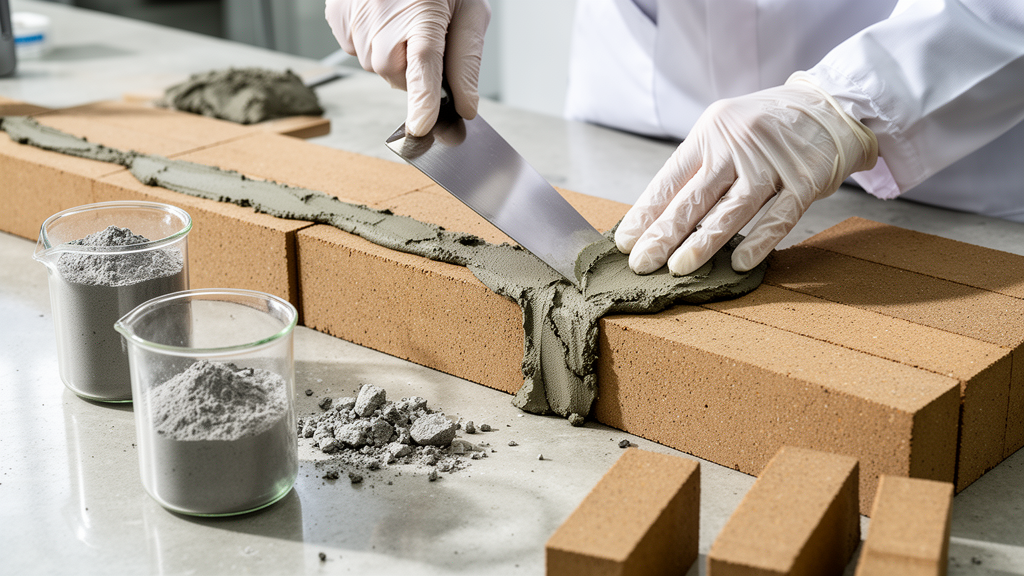
Mortar prisms measuring 160 by 40 by 40 millimeters were subsequently fabricated in triplicate according to Kenyan standard KS EAS 2168-1 using ashes calcined at 600 degrees Celsius for two hours. Batches blended 1350 grams of standard sand with 450 grams of pozzolana-lime binder proportioned at ratios of three to one, two to one, and one to one, with workability controlled on a flow table to achieve a uniform spread diameter of 110 plus or minus five millimeters. Mortars were compacted on a vibrating table, sealed in polyethylene within a curing chamber exceeding ninety percent relative humidity for twenty-four hours, and subsequently air-cured for twenty-eight days at 23 degrees Celsius and 65 percent relative humidity to facilitate atmospheric carbonation, while control ordinary Portland cement prisms were water-cured to support uninterrupted clinker silicate hydration.
Physical testing of hardened twenty-eight-day specimens highlighted significant structural variations between the binder types. The control Portland cement mortar registered a bulk density of 1865.4 kilograms per cubic meter and a water absorption of 7.21 percent, reflecting the dense pore refinement typical of primary clinker hydration products. Among the pozzolanic blends, sugarcane bagasse ash mortar achieved a bulk density of 930.6 kilograms per cubic meter and an intermediate water absorption of 14.14 percent. Sawdust ash mortar produced the lowest bulk density at 812.4 kilograms per cubic meter and the highest water absorption at 18.14 percent, a porous outcome attributed to the high carbon content, low specific gravity, and intrinsic cellular porosity of timber ash particles that impede compact microstructural packing.
Compressive strength evaluations performed on an Instron universal testing machine demonstrated that sugarcane bagasse ash mortars significantly surpassed sawdust ash mortars across every binder ratio, with independent two-sample t-tests confirming statistical significance at p less than 0.0001. Compressive strength peaked at the one-to-one pozzolan-to-lime ratio, where sugarcane ash reached 3.72 megapascals compared to 2.52 megapascals for sawdust ash, while the three-to-one ratio produced 2.98 megapascals and 1.51 megapascals, respectively. The control ordinary Portland cement reached 48.06 megapascals under water curing. Although substantially lower than Portland cement, both agricultural ash systems comfortably exceeded the 2.0 megapascal threshold stipulated by IS 4098-1967 and satisfied CS II to CS III classifications under BS EN 998-1, establishing their technical suitability for non-structural masonry, plastering, and breathable rendering applications.
Subject of Research: Comparative pozzolanic reactivity and mortar performance of calcined agricultural waste ashes in lime binders
Article Title: Pozzolanic reactivity and mortar performance of sugarcane bagasse and sawdust ashes in lime based binders
Article References: Onyango, O. V., Wambu, E. W., Okoth, M. O., & Kipkemboi, P. K. (2026). Pozzolanic reactivity and mortar performance of sugarcane bagasse and sawdust ashes in lime based binders. Discover Concrete and Cement, 2(1), Article 49. https://doi.org/10.1007/s44416-026-00093-1
Image Credits: AI Generated
DOI: 10.1007/s44416-026-00093-1
Keywords: sugarcane bagasse ash, sawdust ash, pozzolanic reactivity, lime binders, mortar compressive strength, supplementary cementitious materials, calcium silicate hydrate, electrical conductivity, amorphous silica, calcination, bulk density, water absorption, sustainable construction, loss on ignition, X-ray diffraction, ordinary Portland cement, circular economy
News Source: Denise Maddox. (November 12, 2026). Sugarcane Ash Outperforms Sawdust Ash in Long-Term Lime Mortar Performance. Scienmag.