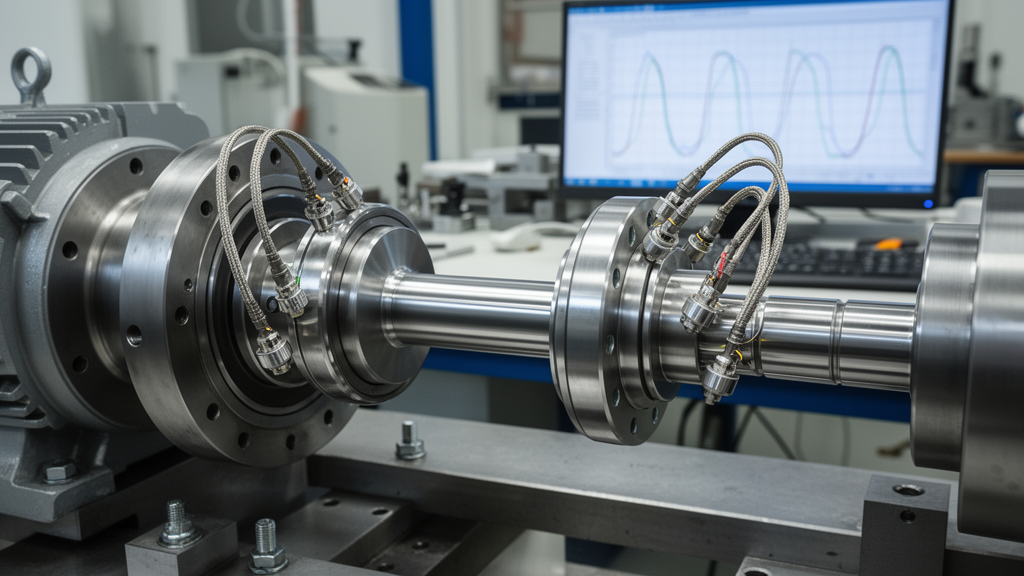
In a controlled proof-of-concept investigation, researchers evaluated an end-to-end machine learning condition monitoring pipeline capable of identifying mechanical fault types and estimating discrete severity levels on a laboratory test bench. Conducting experiments on an unloaded rotating rig driven by a 0.37-kilowatt induction motor, the engineering team recorded multi-axis vibration signals across ten distinct machine conditions, including healthy operation and three escalating severity tiers each of bearing contamination, mass unbalance, and shaft misalignment. Across three full assembly replications yielding thirty independent sixty-second recordings, an ensemble of gradient-boosted decision trees trained on eighteen statistical and spectral descriptors attained a window-level classification accuracy of 98.9 percent, alongside a balanced accuracy of 98.9 percent, a macro-averaged F1 score of 0.988, and a Matthews correlation coefficient of 0.985. When evaluated by majority vote across one-second analysis windows, the deployed gradient-boosted model correctly classified all thirty held-out test recordings without error, demonstrating laboratory feasibility for automated multi-fault diagnostics within an Industrial Internet of Things architecture under single-speed, unloaded conditions.
The motivation behind the study stems from long-standing operational shortcomings in conventional industrial maintenance regimes, where plant operators routinely depend on scalar vibration-severity metrics. Modern industrial facilities rely heavily on continuous rotating equipment arranged in series, including conveyor drives, machine tool spindles, and cooling fans, where unexpected equipment breakdown incurs direct repair expenses and severe secondary downtime costs. Traditional condition monitoring has standardized around broadband root-mean-square velocity evaluation criteria defined by standards such as ISO 10816-1 and its successor ISO 20816-1. While these velocity thresholds effectively alert engineers when overall vibration energy exceeds established severity boundaries, they compress complex, multidimensional mechanical dynamics into a single scalar number. Consequently, a conventional broadband amplitude alarm indicates that a rotating asset has structurally deteriorated, but cannot pinpoint whether the root cause requires rotor balancing, bearing replacement, or coupling alignment, leaving maintenance teams dependent on labor-intensive manual troubleshooting that prolongs repair cycles.
To overcome this diagnostic ambiguity, the experimental investigation focused on three canonical mechanical failure modes that each introduce mathematically and physically distinct dynamic forces into a rotating shaft system. Particulate contamination within rolling-element bearings increases friction and microscopic surface roughness, generating repetitive impacts between moving elements and raceways that elevate high-frequency broadband energy into the kilohertz spectrum. Rotor mass unbalance produces an eccentric centrifugal force that scales directly with unbalance mass, offset radius, and the square of angular velocity, projecting primarily as a synchronous fundamental harmonic component at the rotational running frequency. Meanwhile, angular shaft misalignment imposes cyclical, time-varying bending moments across the coupling, manifesting characteristically as elevated second-harmonic response accompanied by amplified axial vibration. Although these mechanical fault signatures are separable in principle through spectral analysis, their absolute amplitude distributions can overlap significantly during early deterioration, preventing simple scalar thresholds from isolating the underlying mechanism.
The experimental apparatus comprised a purpose-built rotating test bench featuring a 0.37-kilowatt three-phase induction motor with a rated full-load speed of 1,400 revolutions per minute, connected to a 20-millimeter-diameter carbon steel shaft supported by two 6204 ZZ deep-groove ball bearings mounted in pillow blocks on a welded steel frame. Operating without external load, the shaft turned at a steady running speed of approximately 1,300 revolutions per minute, corresponding to a fundamental rotational frequency of 21.6 to 21.7 hertz. Structural response was captured using complementary sensing hardware: a motor-mounted single-axis IMI 603C01 piezoelectric accelerometer possessing manufacturer-calibrated sensitivity of 99 millivolts per gravity, and a bearing-mounted tri-axial ADXL335 microelectromechanical systems accelerometer configured with 0.1-microfarad capacitors that yielded nominal negative three-decibel filter cutoffs at 50 hertz across all three axes. Data acquisition was performed through a 24-bit National Instruments dynamic signal module sampling at 25.6 kilohertz per channel, providing an alias-free bandwidth of approximately 11.5 kilohertz.
Rigorous physical fault seeding governed the experimental trials, avoiding numerical simulation in favor of calibrated physical alterations across three distinct severity steps. Bearing contamination was introduced by degreasing the drive-end bearing, packing it with two, four, or six grams of graded silica particulate having nominal diameters between 0.1 and 0.3 millimeters, and reseating the original grease volume. Mass unbalance was generated by affixing calibrated ten, twenty, or thirty-gram steel weights to a balanced rotor disc at a fixed radius of 65 millimeters. Angular shaft misalignment was imposed by inserting precision shims in increments of two, four, and six millimeters beneath a bearing pedestal, establishing physical angular offsets of 0.78, 1.56, and 2.34 degrees. Crucially, baseline healthy operation was captured at the start of each distinct fault campaign, revealing that healthy root-mean-square velocities on the bearing housing spanned an approximate sevenfold amplitude range between campaigns due to routine assembly variations in residual unbalance, alignment, and mounting torque.
Signal preprocessing converted raw acceleration data into velocity through numerical integration following a third-order high-pass Butterworth filter with a three-hertz cutoff designed to suppress low-frequency mathematical drift. Each sixty-second recording was partitioned into one-second temporal windows with fifty percent overlap, producing 119 overlapping windows per recording and 3,570 windows across the entire thirty-recording dataset. From each of the four acquisition channels, researchers extracted eight time-domain statistics and seven frequency-domain descriptors, yielding sixty candidate features per window. To prevent data leakage arising from adjacent window correlation, the team implemented a nested leave-one-replication-out cross-validation framework that partitioned data strictly at the recording level before windowing. Dimensionality reduction conducted inside each training fold combined analysis-of-variance ranking with recursive feature elimination driven by a random forest estimator, successfully condensing the descriptor set down to eighteen optimal features dominated by eleven metrics derived from the tri-axial bearing housing sensor.
Six distinct machine learning classifiers were evaluated within this nested partitioning protocol, encompassing distance-based, kernel, decision tree, and deep neural architectures. A k-nearest-neighbor baseline achieved an overall window-level accuracy of 94.2 percent, while a multilayer perceptron reached 96.9 percent, and a radial basis function support vector machine achieved 97.3 percent. Bagged random forest ensembles scored 98.6 percent accuracy, while the deployed gradient-boosted trees achieved 98.9 percent mean accuracy with an indicative fold-level 95 percent confidence interval spanning 97.9 to 99.9 percent. A one-dimensional convolutional neural network processing raw velocity spectra achieved a comparable mean accuracy of 99.1 percent. Although both top models performed similarly, gradient-boosted trees were selected for operational deployment due to an inference latency of 2.6 milliseconds per window compared to 18.4 milliseconds for the convolutional network, as well as the superior interpretability of engineered physical features compared to black-box spectral representations.
Detailed examination of the pooled confusion matrix for the deployed gradient-boosted classifier revealed balanced, robust discrimination across individual fault classes. Shaft misalignment was identified most reliably, registering 99.2 percent sensitivity, 99.7 percent specificity, and 99.3 percent precision, benefiting from large characteristic dynamic response amplitudes. Bearing contamination and mass unbalance exhibited sensitivities of 98.9 percent and 98.7 percent respectively, with minor misclassifications concentrated almost exclusively among windows belonging to the lowest, incipient severity levels of both faults. The healthy operating class achieved 98.9 percent sensitivity, 99.8 percent specificity, and 98.3 percent precision, with only four of 357 healthy windows incorrectly labeled as faulty. Complementing classification, dedicated random forest regressors estimated discrete imposed severity levels from the eighteen retained features, achieving mean absolute errors of 0.31 grams for contamination, 1.8 grams for unbalance, and 0.19 millimeters for misalignment, well below the physical step intervals separating tested levels.
The benchmarked machine learning pipeline was directly contrasted against an exploratory univariate root-mean-square velocity threshold rule operating on the bearing sensor. Partitioned into four fixed empirical velocity zones, the simple threshold rule correctly categorized all nine recordings at the incipient fault tier but succeeded on only six of nine intermediate and severe fault recordings due to substantial scatter in particulate contamination response. Most notably, the scalar threshold rule correctly classified only three of nine healthy sets, yielding a meager 33.3 percent healthy accuracy because healthy baseline amplitudes varied widely across campaign assemblies. Mathematical analysis confirmed that this threshold failure was independent of uncalibrated transducer gain, as no single scalar velocity boundary could separate healthy from faulty machine assemblies without incurring at least six classification errors. In contrast, the multidimensional machine learning model reliably accommodated assembly-to-assembly baseline shifts by capturing combined spectral and multi-axis features.
Operational viability was demonstrated through continuous eight-hour edge profiling on an acquisition laptop equipped with an eighth-generation quad-core processor and sixteen gigabytes of memory without graphical processing unit acceleration. Total execution time averaged 11.3 milliseconds per window, consuming approximately 2.3 percent of the available 500-millisecond real-time budget, while adaptive transmission published telemetry records over HTTP to a cloud-based ThingsBoard dashboard. Communication logging demonstrated 99.4 percent live availability and 100 percent data completeness, buffering thirty-five interrupted records during wireless reconnection events. Nevertheless, the authors emphasized significant research limitations: the pipeline was evaluated on a single unloaded machine at a constant rotational speed, the bearing sensor was uncalibrated, and the highest-ranked feature exceeded the rated transducer bandwidth. Consequently, establishing true industrial readiness will require extensive future validation across variable operating speeds, external dynamic loads, combined concurrent faults, and diverse production machinery.
Subject of Research: Machine learning condition monitoring and fault diagnosis in rotating machinery
Article Title: Machine learning condition monitoring systems for rotating machinery fault detection
Article References: Mahazani, M. M., Oktaviadri, M., Mat Yahya, N., & Yusoff, A. R. (2026). Machine learning condition monitoring systems for rotating machinery fault detection. Frontiers in Mechanical Engineering, 12, Article 1979480. https://doi.org/10.3389/fmech.2026.1979480
Image Credits: AI Generated
DOI: 10.3389/fmech.2026.1979480
Keywords: condition monitoring, rotating machinery, fault diagnosis, machine learning, gradient-boosted trees, vibration analysis, predictive maintenance, accelerometer, bearing contamination, mass unbalance, shaft misalignment, nested cross-validation, feature extraction, edge computing, ThingsBoard, industrial internet of things, smart manufacturing
News Source: Teresa Odom. (November 12, 2026). Machine Learning Pipeline Classifies Seeded Rotating Machinery Faults in Laboratory Trials. Scienmag.