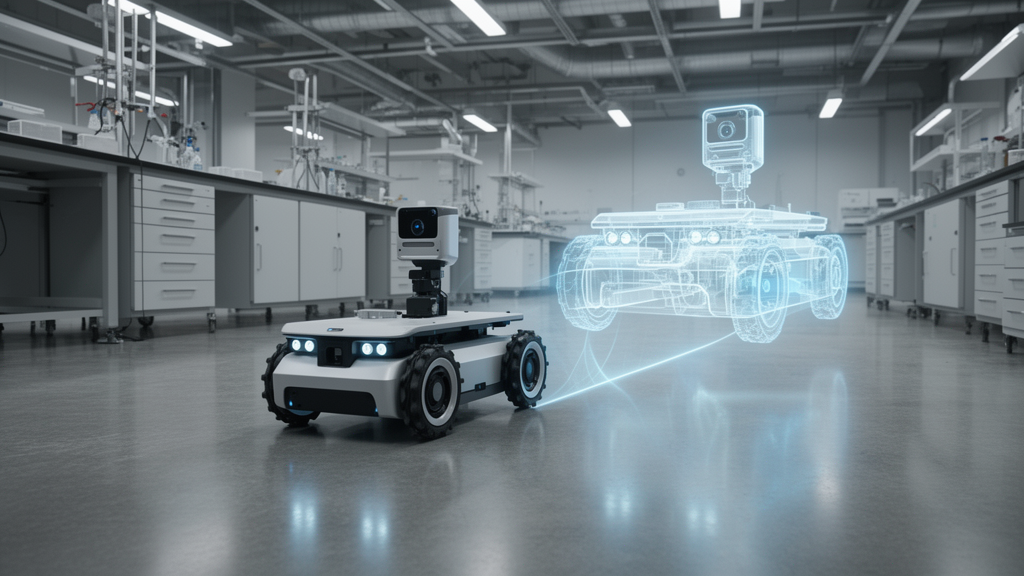
A physics-based digital twin operating in a simulated industrial environment can predict the navigation trajectories of an omnidirectional mobile manipulator to within plus or minus 0.229 meters under a ninety-five percent confidence interval, according to research published in Discover Robotics by engineers at RWTH Aachen University’s Laboratory for Machine Tools and Production Engineering. Across one hundred experimental trials spanning five factory floor layouts, the investigation assessed whether virtual replicas created in simulation software can reliably forecast the spatial behavior and localization fidelity of autonomous machinery before physical deployment. Flexible manufacturing systems increasingly deploy mobile manipulators to handle rapid production reconfigurations, customized assembly schedules, and shifting shop-floor layouts driven by skilled labor shortages. When operational workflows change, automated robots can encounter unpredictable navigation paths, potential line stoppages, and expensive downtime if movements are unverified. While digital models have supported algorithm design, the authors noted that standardized validation protocols and empirical uncertainty quantification have been lacking, limiting industrial confidence in digital twins as reliable forecasting tools.
In industrial manufacturing, a digital twin represents a real-time, bidirectionally synchronized virtual counterpart of a physical system capable of continuous interaction, simulation, and behavioral optimization. In this study, the simulation architecture functioned primarily as a digital shadow by receiving sensor streams and kinematic measurements from the physical robot without actively steering the physical vehicle, though the system is architected for future bidirectional communication. Earlier robotics studies addressed sim-to-real gaps by optimizing perception algorithms, measuring camera discrepancies via metrics like the Instance Performance Difference, or examining manipulation tasks such as bin-picking. Other navigation work focused on mission timing for automated guided vehicles or assessed visual navigation in non-industrial settings. Consequently, previous literature lacked a multi-metric protocol capable of systematically evaluating mobile base kinematics, localization drift, obstacle avoidance decisions, and path deviations for heavy mobile manipulators operating in flexible assembly environments.
To establish this validation methodology, the researchers created a controlled, reconfigurable production testbed spanning forty-four square meters equipped with assembly workcells, logistics stations, a collaborative robot, and diverse obstacle arrangements. Testing utilized an RB-Kairos mobile manipulator platform featuring an omnidirectional wheelbase with four mecanum wheels for tight maneuverability and an onboard Universal Robots UR10 articulated arm. The physical platform carried an extensive sensor payload comprising an inertial measurement unit, Hall effect rotary wheel encoders, two SICK S300 planar safety laser scanners, and an Ouster OS1-128 three-dimensional LiDAR. Ground truth position tracking was captured by an OptiTrack optical motion capture system with thirty-eight Primex41 cameras delivering millimeter-level accuracy. Spherical optical markers mounted to the vehicle base aligned with the base footprint frame, while two three-dimensional printed floor anchors fitted with retroreflective markers established precise start and goal coordinates across all trials.
The virtual replica was constructed in NVIDIA Isaac Sim version 4.2.0, utilizing the PhysX physics engine for multibody dynamics and ray tracing for realistic sensor modeling. The physical robot’s geometry and mass parameters were imported through Isaac Sim’s Unified Robot Description Format importer extension, matching dimensions, joint limits, and sensor placements. Because omnidirectional mecanum wheels feature angled perimeter rollers that present contact challenges in rigid-body physics, the researchers modeled the wheels with sphere colliders approximating roller interactions, iteratively tuning joint parameters. To reconstruct the forty-four-square-meter facility, the physical robot was manually guided through the shop floor to record timestamped point clouds, motion capture poses, and sensor transforms into bag files. A post-processing workflow extracted recordings, interpolated poses, transformed coordinates to the global motion capture frame, filtered outliers via voxel downsampling, and converted point clouds into cubic voxels joined into a watertight three-dimensional mesh.
Both the physical mobile manipulator and its virtual counterpart operated on an identical software foundation built on Robot Operating System 2, ensuring consistent execution across both domains. High-throughput wireless communication between onboard computers, an offboard application server, and the motion capture system was handled by a private fifth-generation radio access network using distributed radio dots, paired with the Zenoh middleware protocol for low-latency transmission. In simulation, an Isaac Sim ROS2 bridge enabled the virtual model to publish synthetic sensor telemetry and subscribe to command topics identically to the physical robot. Simultaneous localization and mapping was conducted using Google Cartographer, fusing three-dimensional LiDAR data with Extended Kalman Filter odometry from wheel encoders and the inertial measurement unit. Navigation was directed by the Nav2 framework using A-star global pathfinding over multi-layer costmaps and a DWB local controller, with goal tolerance set to 0.1 meters and six degrees.
The experimental evaluation compared real-world and simulation behaviors across five operational scenarios executed ten times each in physical and virtual domains, yielding fifty real-world and fifty digital twin trials. The scenarios comprised Open Space Navigation, Navigation with Obstacles containing unknown obstructions omitted from the localization map, Navigation with Obstacles featuring known mapped barriers, Navigation in Narrow Spaces with unknown tight passages, and Navigation in Narrow Spaces with known geometry. System performance was assessed across four quantitative metrics: localization accuracy, goal accuracy, path consistency, and operational reliability. Localization accuracy evaluated Root Mean Square Error between Google Cartographer estimates and motion capture ground truth. Goal accuracy measured Euclidean distance and angular orientation error between final poses and destination coordinates. Finally, operational reliability was tracked through an index recording physical collisions and required human interventions across all conducted runs.
Spatial trajectory alignment between physical runs and simulation was measured using the Hausdorff distance, which determines the maximum Euclidean separation between two sets of trajectory points, capturing worst-case spatial discrepancies. To quantify predictive uncertainty, the researchers developed a three-step statistical method based on non-parametric bootstrapping to compute ninety-five percent confidence intervals. First, all simulation paths within a scenario were aligned to a mean digital reference path, and point-to-point deviations were bootstrapped to determine the upper confidence bound of internal simulation consistency, termed the digital confidence interval. Second, real-world trajectories were matched against corresponding simulation paths to calculate point deviations, which were bootstrapped to determine the upper confidence bound of sim-to-real transferability. Third, these two confidence interval widths were summed to produce a final cumulative confidence interval representing a conservative, worst-case bound on how much a real-world path might deviate from digital twin predictions.
Across one hundred trials, quantitative measurements confirmed close alignment between the physical robot and the Isaac Sim model. Localization accuracy remained consistent across environments, showing an average Root Mean Square Error of 0.028 meters in the physical workshop and 0.033 meters in the digital twin, an absolute difference of just 0.005 meters. In goal positioning tests, the physical robot achieved a mean displacement of 0.055 meters with a maximum of 0.100 meters, while the digital twin recorded a mean error of 0.070 meters and a maximum of 0.147 meters. Mean orientation error was 1.473 degrees physically (peaking at 3.949 degrees) versus 4.157 degrees in simulation (peaking at 5.889 degrees). Path consistency evaluations yielded an overall mean Hausdorff distance of 0.195 meters, ranging from 0.135 meters in narrow spaces with known obstacles to 0.250 meters in open space. Both systems achieved a perfect reliability score of 1.0, completing all runs without collisions or human interventions.
Qualitative path observations revealed that the digital twin accurately mirrored complex behavioral dynamics seen in physical trials. When encountering unknown obstacles along its route, the physical robot dynamically adjusted its trajectory using real-time sensor returns, occasionally exhibiting minor navigational oscillations as costmaps updated. When obstacles were pre-mapped, the robot followed planned paths with minimal deviation. In both situations, the virtual robot inside Isaac Sim mirrored the exact avoidance behaviors of the physical platform, selecting identical lateral detour directions around obstacles. However, minor discrepancies occurred during terminal docking: in three out of fifty simulated trials, the digital robot slightly overshot its destination, failing the 0.1-meter stopping threshold.
The authors concluded that physics-based digital twins offer reliable forecasting capabilities for mobile robot navigation in flexible assembly systems when supported by systematic validation. The combined uncertainty bound of plus or minus 0.229 meters—derived from an internal simulation confidence interval of 0.110 meters and a digital-to-real interval of 0.118 meters—gives production engineers a quantifiable safety envelope for designing automated transport paths. Several limitations remain to guide future work. The current evaluation operated offline rather than as an automated continuous validation pipeline connected to live telemetry. Future efforts will focus on fine-tuning mecanum wheel contact physics through actuator response tests to eliminate goal overshooting, integrating high-fidelity CAD object geometry into environmental models to enhance synthetic sensor matching, and developing closed-loop digital twin synchronization. The team also plans to deconstruct overall navigation uncertainty into component-specific error contributions from sensor noise, actuation inaccuracies, and physical environmental variability.
Subject of Research: Predictive fidelity and uncertainty quantification of physics-based digital twins for mobile robot navigation in flexible assembly systems
Article Title: Evaluating mobile robot navigation behavior in flexible assembly systems through digital twin and real-world experiments
Article References: Bergs, L., Huber, M., Moriz, A., Göppert, A., Schmitt, R., Chan, F. K. S., Law, Y. N., Pan, X., & Drescher, B. (2025). Evaluating mobile robot navigation behavior in flexible assembly systems through digital twin and real-world experiments. Discover Robotics, 1(1), Article 10. https://doi.org/10.1007/s44430-025-00010-4
Image Credits: AI Generated
DOI: 10.1007/s44430-025-00010-4
Keywords: digital twins, mobile manipulators, robot navigation, flexible assembly systems, NVIDIA Isaac Sim, sim-to-real transfer, uncertainty quantification, Hausdorff distance, Google Cartographer, Robot Operating System, OptiTrack motion capture, mecanum wheels, autonomous industrial vehicles, obstacle avoidance, spatial costmaps, path consistency, simulated physics, factory automation
News Source: Denise Maddox. (November 12, 2026). Digital Twin Predicts Mobile Robot Navigation Paths Within Twenty-Three Centimeters. Scienmag.