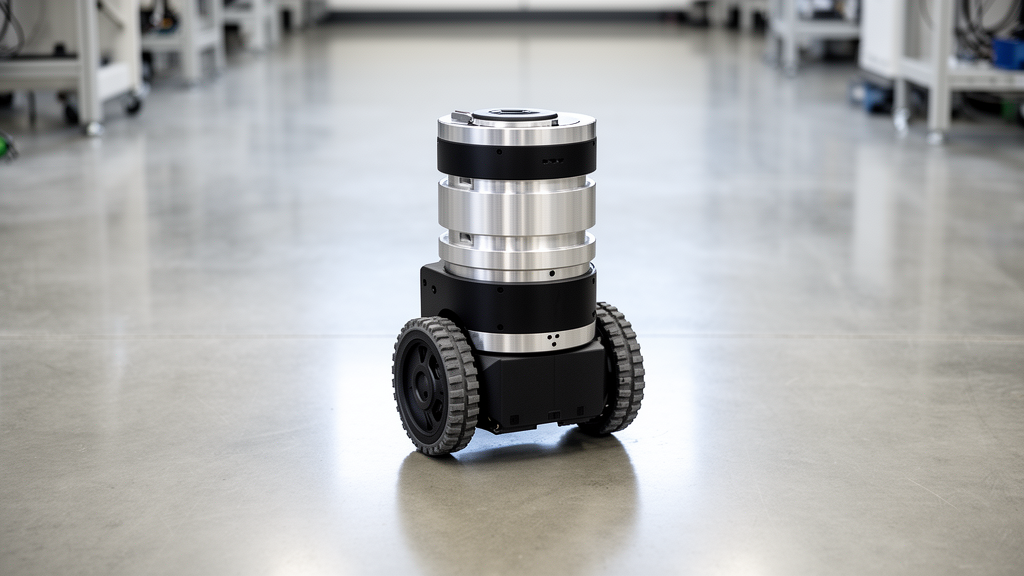
Robotics researchers have introduced an intelligent multi-input multi-output predictive control architecture engineered to stabilize two-wheeled self-balancing autonomous mobile robots operating under stochastic conditions and structural model uncertainties. Developed by Belkacem Bekhiti, Raheem Al-Sabur, Mohamed Roudane, Jihad A. Younis, and Abdel-Nasser Sharkawy, the framework integrates an Adaptive Neuro-Fuzzy Inference System with maximum likelihood parameter identification directly inside a multivariable generalized predictive control scheme. Two-wheeled mobile robots, constructed around the mechanical dynamics of an inverted pendulum, present complex challenges in autonomous control due to their inherently unstable, non-linear, and under-actuated characteristics, where actuators lack independent authority over every mechanical degree of freedom. By establishing a recursive mathematical method to evaluate matrix Diophantine equations in real time, the engineering team eliminated the computational bottleneck of repeated large-scale matrix inversions. Extensive computer simulations confirmed that this integrated neuro-fuzzy strategy reliably balances the robot, tracks demanding multi-channel trajectories, suppresses external perturbations, and accommodates plant parameter deviations without demanding precise prior knowledge of underlying physical constants.
The study formalizes the mechanical and electrical dynamics of the balancing robot using systematic Newton-Euler formulations coupled with Kirchhoff’s voltage laws across two direct-current drive motors. Each actuator generates an electromagnetic torque that is directly proportional to armature current through a specific motor torque constant, while inducing a counter-electromotive force proportional to rotational shaft velocity. To establish a practical control baseline, the analysis models motor shaft friction as a linear velocity function and applies Newton’s second law of motion to scale total shaft torque against armature rotational inertia. Rotor winding inductance and mechanical friction parameters were approximated as negligible, producing an effective linear representation relating terminal voltages and mechanical torques to shaft acceleration. Combining these actuator relations with separate horizontal force balances for the rolling wheels and angular momentum formulations for the pendulum-like chassis yielded coupled non-linear differential equations of motion. These equations formally isolate horizontal reaction forces, wheel inertia, chassis mass, and the critical distance separating the overall center of gravity from the rotational wheel axis.
Because generalized predictive control algorithms require linear plant representations, the investigators linearized the robot’s coupled differential equations around the upright equilibrium position where the tilt angle equals zero degrees. Applying small-angle Taylor series approximations enabled the construction of a continuous four-dimensional multivariable state-space model governed by explicit dynamic state and input matrices. The state vector incorporates linear forward velocity, chassis tilt angle, chassis angular velocity, and the rotational speed of an internal reaction wheel, while the control input vector captures the distinct operational voltages delivered to both the driving wheels and the reaction wheel actuator. The continuous model was subsequently discretized across a uniform sampling period assumed to be exceptionally short relative to the mechanical response times of the platform. Using similarity transformations, the controllable discrete state-space formulation was mapped into left and right matrix fraction descriptions, generating discrete polynomial matrices that define input-output relationships using the backward time-shift operator.
At the center of the control law lies a multivariable generalized predictive control algorithm structured around a Controlled Auto-Regressive Integrated Moving Average stochastic model. To regulate the balancing vehicle, the controller optimizes a quadratic performance index across a receding prediction horizon by balancing anticipated future tracking errors against penalizing excessive control signal increments. The cost function incorporates selectable set-point trajectories, minimum and maximum output horizons, and specific weighting parameters assigned to each input channel to prevent actuator saturation and avoid abrupt mechanical wear. While standard generalized predictive control can compute an entire sequence of future control actions, the sliding horizon principle dictates that only the immediate first control increment is physically applied to the actuators at each sampling instant before predictions are recalculated. Generating these optimal predictive outputs requires separating the unforced free response of the dynamic system from forced responses driven by future control signals, a task traditionally hampered by intensive online matrix inversion.
To overcome this computational obstacle, the research team implemented a recursive algorithmic scheme to resolve two primary matrix Diophantine equations governing the polynomial matrix relationships within the predictive model. The unique solution to the first Diophantine equality isolates future disturbance noise terms from current tracking outputs by iteratively computing polynomial coefficient matrices step by step from initial boundary identities. A secondary Diophantine equation was resolved recursively to split future control inputs from historical actuator commands across the maximum control horizon without computing full matrix inverses at every sampling step. This algebraic recursion directly establishes the optimal gain matrix for the compensator, streamlining real-time calculation and ensuring that unmeasurable stochastic perturbations do not corrupt future trajectory estimates. As a result, the controller continuously constructs exact predictive outputs using only available past input-output measurements and deterministic future reference targets.
Because physical robots experience mechanical variations, payload shifts, and dynamic environmental disturbances that degrade fixed mathematical models, the authors embedded an online Adaptive Neuro-Fuzzy Inference System into the predictive architecture. The neuro-fuzzy network utilizes a five-layer feedforward architecture implementing a first-order Takagi-Sugeno fuzzy inference mechanism driven by gradient descent learning. The initial layer contains adaptive nodes representing Gaussian membership functions that evaluate input variables using adjustable premise centers and spread parameters. Intermediate layers perform signal multiplication to calculate individual rule firing strengths followed by algebraic normalization across the complete rule base. In the fourth layer, adaptive nodes generate linear rule outputs using calibrated consequence parameters, which the fifth layer aggregates into an overall inferred output. Working alongside maximum likelihood identification formulated with Kronecker matrix operators and numerical Gauss-Newton update routines, the neuro-fuzzy framework dynamically tracks time-varying plant variations and compensates for unmodeled high-frequency dynamics in real time.
The efficacy of the proposed neuro-fuzzy predictive control strategy was validated through extensive comparative simulation trials executed under challenging operational profiles. In the initial test, the autonomous platform demonstrated stable upright balance and precise path tracking across a defined trajectory, with recorded angular position and velocity tracking errors remaining strictly bounded within a narrow band without showing cumulative numerical drift. To rigorously assess robustness against external perturbations, the researchers injected an abrupt disturbance with an amplitude of 0.1 between simulation samples 400 and 600, supplemented by an intentional variation at sample 500 alongside persistent additive white noise possessing a standard deviation of 0.05. The control scheme mitigated the destabilizing forces within a narrow temporal window by commanding sharp, bounded actuator energy bursts, verifying an active integral response that rapidly returned both chassis tilt and rotational velocity back to steady-state equilibrium.
Quantitative evaluations confirmed that the adaptive neuro-fuzzy architecture achieved a rapid settling time of 0.92 seconds and maintained an Integral of Absolute Error metric of 0.061 throughout severe disturbance conditions. When measured against standard performance benchmarks commonly applied to self-balancing robotic platforms—including Integral of Time-weighted Absolute Error and Integral of Squared Error—the proposed controller exhibited superior trajectory tracking accuracy and disturbance rejection relative to existing methods cited from published literature. In a third rigorous simulation scenario, the researchers assumed an explicit seven percent model uncertainty across the nominal plant transfer matrix while subjecting the vehicle to continuous sinusoidal reference inputs. Even under this combination of parameter mismatch, additive noise, and cyclic reference changes, the controller retained tight tracking capability, exhibiting rapid parameter convergence across the neuro-fuzzy network and maintaining consistent integral damping with efficient motor power usage.
To rigorously verify system-wide stability across adaptive iterations, the authors evaluated the complex eigenvalue spectrum of the estimated denominator polynomial matrix throughout the closed-loop simulation. Mathematical stability in discrete predictive architectures mandates that all system poles generated by the online identification algorithm remain strictly confined within the unit circle on the complex plane. Trajectory tracking error waveforms demonstrated exponential convergence tendencies, transitioning smoothly from initial start-up discrepancies toward zero as the sliding predictive control law took full effect. Root-locus plots generated across sequential adaptation stages confirmed that the estimated matrix polynomial eigenvalues remained securely bounded inside the unit perimeter, mathematically proving that the interconnected combination of the two-wheeled inverted pendulum and the indirect adaptive neuro-fuzzy controller maintains asymptotic stability without exhibiting unbounded oscillatory divergence.
While the simulation evidence conclusively illustrates the advantages of combining recursive Diophantine solutions with neuro-fuzzy identification, the authors noted several important operational constraints and targeted avenues for subsequent research. Because the underlying generalized predictive control formulation relies on plant equations linearized around the zero-degree vertical equilibrium point, the mathematical guarantee of stable control is strictly valid only when the chassis operates in proximity to the upright orientation. To expand the operational envelope, the investigators highlighted hyper-stable adaptive control as a viable mechanism to manage bounded parameter intervals, alongside recursive extended instrumental variable techniques to strengthen stochastic parameter estimation. Furthermore, developing non-linear intelligent adaptive back-stepping schemes and conducting physical experimental trials on an actual two-wheeled hardware prototype represent essential subsequent steps to validate the algorithm’s disturbance rejection and computational efficiency outside simulated environments.
Subject of Research: Intelligent adaptive predictive control for two-wheeled self-balancing mobile robots
Article Title: Intelligent neuro-fuzzy adaptive MIMO control for a self-balancing two wheeled autonomous robot via recursive resolution of the matrix diophantine equation
Article References: Bekhiti, B., Al-Sabur, R., Roudane, M., Younis, J. A., & Sharkawy, A.-N. (2025). Intelligent neuro-fuzzy adaptive MIMO control for a self-balancing two wheeled autonomous robot via recursive resolution of the matrix diophantine equation. Discover Robotics, 1(1), Article 11. https://doi.org/10.1007/s44430-025-00011-3
Image Credits: AI Generated
DOI: 10.1007/s44430-025-00011-3
Keywords: Adaptive Neuro-Fuzzy Inference System, Multi-Input Multi-Output Control, Generalized Predictive Control, Two-Wheeled Self-Balancing Robot, Matrix Diophantine Equations, Maximum Likelihood Identification, CARIMA Modeling, Under-Actuated Robotics, Inverted Pendulum Dynamics, Disturbance Rejection, Integral of Absolute Error, Settling Time Analysis, Takagi-Sugeno Fuzzy Inference, Closed-Loop Stability Analysis, Autonomous Mobile Platforms, Stochastic Parameter Estimation
News Source: Denise Maddox. (November 12, 2026). Adaptive Neuro-Fuzzy Predictive Controller Stabilizes Uncertain Two-Wheeled Robots in Simulations. Scienmag.