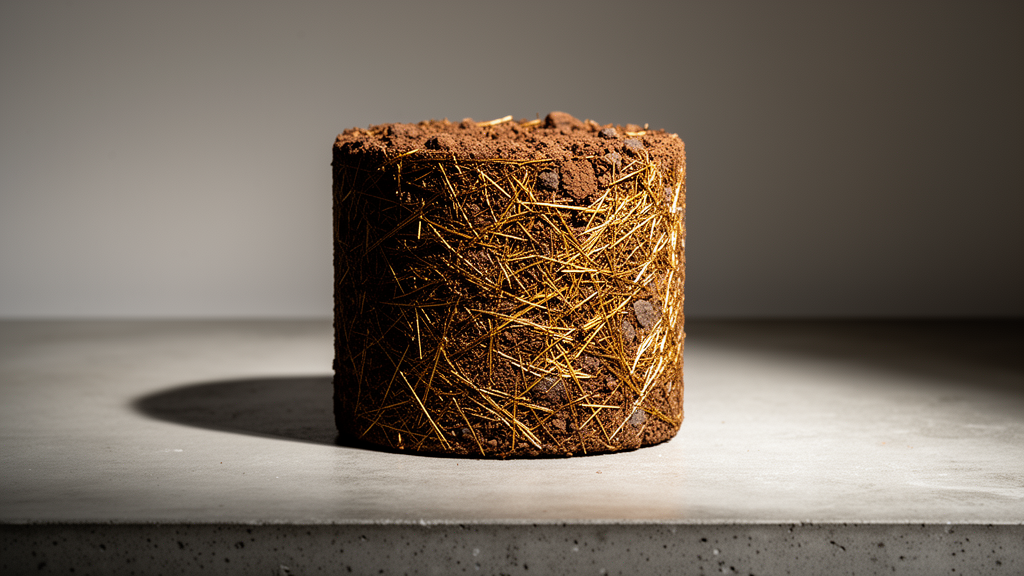
Subjecting compacted clay to repeated drying and wetting cycles induces progressive structural cracking, elevated hydraulic conductivity, and reduced shear strength, but incorporating discrete basalt fibers markedly mitigates this hydro-mechanical deterioration. In a laboratory investigation evaluating compacted clay samples treated with basalt fiber contents ranging from 0% to 0.6% by dry mass across up to twelve environmental cycles, researchers observed that unreinforced soil suffered a dramatic surge in water permeability alongside substantial loss of cohesive strength. The inclusion of basalt fibers transformed broad, continuous primary crack channels into fine, dispersed fracture networks, stabilizing the soil matrix against severe internal damage and preserving barrier efficacy under simulated cyclic weather exposure.
Compact clay fills represent a foundational material in environmental and hydraulic earthworks, functioning extensively as impervious liners, embankment structures, and dam cores owing to their natural availability, high plasticity, and intrinsically low hydraulic conductivity. In practical service settings, however, atmospheric exposure drives continuous moisture fluctuations that trigger alternating shrinkage during drying and swelling upon rewetting. As soil dries, capillary tensions and non-uniform shrinkage strains induce desiccation cracks that interconnect into preferential seepage pathways. When rainwater subsequently infiltrates these fractures, it accelerates structural softening, internal erosion, piping hazards, and slope instability, compromising long-term engineering integrity.
To explore mechanisms for curtailing this environmental degradation, investigators collected natural clay from an excavation depth of 1.5 to 2.0 meters at a construction site in Xi’an, Shaanxi Province, China. Physical characterization demonstrated that the test soil possessed a clay fraction of 45.26%, a natural water content of 21.22%, a specific gravity of 2.72, a liquid limit, a plastic limit of 29.4%, and a plasticity index of 16.32. Compaction testing identified a maximum dry density of 1.59 grams per cubic centimeter, which served as the operational baseline for all subsequent sample manufacturing. Brown basalt fibers, produced by high-temperature melting and drawing of natural rock, were selected as the reinforcement material. These fibers featured diameters between 8 and 15 micrometers, lengths of 12 millimeters, a tensile strength of 2984 megapascals, an elastic modulus of 95.3 gigapascals, and a tensile elongation of 2.68%.
Specimen preparation required careful multi-stage mixing to prevent fiber clustering and ensure homogeneous dispersion throughout the mineral matrix. Naturally air-dried soil was pulverized, passed through a 2-millimeter sieve, and spread into thin layers before basalt fibers were sprinkled incrementally at target proportions of 0%, 0.2%, 0.4%, and 0.6% by total dry mass. Distilled water was sprayed until the moisture content reached 18.42%, after which the mixtures were sealed for 24 hours to promote uniform moisture equilibration. All test specimens were subsequently statically compacted in equal-mass layers to a target dry density of 1.51 grams per cubic centimeter, corresponding to 95% of the unreinforced maximum dry density, with layer surfaces scarified to eliminate weak compaction interfaces. The program generated cylindrical specimens measuring 39.1 millimeters in diameter and 80 millimeters in height for triaxial shear testing, corresponding dimensions for falling-head permeameters, and disk-shaped specimens 150 millimeters in diameter and 30 millimeters in compacted thickness for surface crack monitoring.
The testing regime subjected all specimens to identical drying and wetting cycles, establishing evaluation stages at zero, one, two, four, six, and twelve complete cycles. Specimens were dried in a controlled oven at 40 ± 2 degrees Celsius until their moisture dropped from 18.42% to 2.0 ± 0.2%, after which the precise mass of water required to restore 18.42% moisture was applied incrementally with a spray bottle during continuous rotational manipulation. The samples were then sealed for 24 hours to achieve internal moisture redistribution, with the initial sequence designated as baseline conditioning. Continuous photographic records were captured every two hours during drying under standardized illumination, followed by binarization using Otsu’s automatic thresholding to track the surface crack ratio and average crack width.
Consolidated undrained triaxial compression tests were performed on vacuum-saturated specimens at confining pressures of 100, 200, and 300 kilopascals at an axial displacement rate of 0.08 millimeters per minute, monitoring deviator stress, pore-water pressure, and Mohr–Coulomb strength parameters. Concurrently, falling-head permeability tests were conducted on vacuum-saturated specimens sealed with sidewall petroleum jelly, measuring hydraulic conductivity at a test water temperature of 20 degrees Celsius. These complementary procedures enabled the research team to systematically correlate macroscopic surface crack progression directly with quantitative shifts in load-bearing capacity and hydraulic barrier efficiency.
Digital surface image analysis revealed that drying and wetting cycles intensified cracking across all groups, with the most severe morphological reorganization taking place during the initial cycle. In unreinforced specimens, initial desiccation produced broad, concentrated primary cracks that propagated and branched upon rewetting and redrying, fragmenting the clay into isolated clods. Incorporating basalt fibers fundamentally altered this geometric pattern, progressively suppressing wide fracture opening and promoting a high density of fine, interconnected microcracks. Across twelve cycles, the surface crack ratio of unreinforced clay increased substantially, reaching 19.42% with an average crack width of 1.571 millimeters. By comparison, specimens reinforced with 0.6% basalt fibers exhibited a final crack ratio of only 10.73% and an average width of 0.687 millimeters, representing reductions of 44.7% and 56.3%, respectively.
Triaxial compression measurements demonstrated that cyclic drying and wetting consistently depressed peak deviator stress across all tested confining pressures, whereas fiber addition provided substantial mechanical reinforcement. At a confining pressure of 200 kilopascals, unreinforced clay suffered a 26.6% drop in peak deviator stress after twelve cycles, falling from 243.23 kilopascals to 178.53 kilopascals. In contrast, the 0.6% fiber composite began at an uncycled peak stress of 312.68 kilopascals and retained 258.95 kilopascals after twelve cycles, experiencing a cumulative loss of 17.2% and maintaining a 45.0% strength advantage over the aged plain soil. Analysis of effective shear strength parameters established that this mechanical resilience stemmed primarily from the retention of cohesion, which dropped by 31.4% in unreinforced soil but only 19.7% in 0.6% fiber specimens, whereas internal friction angle reductions remained closely bounded between 10.9% and 12.1% across all treatments.
Hydraulic evaluations confirmed that moisture cycling severely compromised the seepage-control performance of plain clay, while basalt fibers effectively preserved matrix impermeability. Over twelve cycles, the hydraulic conductivity of unreinforced specimens escalated by more than fifty-fold, climbing from 8.27 × 10⁻⁸ centimeters per second to 4.23 × 10⁻⁶ centimeters per second. The introduction of basalt fibers sharply curtailed this flow expansion; specimens containing 0.2%, 0.4%, and 0.6% fibers registered twelve-cycle hydraulic conductivities of 2.52 × 10⁻⁷, 5.83 × 10⁻⁸, and 2.32 × 10⁻⁸ centimeters per second, respectively. These values corresponded to permeability reductions of 94.0%, 98.6%, and 99.5% relative to the unreinforced baseline, demonstrating that discrete fibers prevent the formation of broad, unobstructed internal seepage conduits.
Physical mechanisms underlying this performance enhancement involve interfacial friction, spatial anchorage, and crack-bridging actions exerted by the distributed fiber network. As desiccation shrinkage generates localized tensile stresses at advancing crack tips, fibers crossing the microcracks redistribute stress concentrations into the surrounding matrix, limiting aperture widening and forcing fracture paths to branch into tortuous networks. Furthermore, the three-dimensional fiber skeleton envelops and restrains soil aggregates, suppressing particle detachment, aggregate breakdown, and internal void expansion during cyclical swelling and contraction. During shear failure, mobilized fiber pullout resistance and interfacial friction stabilize local force chains, effectively sustaining apparent cohesion even as environmental weathering degrades interparticle mineral contacts.
The study also highlighted an important divergence between surface cracking patterns and internal hydraulic-mechanical degradation. After approximately six cycles, surface crack morphology, crack ratios, and average widths stabilized into relatively static arrangements, showing only minor localized adjustments through cycle twelve. Conversely, internal hydraulic conductivity and shear strength parameters continued to degrade between cycles six and twelve. This asynchronous response demonstrates that visible surface closure during rewetting does not signify internal structural recovery, as sub-surface voids and microstructural shear bands continue to reorganize. Consequently, two-dimensional surface crack measurements alone cannot fully capture cumulative cyclic damage, underscoring the necessity of integrated hydro-mechanical assessments when projecting the service lifespan of reinforced geotechnical barriers.
Subject of Research: Basalt fiber reinforcement and hydro-mechanical degradation of compacted clay under drying–wetting cycles
Article Title: Damage evolution and hydro-mechanical degradation of basalt-fiber-reinforced compacted clay under drying–wetting cycles
Article References: Hu, M., Yang, Y., Chen, F., & Liu, C. (2026). Damage evolution and hydro-mechanical degradation of basalt-fiber-reinforced compacted clay under drying–wetting cycles. Case Studies in Construction Materials, 25, Article e06718. https://doi.org/10.1016/j.cscm.2026.e06718
Image Credits: AI Generated
DOI: 10.1016/j.cscm.2026.e06718
Keywords: basalt fiber, compacted clay, drying-wetting cycles, crack evolution, hydraulic conductivity, shear strength, cohesion, internal friction angle, triaxial compression, falling-head permeability, digital image analysis, crack ratio, geotechnical engineering, seepage control, soil stabilization, desiccation cracking, aggregate stability
News Source: Gavin Prescott. (November 14, 2026). Basalt Fibers Mitigate Crack Evolution and Strength Loss in Compacted Clay. Scienmag.