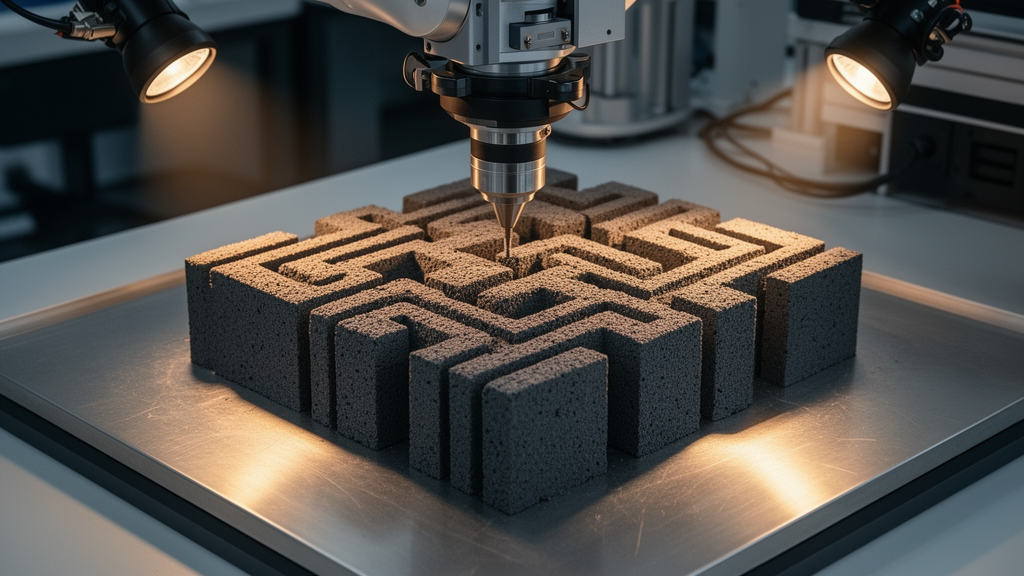
Permanent infrastructure on the lunar surface may ultimately be constructed from the loose material covering the Moon, according to an experimental study conducted by researchers at the University of Arkansas. The investigation, published in the journal npj Advanced Manufacturing, demonstrated that pure lunar regolith can be fabricated into interlocking, LEGO-like building blocks through additive manufacturing.
Unlike terrestrial soil, lunar regolith is completely devoid of organic matter and is composed of sharp, loose, and jagged fragments generated across billions of years by the continuous impacts of asteroids, micrometeorites, and other space debris. To test manufacturing feasibility under laboratory conditions, the research team employed Lunar Highlands Regolith Simulant, designated commercially as LHS-1.
The engineering team fabricated the structural units using an additive manufacturing approach known as laser powder bed fusion. During this operation, a fine layer of the regolith simulant is distributed evenly across a flat build bed. A high-powered light source, such as an industrial laser, is then directed across the powder to fuse the particulate matter together through thermal sintering. Once a layer is solidified, the build platform is lowered incrementally, an additional layer of powder is spread over the surface, and the subsequent cross-section is sintered, progressively forming a three-dimensional object.
The University of Arkansas researchers established the first demonstration that lunar regolith simulant could be sintered directly into reconfigurable construction components without any binder, utilizing a comparatively low-power light source. First author Cole McCallum, who carried out the experiments as an undergraduate student, noted that the regolith powder binds entirely to itself rather than adhering to an external chemical matrix.
The experimental process yielded solid blocks measuring a few centimeters in width, fabricated in two representative interlocking configurations: cross shapes and letter-H geometries. These individual components were designed to fit securely together in the manner of toy building blocks to assemble larger composite configurations. However, laboratory characterization revealed that components sintered entirely from pure regolith exhibit higher porosity and reduced structural strength compared to specimens produced with specialized chemical binders. McCallum indicated that while the resulting structures are fully capable of supporting their own weight, the current manufacturing process is not yet verified to sustain external secondary loads.
Senior author Wan Shou, an assistant professor of mechanical engineering at the University of Arkansas, emphasized that further experimental research will be necessary to observe how the laser powder bed fusion sintering process behaves within true microgravity and vacuum conditions.
The experimental project also highlighted early undergraduate engagement in advanced engineering research within Shou’s laboratory, where McCallum began work early in his collegiate program. McCallum subsequently completed dual degrees in physics and mechanical engineering before receiving an inaugural Lafayette Fellowship to pursue graduate aerospace engineering studies at ISAE-SUPAERO in Toulouse, France. Although his subsequent research shifted toward aerospace engineering, McCallum noted that navigating early trial-and-error phases in additive manufacturing provided essential foundational insights into addressing engineering challenges and mastering the experimental research process.
The peer-reviewed experimental study, titled “Additive manufacturing of lunar regolith for reconfigurable building blocks toward lunar habitation,” was published on August 29, 2026, in npj Advanced Manufacturing under DOI 10.1038/s44334-026-00111-x.
“He had this really strong belief that undergrads should get involved more with research,” McCallum said. McCallum received an inaugural Lafayette Fellowship, a program created to celebrate the 250th anniversary of the United States by selecting 30 fellows from more than 3,400 applicants to pursue master’s degrees in France. Now studying aerospace engineering at ISAE-SUPAERO, one of France’s leading aerospace engineering schools, McCallum credited the manufacturing project with teaching him essential research skills: “It helps you refine and overcome all the problems you have as a researcher. There are a lot of mistakes that I made the first time through,” he said. “It was really nice to have a head start on everyone else and make those mistakes early.”
Subject of Research: Additive manufacturing of binder-free interlocking building blocks from lunar regolith simulant
Article Title: Researchers turn moon dust into LEGO-like blocks for settlements
Article References: Researchers turn moon dust into LEGO-like blocks for settlements. Original publication (Bibliographic details unavailable.)
Image Credits: AI Generated
DOI: Not provided
Keywords: Lunar Regolith, 3D Printing, Laser Powder Bed Fusion, Additive Manufacturing, Sintering, Lunar Exploration, Moon Settlement, Lunar Highlands Regolith Simulant, LHS-1, University of Arkansas, NPJ Advanced Manufacturing, Wan Shou, Cole McCallum, Interlocking Bricks, Space Construction, Binder-Free Manufacturing, Apollo Mission Samples
News Source: Denise Maddox. (November 11, 2026). Engineers 3D-Print Binder-Free Interlocking Blocks From Lunar Regolith Simulant. Scienmag.