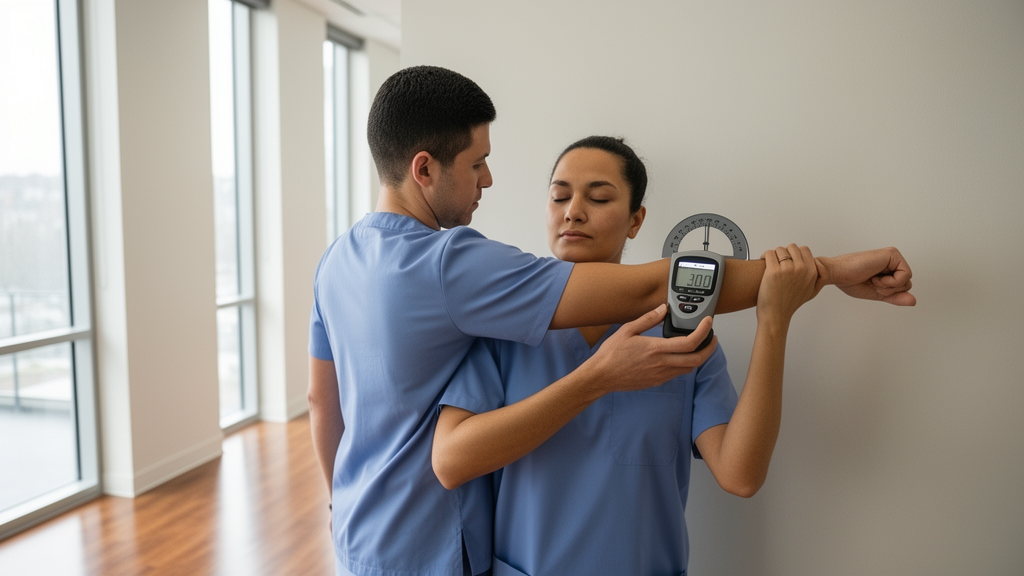
A systematic review and meta-analysis published in BMC Musculoskeletal Disorders indicates that smartphone applications and inertial measurement units generally achieve good reliability for measuring active shoulder range of motion, although performance varies by movement and overall evidence certainty remains very low. The researchers synthesized data from twenty-two eligible studies encompassing 702 participants, with eighteen studies providing sufficient data for quantitative pooling across digital assessment modalities.
Accurate measurement of shoulder range of motion is essential across clinical diagnosis, rehabilitation, and sports science. While the universal goniometer remains the clinical reference standard, its accuracy depends substantially on operator experience. Digital alternatives—including smartphone applications, inertial measurement units, and markerless motion capture systems—have emerged as potential options, but reliability evidence for individual shoulder movements has remained fragmented.
To evaluate the available literature, researchers searched PubMed, Web of Science, Embase, the Cochrane Library, and EBSCOhost databases from January 2010 to October 2025. Two reviewers independently screened identified studies, extracted data, and evaluated study quality using the COSMIN Risk of Bias checklist. Eligible investigations were required to report intra-rater or inter-rater intraclass correlation coefficients for digital technologies measuring active shoulder range of motion.
During the quantitative synthesis, intraclass correlation coefficients were transformed using Fisher’s Z method and pooled using random-effects models with restricted maximum likelihood estimation, with standard errors derived from reported 95 percent confidence intervals. Meta-analytic pooling required at least three studies per technology, movement, and rater combination, while sensitivity analyses excluded studies rated doubtful or inadequate, and an adapted GRADE approach assessed evidence certainty.
Pooled estimates demonstrated good intra-rater and inter-rater reliability for smartphone applications across four shoulder movements. Inertial measurement units demonstrated favorable inter-rater reliability, but intra-rater estimates for abduction and flexion exhibited extremely high heterogeneity exceeding 99 percent. Markerless motion capture showed movement-dependent reliability, with good intra-rater reliability for internal rotation but lower values for abduction and flexion, while shoulder extension failed to meet the three-study threshold for any technology and was analyzed descriptively.
Because most combinations showed substantial heterogeneity, inconsistent intraclass correlation coefficient model reporting, and very low certainty of evidence across all pooled analyses, the authors concluded that these findings are hypothesis-generating rather than definitive guidance for clinical device selection. The researchers highlighted that future investigations require standardized reporting of intraclass correlation coefficient models, absolute measurement error, and testing protocols.
The comparative findings reveal distinct performance profiles among the digital measurement modalities across specific active shoulder movements. Smartphone applications demonstrated the most uniform performance, maintaining good intra-rater and inter-rater reliability across all four examined movement types. In contrast, markerless motion capture systems exhibited pronounced movement-dependent variability, recording good intra-rater reliability during internal rotation assessments but yielding noticeably lower reliability values when tracking active abduction and flexion. Meanwhile, wearable inertial measurement units displayed favorable consistency between separate assessors, but their intra-rater evaluations for shoulder abduction and flexion were undermined by extreme statistical heterogeneity, with I-squared values exceeding 99 percent.
A notable gap emerged concerning active shoulder extension, which could not be evaluated through pooled statistical models. Meta-analytic synthesis required a minimum threshold of at least three eligible studies for each unique technology, movement, and rater configuration. Because shoulder extension failed to satisfy this three-study criterion for any evaluated digital system, researchers were restricted to analyzing extension data descriptively. This absence of sufficient data highlights how unevenly research has been distributed, leaving active extension largely underrepresented compared to other shoulder actions despite the inclusion of twenty-two primary studies and 702 total participants across the broader systematic review.
Methodological quality appraisal underscored substantial weaknesses across the available literature. While sensitivity analyses were incorporated to omit investigations judged to have doubtful or inadequate quality under the COSMIN Risk of Bias checklist, broader quality concerns persisted throughout the pooled evidence base. Applying an adapted GRADE framework resulted in a certainty rating of very low for all pooled analyses. This pervasive rating was driven by extensive heterogeneity across study combinations and widespread deficiencies in how primary investigations formulated and reported their statistical models, particularly regarding intraclass correlation coefficients.
Because of these pervasive evidentiary constraints, the synthesis emphasizes that current findings must be treated as hypothesis-generating rather than definitive clinical guidance for selecting measurement devices. Although digital technologies such as smartphone applications and inertial sensors offer potential alternatives to the universal goniometer, their capacity to overcome operator-dependent limitations remains uncertain without standardized validation. Moving forward, establishing their clinical utility in diagnosis, rehabilitation, and sports science will require primary investigators to adopt rigorous testing protocols, explicitly specify intraclass correlation coefficient models, and consistently report absolute measurement errors alongside relative reliability metrics.
Subject of Research: Movement-specific reliability of digital technologies for active shoulder range of motion
Article Title: Movement-specific reliability of digital technologies for measuring active shoulder range of motion: a systematic review and meta‑analysis
Article References: Bian, S., Chen, Z., Yan, Q., & Zhang, D. (2026). Movement-specific reliability of digital technologies for measuring active shoulder range of motion: a systematic review and meta‑analysis. BMC Musculoskeletal Disorders. https://doi.org/10.1186/s12891-026-10633-2
Image Credits: AI Generated
DOI: 10.1186/s12891-026-10633-2
Keywords: shoulder range of motion, active shoulder ROM, digital technologies, smartphone applications, inertial measurement units, IMUs, markerless motion capture, universal goniometer, intraclass correlation coefficients, inter-rater reliability, intra-rater reliability, COSMIN risk of bias, GRADE approach, shoulder abduction, shoulder flexion, shoulder internal rotation, shoulder extension
News Source: Ophelia Keating. (November 11, 2026). Digital Tools Show Movement-Specific Reliability for Measuring Shoulder Range of Motion. Scienmag.