Researchers evaluating new precursor routes for the automated production of the diagnostic imaging agent 4-borono-2-[18F]fluorophenylalanine have demonstrated that a pre-installed diboronate precursor achieves the highest radiochemical yields on a clinical synthesizer module, while complexation with sorbitol dramatically enhances tumor accumulation in preclinical cancer models. The study, conducted by Ting-Yu Chang, Yu-Hou Yu, Zhen-Fan You, Ping-Chuan Cho, Yuh-Feng Wang, Chun-Yi Wu, and colleagues, aimed to develop and systematically compare structurally analogous precursors for the no-carrier-added nucleophilic radiofluorination of the imaging probe. The target radiotracer, known as [18F]FBPA, serves as a vital positron emission tomography imaging biomarker to select and evaluate patients undergoing boron neutron capture therapy, an advanced binary radiotherapy that destroys tumor tissue while sparing adjacent normal cells.
Boron neutron capture therapy relies on a binary mechanism where neither the administered boron-containing compound nor exposure to thermal or epithermal neutron beams produces significant cellular damage on its own. When non-radioactive boron-10, which comprises roughly 20 percent of natural boron, absorbs a thermal neutron due to its high cross-section of 3837 barns, it transforms into an unstable boron-11 nucleus. This nuclear fission event generates high linear energy transfer alpha particles and lithium-7 recoil nuclei that release their entire energy within a microscopic path length of 5 to 9 micrometers. Because this lethal path length is roughly equivalent to the diameter of a single cell, the double-strand DNA damage and destructive cellular events remain strictly confined to the specific cells that have accumulated boron atoms. Consequently, delivering sufficient concentrations of boron specifically to malignant cells is mandatory for therapeutic efficacy.
Historically, 4-borono-L-phenylalanine has stood as the primary therapeutic boron carrier worldwide, exploiting the elevated metabolic demands and increased amino acid transport of proliferating cancer cells. However, native 4-borono-L-phenylalanine exhibits an intrinsic aqueous solubility of only approximately 1.6 grams per liter at physiological pH, falling far short of the high concentrations required for human therapeutic administration. To overcome this limitation, clinicians complex the compound with carbohydrates possessing cis-diol motifs, such as fructose or sorbitol, forming water-soluble boronate ester complexes that elevate drug solubility beyond 30 grams per liter while maintaining tumor targeting. Although fructose-formulated conjugates have documented success across international clinical trials, their vulnerability to degradation during prolonged storage and risks in patients with hereditary fructose intolerance have spurred contemporary clinical practice toward sorbitol conjugates.
Accurately mapping and quantifying boron accumulation prior to neutron irradiation is vital, making [18F]FBPA a key diagnostic surrogate whose tissue distribution closely mirrors therapeutic boron delivery. Early manufacturing routes depended on electrophilic radiofluorination using fluorine-18 gas, which required specialized cyclotron gas targets and yielded radiotracers with low molar activities, recorded around 0.257 gigabecquerels per micromole. To make production widely accessible across medical cyclotrons and automated synthesizers, recent efforts shifted toward no-carrier-added nucleophilic substitution. Nevertheless, previous nucleophilic methods differed markedly in reaction schemes and precursor structures, precluding direct comparisons of manufacturing efficiency, molar activity, and automated synthesizer feasibility. The investigative team resolved this knowledge gap by synthesizing and benchmarking a series of structurally related precursors under identical experimental conditions.
The researchers evaluated three primary manufacturing approaches: a multi-step pathway starting from commercially available 4-bromo-2-nitrobenzaldehyde without pinacol boronate ester motifs, a three-step route employing newly synthesized mono-boronate ester precursors designated P-01 and P-02, and a streamlined two-step pathway utilizing a di-boronate ester precursor designated P-03. Precursors P-01 and P-02 were prepared through multistep chemical syntheses featuring tert-butyl or benzyl protective groups, while P-03 incorporated two pre-installed pinacol boronate ester groups on the aromatic ring. Reaction parameters including solvent composition, temperature, catalyst loading, base additives, and acid concentrations were systematically optimized in manual trials before translation to a commercial TRASIS AllinOne automated synthesis platform.
Manual optimization experiments revealed distinct chemical behaviors among the precursor classes during copper-mediated radiofluorination and subsequent catalytic transformations. For the mono-boronate precursors P-01 and P-02, dimethylformamide proved superior to dimethyl sulfoxide, achieving radiofluorination efficiencies of 83.6 percent and 80.8 percent, respectively, at an optimal temperature of 120 degrees Celsius. In contrast, the di-boronate precursor P-03 required a mixed solvent system of dimethylformamide and acetonitrile in equal volumes, which significantly elevated radiochemical yields to 7.5 percent compared to 1.3 percent in dimethylacetamide and 2.8 percent in neat dimethylformamide. For all three precursors, departing from the 120 degrees Celsius thermal window caused substantial yield drops due to incomplete reaction at lower temperatures or thermal decomposition at elevated temperatures.
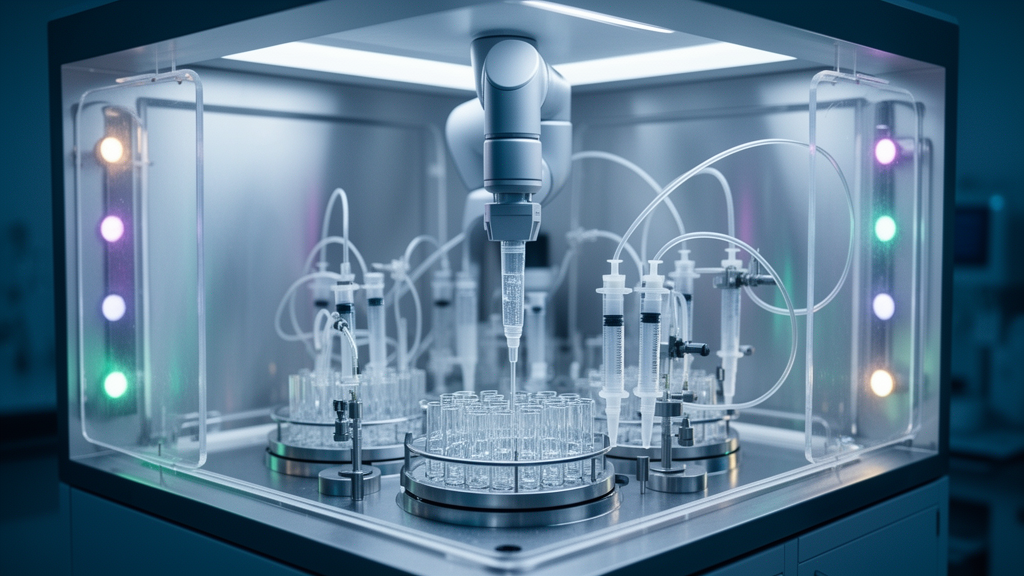
When translated to the automated synthesizer module, the di-boronate P-03 protocol demonstrated superior performance among the tested candidates. Automated synthesis using P-03 achieved a non-decay-corrected radiochemical yield of 3.1 percent and a decay-corrected yield of 6.4 percent, completing the sequence in fewer reaction steps than the alternative routes. The multi-step route using 4-bromo-2-nitrobenzaldehyde achieved a non-decay-corrected yield of 2.6 percent, corresponding to a decay-corrected yield of 6.1 percent, but required an intricate six-step sequence that placed high demands on fluidic cassette automation. Precursor P-02 yielded a non-decay-corrected yield of 0.3 percent and a decay-corrected yield of 0.9 percent, hampered by low conversion during the palladium-catalyzed borylation step, which remained below 30 percent even after extensive catalytic screening. Crucially, all automated nucleophilic protocols delivered high molar activities ranging from 36.3 to 50 gigabecquerels per micromole, representing a roughly 200-fold increase over traditional electrophilic methods while conforming entirely to release criteria and chiral purity standards.
Biological performance was subsequently characterized in Balb/c nude mice bearing subcutaneous SASV03 human tongue carcinoma xenografts using integrated small-animal microPET/MR imaging and post-mortem gamma-counting biodistribution assays at one hour post-injection. The researchers evaluated uncomplexed [18F]FBPA alongside its fructose and sorbitol formulations. MicroPET/MR imaging revealed that the sorbitol conjugate, [18F]FBPA-Sor, produced a tumor standardized uptake value of 2.57, markedly outperforming uncomplexed [18F]FBPA at 1.72 and the fructose conjugate at 1.29. Corresponding tumor-to-muscle ratios were 9.38 for the sorbitol conjugate, 4.64 for the fructose conjugate, and 3.34 for uncomplexed [18F]FBPA, demonstrating substantially improved diagnostic imaging contrast.
Quantitative biodistribution measurements confirmed the pronounced tumor targeting of the sorbitol formulation, recording a tumor accumulation of 19.32 percent injected dose per gram of tissue for [18F]FBPA-Sor, compared to 11.51 percent for the fructose conjugate and 10.46 percent for uncomplexed [18F]FBPA. The tumor-to-muscle and tumor-to-blood ratios for [18F]FBPA-Sor reached 11.2 and 8.1, respectively, while non-target healthy tissues exhibited low baseline radioactivity across all cohorts. Unconjugated [18F]FBPA and its fructose complex exhibited notably higher non-specific pancreatic uptake, reaching up to 36.75 percent injected dose per gram. Furthermore, correlation analysis comparing imaging signals with tissue boron concentrations measured by mass spectrometry demonstrated a strong linear correlation for [18F]FBPA-Sor (R2 = 0.83), whereas unconjugated [18F]FBPA displayed poorer correlation (R2 = 0.57), underscoring the stabilizing and hydrophilic shielding role of the open-chain sugar alcohol vehicle.
The study authors highlighted several technical and translational constraints that must be resolved prior to routine clinical implementation. Although the pre-installed di-boronate precursor P-03 eliminated the inefficient borylation step, competitive radiofluorination occurring at both the 2- and 4-positions resulted in undesired isomers that constrained absolute radiochemical yields. Additionally, automated yields on the commercial module were affected by fluidic dead volumes and open-vial thermal fluctuations during acidic hydrolysis. Transitioning these automated protocols to human clinical production will necessitate rigorous quality validation across consecutive manufacturing batches, alongside inductively coupled plasma mass spectrometry testing to ensure residual copper and palladium catalyst residues remain strictly within international safety thresholds. Preclinically, because in vivo evaluation was restricted to a single subcutaneous xenograft model at one static time point, broader validation across varied tumor models and dynamic pharmacokinetic imaging remains essential to solidify diagnostic planning protocols.
Subject of Research: Automated radiosynthesis and preclinical evaluation of [18F]FBPA precursors and carbohydrate conjugates for boron neutron capture therapy
Article Title: Optimization of [18F]FBPA production for clinical translation through precursor development and manufacturing route evaluation
Article References: Chang, T.-Y., Yu, Y.-H., You, Z.-F., Cho, P.-C., Wang, Y.-F., & Wu, C.-Y. (2026). Optimization of [18F]FBPA production for clinical translation through precursor development and manufacturing route evaluation. EJNMMI Radiopharmacy and Chemistry, 11(1), Article 68. https://doi.org/10.1186/s41181-026-00471-x
Image Credits: AI Generated
DOI: 10.1186/s41181-026-00471-x
Keywords: Radiopharmacy, Positron Emission Tomography, Boron Neutron Capture Therapy, Precursor Synthesis, Cancer Diagnostics, Automated Radiochemistry, Molecular Imaging, Pharmacokinetics, Optimization, FBPA, production, clinical
News Source: Ophelia Keating. (November 11, 2026). Automated Precursor Evaluation Optimizes Boron Cancer Diagnostic Imaging Radiosynthesis. Scienmag.