A physiological investigation evaluating well-trained male athletes across track distances between 100 meters and 3,000 meters has demonstrated that physiological markers predictive of middle-distance running success depend heavily on the specific event distance and the composition of the tested athletic cohort. The investigation, conducted by researchers at the Karlsruhe Institute of Technology and the German Sport University Cologne, determined that traditional oxidative predictors such as maximal oxygen uptake and running economy explain progressively more variance in time-trial velocity as distance increases from 1,000 meters to 3,000 meters. Concurrently, physiological measures of non-oxidative power and capacity exhibited shifting statistical associations with running performance depending on whether specialized sprint runners were included alongside endurance runners.
Understanding the key determinants governing athletic performance represents an ongoing challenge for coaches, sports scientists, and competitive runners seeking optimized outcomes. While individual sporting disciplines introduce complex tactical, cognitive, biomechanical, and psychological factors, running performance over middle distances spanning 800 to 3,000 meters is fundamentally anchored in physiological metabolism. Classical deterministic frameworks have long positioned maximal oxygen uptake, running economy, and fractional utilization at the maximal lactate steady-state as the primary determinants of prolonged distance running. However, because shorter events rely increasingly on substrate-level phosphorylation to generate rapid muscular power, researchers have increasingly evaluated non-oxidative metabolic parameters, such as the maximal lactate accumulation rate and the anaerobic speed reserve, to establish how metabolic systems interact during high-intensity track efforts.
To investigate these physiological interrelationships across varying distances, the researchers recruited well-trained male volunteers from local track clubs and the university setting who completed at least three weekly training sessions dedicated to their running discipline. The experimental cohort was designed to represent a diverse physiological spectrum, encompassing competitive athletes ranging from short sprinters competing in the 200-meter and 400-meter sprints to long-distance specialists and ultra-marathon runners competing beyond marathon distance. An a priori statistical power calculation determined that a minimum sample of 25 participants was necessary to detect expected incremental effects. Following an initial enrollment of 29 athletes, four participants withdrew due to time constraints or acute illness, leaving 25 participants who completed laboratory testing, of whom 20 completed the full series of outdoor time trials.
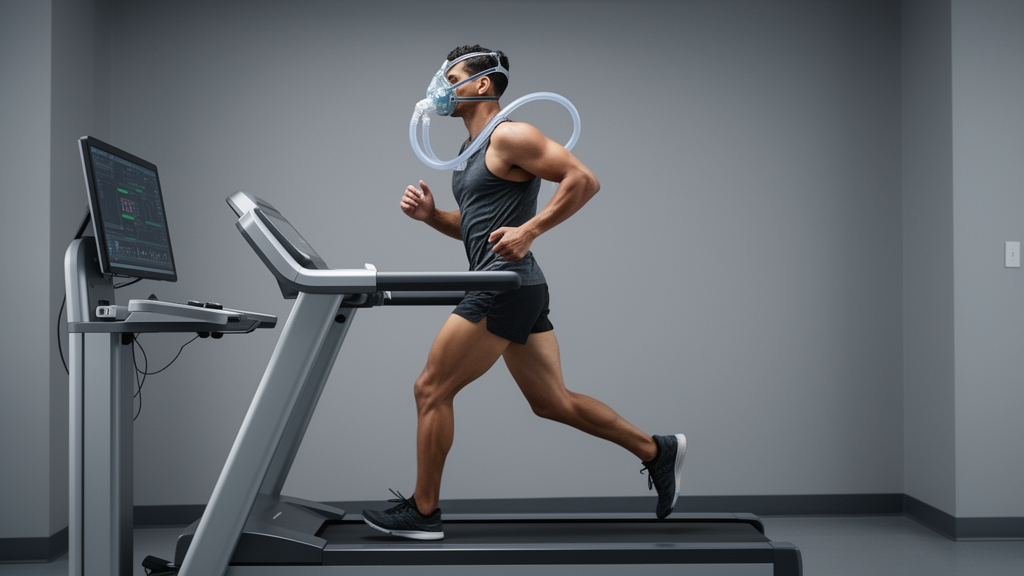
The testing protocol spanned a structured three-week testing period with at least 48 hours separating rigorous sessions to minimize cumulative physical fatigue. During the initial laboratory visits, participants underwent comprehensive medical screening, anthropometric assessments including ten-site skinfold caliper measurements to determine body fat percentage, and an incremental step test on a motorized treadmill. Two days later, participants ran a 100-meter all-out sprint test on a dedicated indoor track, followed by one hour of passive recovery and an incremental ramp treadmill test to volitional exhaustion to assess maximal oxygen uptake and peak post-exercise blood lactate concentrations. During the second week, participants performed multiple constant-velocity treadmill runs to precisely identify individual velocity and fractional oxygen utilization at maximal lactate steady-state, while running economy was evaluated using respiratory gas exchange data.
Field performance was evaluated during the final testing week through individual, randomized time trials conducted over 1,000 meters, 2,000 meters, and 3,000 meters on an outdoor 400-meter synthetic tartan track. Each track trial was preceded by a standardized 20-minute warm-up, and runners ran completely alone under controlled meteorological conditions, requiring ambient temperatures between 15 and 25 degrees Celsius and wind speeds sustained below 3 meters per second. The final analyzed cohort comprised 20 participants, including 16 endurance runners and four sprinters, with an average age of 25.1 years, an average maximal oxygen uptake of 65.7 milliliters per kilogram per minute, and mean time-trial performances of 2 minutes 53 seconds for 1,000 meters, 6 minutes 23 seconds for 2,000 meters, and 10 minutes 6 seconds for 3,000 meters.
Statistical evaluation using hierarchical regression revealed that baseline physiological models comprising maximal oxygen uptake and running economy accounted for less than 40 percent of performance variance at 1,000 meters, whereas the same baseline variables accounted for more than 60 percent of variance at 2,000 meters and 3,000 meters. The addition of maximal fat oxidation rate significantly improved the explanatory capability of the models over longer distances, contributing an additional 15.4 percent of explained variance at 2,000 meters and 14.1 percent at 3,000 meters beyond the baseline predictors. At 3,000 meters, the single addition of fractional utilization at maximal lactate steady-state also yielded an 11.3 percent increase in explained variance, whereas none of the tested non-oxidative or submaximal parameters significantly improved performance prediction in the 1,000-meter model.
Bivariate correlation analysis further highlighted the distance-dependent trajectory of physiological parameters within the pooled sample of 20 runners. Maximal oxygen uptake showed positive correlations that strengthened progressively with event distance, rising from a correlation of 0.677 at 1,000 meters to 0.806 at 2,000 meters and 0.843 at 3,000 meters, while showing no significant relationship with 100-meter sprint velocity. Similar distance-dependent patterns were documented for velocity at maximal lactate steady-state and maximal fat oxidation. Conversely, parameters related to non-oxidative metabolism—including maximal lactate accumulation rate, peak post-exercise lactate, curvature constant, and anaerobic speed reserve—correlated positively with 100-meter sprinting speed but displayed strong negative correlations with running velocity over 3,000 meters in the pooled group.
A critical outcome of the study emerged when the authors performed sensitivity analyses by excluding the four sprinters to examine performance determinants within the homogeneous endurance-only subgroup of 16 runners. While the strong positive associations of maximal oxygen uptake and maximal fat oxidation with 2,000-meter and 3,000-meter times remained stable, several prominent associations involving non-oxidative markers were substantially attenuated. In particular, the negative correlations between longer-distance endurance performance and both maximal lactate accumulation rate and peak post-exercise lactate diminished to near zero in the endurance-only cohort. In contrast, anaerobic speed reserve maintained its statistically significant negative association with 2,000-meter and 3,000-meter running velocity across both the pooled sample and the endurance-only subgroup.
The study authors noted that the unexpected explanatory contribution of maximal fat oxidation to high-intensity 2,000-meter and 3,000-meter time trials does not imply a direct reliance on lipid fuel during competition, as exercise intensities near or above the maximal lactate steady-state rely almost exclusively on carbohydrate oxidation. Instead, higher maximal fat oxidation rates likely reflect a broader phenotype of endurance adaptation, serving as a functional proxy for mitochondrial density, metabolic flexibility, and cumulative endurance training volume that is not captured by maximal oxygen uptake alone. For the 1,000-meter distance, the lower predictive power of baseline oxidative models suggests that athletes may achieve competitive middle-distance times through divergent physiological profiles, relying either on superior oxidative power or heightened non-oxidative energy delivery.
The researchers recognized several methodological limitations inherent to the study design, foremost being the small sprint subgroup of four athletes resulting from recruitment challenges, which rendered the overall sample unbalanced and prevented a standalone sprint-only regression analysis. Additionally, because only 19 participants provided complete laboratory and field datasets across all variables, the statistical models possessed 80 percent power only to detect relatively large incremental effects, meaning smaller physiological contributions may have remained undetected. The study was also conducted exclusively in male runners, precluding direct generalization to female athletes who may exhibit distinct substrate utilization patterns. The authors concluded that physiological profiling must be interpreted within the context of specific competition distances and athlete training backgrounds, emphasizing the need for confirmation in larger, balanced cohorts.
Subject of Research: Physiological determinants of running performance across middle distances and cohort sampling effects
Article Title: Sampling matters: the interplay of physiological parameters and performance over 1, 2 and 3 km in well-trained male endurance runners and sprinters
Article References: Sondermann, Y. M., Quittmann, O. J., Nolte, S., Fuchs, M., Gehlert, G., Foitschik, T., & Abel, T. (2026). Sampling matters: the interplay of physiological parameters and performance over 1, 2 and 3 km in well-trained male endurance runners and sprinters. Frontiers in Physiology, 17, Article 1912310. https://doi.org/10.3389/fphys.2026.1912310
Image Credits: AI Generated
DOI: 10.3389/fphys.2026.1912310
Keywords: running physiology, exercise science, VO2max, maximal fat oxidation, middle-distance running, anaerobic speed reserve, maximal lactate accumulation rate, athletic performance, Sampling, matters, interplay, physiological
News Source: Drew Townsend. (November 11, 2026). Runner Physiology Study Reveals Distance and Sampling Reshape Middle-Distance Performance Predictors. Scienmag.