• HOME
  • NEWS
  • EXPLORE
    • CAREER
      • Companies
      • Jobs
    • EVENTS
    • iGEM
      • News
      • Team
    • PHOTOS
    • VIDEO
    • WIKI
  • BLOG
  • COMMUNITY
    • FACEBOOK
    • INSTAGRAM
    • TWITTER
Tuesday, November 17, 2026
BIOENGINEER.ORG
No Result
View All Result
  • Login
  • HOME
  • NEWS
  • EXPLORE
    • CAREER
      • Companies
      • Jobs
        • Lecturer
        • PhD Studentship
        • Postdoc
        • Research Assistant
    • EVENTS
    • iGEM
      • News
      • Team
    • PHOTOS
    • VIDEO
    • WIKI
  • BLOG
  • COMMUNITY
    • FACEBOOK
    • INSTAGRAM
    • TWITTER
No Result
View All Result
Bioengineer.org
No Result
View All Result
Home NEWS Science News Technology

Freezing Pipe Ruptures Produce Sharp Vibration Peaks in Controlled Laboratory Tests

by
November 11, 2026
in Technology
Reading Time: 2 mins read
0
Freezing Pipe Ruptures Produce Sharp Vibration Peaks in Controlled Laboratory Tests

Freezing Pipe Ruptures Produce Sharp Vibration Peaks in Controlled Laboratory Tests

Share on FacebookShare on TwitterShare on LinkedinShare on RedditShare on Telegram

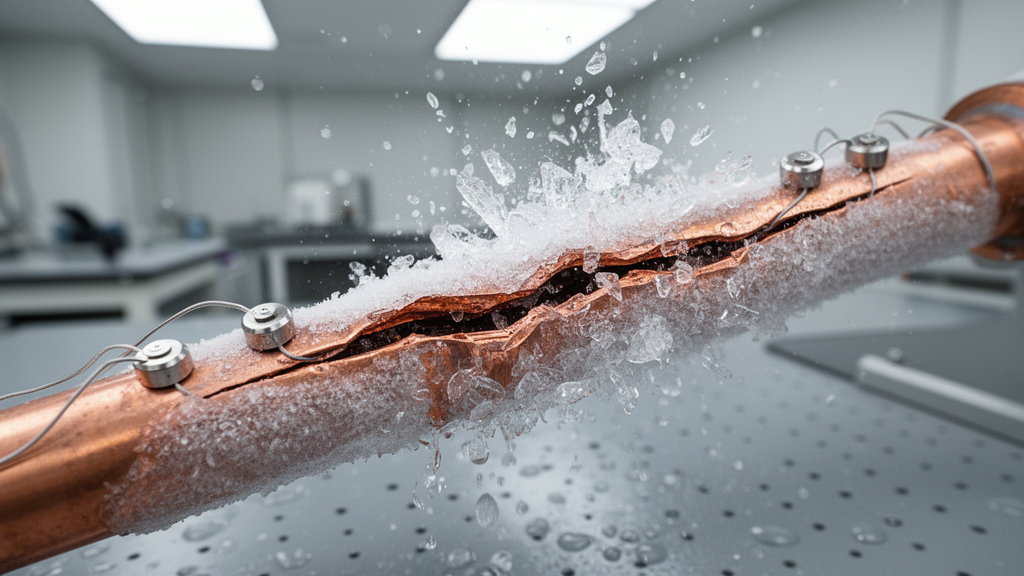
Vibration amplitude rises sharply to peak values at the exact moment a freezing pipe ruptures during artificial ground freezing, according to laboratory model tests.

Artificial ground freezing is an essential construction technique widely implemented across underground engineering operations. However, freezing pipe fractures pose severe hazards that can jeopardize overall construction safety, creating an operational need to reliably recognize fracture states through physical signal monitoring.

To investigate these fracture events under controlled conditions, the research team designed and conducted laboratory model tests using a self-designed model specimen. This experimental assembly was composed of steel pipe and frozen soil analog materials, allowing the investigators to systematically record the vibration signals generated during rupture events under diverse working conditions.

The primary objective of the investigation was to systematically analyze the propagation and attenuation patterns of rupture vibration signals under single-factor controlled conditions. This experimental framework focused quantitatively on how external confining pressure and internal fluid pressure individually alter key vibration characteristic parameters, specifically signal amplitude and dominant frequency, addressing an existing gap in single-factor parameter evaluation.

By examining these conditions, the study extended previous research to account for coupled influencing factors that had previously been overlooked, including external confining pressure, internal brine pressure, and the medium properties of the frozen soil. Within the tested scope, increasing the external confining pressure caused the dominant frequency of the rupture-induced vibration signals to follow a decreasing trend.

In contrast to the effects of external confining pressure, the dominant frequency of the vibration signals remained relatively stable with negligible variation as internal fluid pressure increased.

Subject of Research: Vibration signal characteristics of freezing pipe rupture under controlled pressure conditions

Article Title: Single-factor analysis of influencing laws for vibration signal characteristics of freezing pipes in artificial freezing construction

Article References: Xu, J., Chen, E., Wu, X., & Wang, Y. (2026). Single-factor analysis of influencing laws for vibration signal characteristics of freezing pipes in artificial freezing construction. Discover Applied Sciences. https://doi.org/10.1007/s42452-026-09801-9

Image Credits: AI Generated

DOI: 10.1007/s42452-026-09801-9

Keywords: artificial ground freezing, freezing pipes, pipe rupture, vibration signals, confining pressure, internal fluid pressure, vibration amplitude, dominant frequency, signal attenuation, underground engineering, model testing, frozen soil, brine pressure, fracture detection, propagation patterns, steel pipe, structural safety

News Source: Denise Maddox. (November 11, 2026). Freezing Pipe Ruptures Produce Sharp Vibration Peaks in Controlled Laboratory Tests. Scienmag.


Tags: artificial ground freezingbrine pressureconfining pressuredominant frequencyfracture-detectionfreezing pipesfrozen soilinternal fluid pressuremodel testingpipe rupturepropagation patternssignal attenuationsteel pipestructural safetyunderground engineeringvibration amplitudevibration signals
Share12Tweet7Share2ShareShareShare1

Related Posts

XGBoost Achieves Lowest Error in Temporally Partitioned Wind Power Forecasting Benchmark

XGBoost Achieves Lowest Error in Temporally Partitioned Wind Power Forecasting Benchmark

November 17, 2026
Self-Supervised Framework Enhances Anomaly Detection Accuracy Across Dynamic Internet of Things Networks

Self-Supervised Framework Enhances Anomaly Detection Accuracy Across Dynamic Internet of Things Networks

November 17, 2026

AI Model Improves Geological Pattern Discovery Through Causal Chain Analysis

November 17, 2026

Intensity-Cycling Microscopy Enables Precision Imaging of Many-Body Interactions in Semiconductors

November 17, 2026

POPULAR NEWS

  • Five Clinical Factors Predict Diabetic Retinopathy Risk in Type 2 Diabetes

    Five Clinical Factors Predict Diabetic Retinopathy Risk in Type 2 Diabetes

    29 shares
    Share 12 Tweet 7
  • Abdominal CT Radiomics Identifies Prevalent Heart Disease in Type 2 Diabetes

    29 shares
    Share 12 Tweet 7
  • Researchers Propose D-Allulose Framework to Test Metabolic Signaling and Aging

    29 shares
    Share 12 Tweet 7
  • Gut Microbiome Shifts Linked to Depressive Symptoms in Diabetes Patients

    29 shares
    Share 12 Tweet 7

About

We bring you the latest biotechnology news from best research centers and universities around the world. Check our website.

Follow us

Recent News

Higher Body Mass Index Linked to Reduced Osteoporosis Risk

Five Clinical Factors Predict Diabetic Retinopathy Risk in Type 2 Diabetes

Abdominal CT Radiomics Identifies Prevalent Heart Disease in Type 2 Diabetes

Subscribe to Blog via Email

Enter your email address to subscribe to this blog and receive notifications of new posts by email.

Join 88 other subscribers
  • Contact Us

Bioengineer.org © Copyright 2023 All Rights Reserved.

Welcome Back!

Login to your account below

Forgotten Password?

Retrieve your password

Please enter your username or email address to reset your password.

Log In
No Result
View All Result
  • Homepages
    • Home Page 1
    • Home Page 2
  • News
  • National
  • Business
  • Health
  • Lifestyle
  • Science

Bioengineer.org © Copyright 2023 All Rights Reserved.